

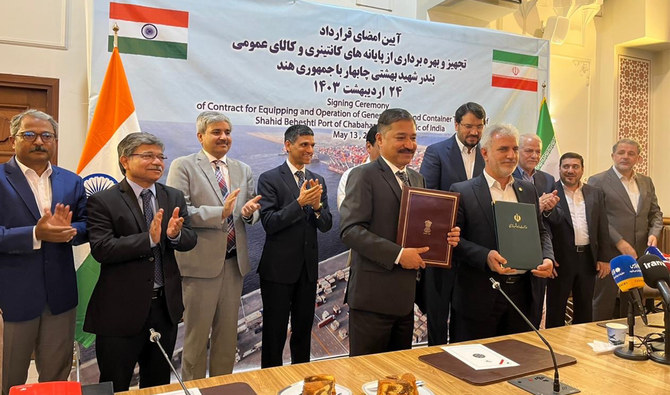
India inks 10-year deal to operate Iran’s Chabahar port

Iranian and Indian officials pose for a picture as India signs a 10-year contract with Iran to develop and operate Chabahar on May 13, 2024. (@IndianTechGuide/X)
Short Url
Updated 14 May 2024
Follow

India inks 10-year deal to operate Iran’s Chabahar port

  • India developing port to bypass Pakistan in bid to transport goods to Iran, Afghanistan and Central Asia
  • Washington says US sanctions on Iran “remain in place,” warns countries they will be imposed

NEW DELHI: India signed a 10-year contract with Iran on Monday to develop and operate the Iranian port of Chabahar, the Narendra Modi-led government said, strengthening relations with a strategic Middle Eastern nation.

India has been developing the port in Chabahar on Iran’s south-eastern coast along the Gulf of Oman as a way to transport goods to Iran, Afghanistan and central Asian countries, bypassing the port of Karachi and Gwadar in its rival Pakistan.

US sanctions on Iran, however, slowed the port’s development.

“Chabahar Port’s significance transcends its role as a mere conduit between India and Iran; it serves as a vital trade artery connecting India with Afghanistan and Central Asian Countries,” India’s Shipping Minister Sarbananda Sonowal said in Tehran, after the signing of the agreement.

“This linkage has unlocked new avenues for trade and fortified supply chain resilience across the region.”

US State Department deputy spokesperson Vedant Patel, asked about the deal, told reporters that US sanctions on Iran remain in place and warned that Washington will continue to enforce them.

“Any entity, anyone considering business deals with Iran — they need to be aware of the potential risks that they are opening themselves up to and the potential risk of sanctions,” Patel told reporters.

The long-term deal was signed between Indian Ports Global Limited (IPGL) and the Port & Maritime Organization of Iran, authorities in both countries said.

Under the agreement, IPGL will invest about $120 million while there will be an additional $250 million in financing, bringing the contract’s value to $370 million, said Iranian Minister of Roads and Urban Development Mehrdad Bazrpash.

IPGL first took over operations of the port at the end of 2018 and has since handled container traffic of more than 90,000 TEUs and bulk and general cargo of more than 8.4 million tons, an Indian government official said.

A total of 2.5 million tons of wheat and 2,000 tons of pulses have been shipped from India to Afghanistan through Chabahar Port, the official added.

“It will clear the pathway for bigger investments to be made in the port,” Indian Foreign Minister Subrahmanyam Jaishankar told reporters in Mumbai on Monday. 


Attacks on Sudan health care facilities killed 69 this year: WHO

Updated 8 sec ago
Follow

Attacks on Sudan health care facilities killed 69 this year: WHO

  • “Five attacks on health care have already been recorded in Sudan, killing 69 people and injuring 49,” WHO chief wrote on X
  • The WHO has confirmed at least 206 attacks on health care facilities since the start of the war

CAIRO: Five attacks on health care facilities have killed dozens of people in Sudan since the beginning of the year, the WHO said Saturday, as the war nears the start of its fourth year.
The fighting between Sudan’s army and the paramilitary Rapid Support Forces has dismantled an already fragile medical system, with more than a third of facilities currently out of service.
“During the first 50 days of 2026, five attacks on health care have already been recorded in Sudan, killing 69 people and injuring 49,” WHO chief Tedros Adhanom Ghebreyesus wrote on X.
On Sunday a hospital was targeted in the southeastern state of Sennar, leaving three patients dead and seven people wounded, including an employee, Tedros said.
In three other attacks early this month, more than 30 people were killed when medical centers were targeted in South Kordofan, a vast region south of the capital Khartoum that is currently a focus of the fighting.
The WHO has confirmed at least 206 attacks on health care facilities since the start of the war in April 2023, resulting in the deaths of around 2,000 people and injuries to several hundred.
Last year alone, 65 attacks killed more than 1,620 people, accounting for 80 percent of all deaths worldwide linked to attacks on the medical sector, according to the WHO.
Since it broke out, Sudan’s civil war has killed tens of thousands of people and forced 11 million to flee their homes, triggering what the UN says is one of the world’s worst humanitarian crises.
According to the WHO, the country is facing multiple disease outbreaks, notably cholera, malaria, dengue and measles, in addition to malnutrition.
Some 4.2 million cases of acute malnutrition are expected to arise in Sudan this year, including more than 800,000 cases of severe acute malnutrition, the WHO chief said earlier this month.
Around 33 million people will be left without humanitarian aid in 2026, with the United Nations warning in January that its aid stocks could run out by the end of March.