

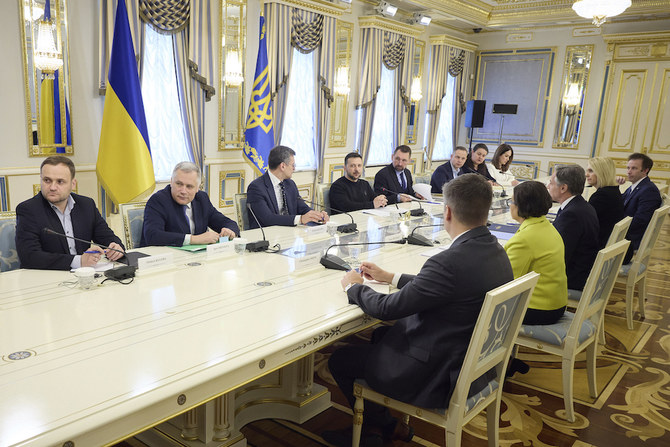


KYIV: US Secretary of State Antony Blinken said Tuesday that American military aid on its way to Ukraine will make a “real difference” on the battlefield, as the top diplomat made an unannounced visit to reassure an ally facing a fierce new Russian offensive.
In increasingly intense attacks along the northeastern border in recent days, Moscow’s troops have captured around 100 to 125 square kilometers (about 40 to 50 square miles) of territory that includes at least seven villages, according to open source monitoring analysts. Though most of those villages were already depopulated, thousands of civilians in the area have fled the fighting.
Analysts have called this moment one of the most dangerous for Ukraine since Russia’s full-scale invasion in February 2022 — and President Volodymyr Zelensky asked Tuesday for more air defense systems to protect civilians under Russian fire in the northeast.
“We know this is a challenging time,” Blinken said in the Ukrainian capital where he met with Zelensky. But he added that American military aid is “going to make a real difference against the ongoing Russian aggression on the battlefield.”
The visit comes less than a month after Congress approved a long-delayed foreign assistance package that sets aside $60 billion in aid for Ukraine, much of which will go toward replenishing badly depleted artillery and air defense systems.
Some of that “is now on the way,” Blinken said, and some has already arrived in Ukraine.
Moscow’s renewed offensive in the northeastern region of Kharkiv is the most significant border incursion since the early days of the war. More than 7,500 civilians have been evacuated from the area, according to authorities.
The Kremlin’s forces are now expanding their push to the northern border regions of Sumy and Chernihiv, Ukrainian officials say, and repeated shelling and sabotage raids there are further stretching Kyiv’s resources.
Zelensky thanked Blinken for the aid — but added that more is necessary, including two Patriot air defense systems that are urgently needed to protect Kharkiv.
“The people are under attack: civilians, warriors, everybody. They’re under Russian missiles,” he said.
Artillery, air defense interceptors and long-range ballistic missiles have already been delivered, some of them already to the front lines, said a senior US official traveling with the secretary on an overnight train from Poland who spoke to reporters on condition of anonymity ahead of Blinken’s meetings.
On his fourth trip to Kyiv since Russian troops rolled over the border, Blinken’s goal is to underscore the Biden administration’s commitment to Ukraine’s defense and long-term security, US officials said. They noted that since President Joe Biden signed the aid package late last month, the administration has already announced $1.4 billion in short-term military assistance and $6 billion in longer-term support.
In a statement released after Blinken’s arrival, the State Department said he would hold talks with Zelensky and other top Ukrainian officials “to discuss battlefield updates, the impact of new US security and economic assistance, long-term security and other commitments, and ongoing work to bolster Ukraine’s economic recovery.”
Delays in US assistance, particularly since the Israel-Hamas war began and has preoccupied top administration officials, triggered deep concerns in Kyiv and Europe. Blinken, for example, has visited the Middle East seven times since the Gaza conflict began in October. His last trip to Kyiv was in September.
The US official added that Blinken also would give a speech later Tuesday extolling Ukraine’s “strategic successes” in the war. It is intended to complement a Blinken address last year in Helsinki, Finland, deriding Russian President Vladimir Putin for Moscow’s strategic failures in launching the war.
Since the Helsinki speech, however, Russia has intensified its attacks, most noticeably as the US House of Representatives sat on the aid package for months without action, forcing a suspension in the provision of most US assistance. Those attacks have increased in recent weeks as Russia has sought to take advantage of Ukrainian shortages in manpower and weapons while the new assistance is in transit.
Top Biden administration officials and Ukrainian national security officials held a call Monday “about the situation on the front, about the capabilities that they are most in need of, and a real triage effort to say, ‘Get us this stuff this fast so that we can be in a position to effectively defend against the Russian onslaught,’” said national security adviser Jake Sullivan.
The administration is “trying to really accelerate the tempo” of US weapon shipments, he said.
Zelensky said over the weekend that “fierce battles” are taking place near the border in eastern and northeastern Ukraine as outgunned and outnumbered Ukrainian soldiers try to push back a significant Russian ground offensive.
The new Russian push in the northeastern Kharkiv region and a drive into the eastern Donetsk region come after months when the roughly 1,000-kilometer (620-mile) front line barely budged. In the meantime, both sides have used long-range strikes in what largely became a war of attrition.
The senior US official said despite some recent setbacks, Ukraine could still claim significant victories. Those include reclaiming some 50 percent of the territory Russian forces took in the early months of the war, boosting its economic standing and improving transportation and trade links, not least through military successes in the Black Sea.
The official acknowledged that Ukraine faces “a tough fight” and is “under tremendous pressure” but argued that Ukrainians “will become increasingly more confident” as the new US and other Western assistance begins to arrive.


