Two Americans, one Russian citizen among 20 detained in Georgia, Russia’s TASS reports

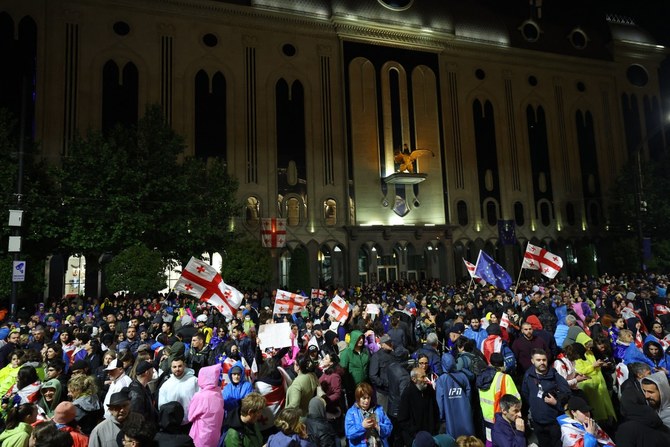
Protesters wave the Georgian and EU flags as they gather outside parliament during a rally against the controversial "foreign influence" bill in Tbilisi on May 12, 2024. (AFP)
Short Url
Updated 13 May 2024
Follow

Two Americans, one Russian citizen among 20 detained in Georgia, Russia’s TASS reports

  • 20 people detained at protests in Tbilisi while Georgian lawmakers were debating a “foreign agents” bill

Tbilisi: Some 1,000 protesters stood firm outside parliament in Georgia on Monday, vowing not to back down in their fight against a Russia-styled “foreign agent” bill, a day before it’s due to be adopted.
Protests have gripped the small Caucasus nation for weeks over the bill, which critics say will erode democracy and derail the ex-Soviet republic’s long-held ambition of joining the European Union.
Critics say the measure, which resembles one Russia has used to crack down on dissent, will steer Tbilisi back under Moscow’s influence.
The ruling Georgian Dream party has portrayed it as necessary for Georgia’s sovereignty, saying it will boost transparency of civil groups’ funding.
The bill is due to go for a third and final reading in parliament on Tuesday.
On Monday, it passed a committee vote, a final step before it goes for a vote in parliament.
The bill targets NGOs that receive foreign funding, with Georgian Dream’s billionaire backer Bidzina Ivanishvili accusing them of working on foreign orders and plotting a revolution.
Part of Tbilisi’s main Rustaveli Avenue was closed off around parliament on Monday.
Hundreds of riot police officers lined a street behind parliament, and some scuffles broke out between them and protesters.
Authorities a day earlier warned that they would arrest people who blocked parliament, but thousands defied the warning and came to the parliament’s gates anyway.
“We are planning to stay here for as long as it takes,” 22-year-old Mariam Kalandadze told AFP.
“This law means not joining Europe,” she said, adding that “this is something that I have wanted my whole life.”


Tug of war: how US presidents battle Congress for military powers

Updated 5 sec ago
Follow

Tug of war: how US presidents battle Congress for military powers

  • The last official declaration of war by Congress was as far back as World War II

WASHINGTON, United States: Donald Trump’s unleashing of operation “Epic Fury” against Iran has once more underscored the long and bitter struggle between US presidents and Congress over who has the power to decide on foreign military action.
In his video address announcing “major combat” with the Islamic republic, Trump didn’t once mention any authorization or consultation with the US House of Representatives or Senate.
In doing so he sidelined not only Democrats, who called for an urgent war powers vote, but also his own Republican party as he asserts his dominance over a largely cowed legislature.
A US official said Secretary of State Marco Rubio had called top congressional leaders known as the “Gang of Eight” to give them a heads up on the Iran attack — adding that one was unreachable.
Rubio also “laid out the situation” and consulted with the same leaders on Tuesday in an hour-long briefing, the US official said.
According to the US Constitution, only Congress can declare war.
But at the same time the founding document of the United States first signed in 1787 says that the president is the “commander in chief” of the military, a definition that US leaders have in recent years taken very broadly.
The last official declaration of war by Congress was as far back as World War II.
There was no such proclamation during the unpopular Vietnam War, and it was then that Congress sought to reassert its powers.
In 1973 it adopted the War Powers Resolution, passed over Richard Nixon’s veto, to become the only lasting limit on unilateral presidential military action abroad.
The act allows the president to carry out a limited military intervention to respond to an urgent situation created by an attack against the United States.
In his video address on Saturday, Trump evoked an “imminent” threat to justify strikes against Iran.

- Sixty days -

Yet under this law, the president must still inform Congress within 48 hours.
It also says that if the president deploys US troops for a military action for more than 60 days, the head of state must then obtain the authorization of Congress for continued action.
That falls short of an official declaration of war.
The US Congress notably authorized the use of force in such a way after the September 11, 2011 attacks on the United States by Al-Qaeda. Presidents have used it over the past two decades for not only the 2001 invasion of Afghanistan but a series of operations in several countries linked to the “War on Terror.”
Trump is far from the first US president to launch military operations without going through Congress.
Democrat Bill Clinton launched US air strikes against Kosovo in 1999 as part of a NATO campaign, despite the lack of a green light from skeptical lawmakers.
Barack Obama did the same for airstrikes in Libya in 2011.
Trump followed their example in his first term in 2018 when he launched airstrikes in Syria along with Britain and France.
But since his return to power the 79-year-old has sought to push presidential power to its limits, and that includes in the military sphere.
Trump has ordered strikes on alleged drug trafficking boats in Latin America without consulting Congress, and in June 2025 struck Iran’s nuclear facilities.
Perhaps the most controversial act was when he ordered the capture of Venezuelan president Nicolas Maduro in a lightning military raid on January 3.
Republicans however managed to knock down moves by Democrats for a rare war powers resolution that would have curbed his authority over Venezuela operations.
Trump has meanwhile sought to extend his powers over the home front. Democrats have slammed the Republican for deploying the National Guard in several US cities in what he calls a crackdown on crime and immigration.