

Ukraine’s first lady and foreign minister visit Russia-friendly Serbia

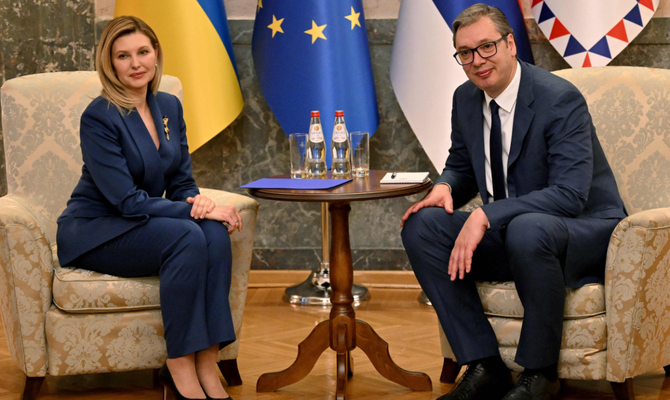
Serbia's President Aleksandar Vucic (R) poses for a photo with the First Lady of Ukraine Olena Zelenska, during their meeting in Belgrade on May 13, 2024. (AFP)
Short Url
Updated 13 May 2024
Follow

Ukraine’s first lady and foreign minister visit Russia-friendly Serbia

  • Although Serbia has condemned the Russian aggression on Ukraine, it has refused to join international sanctions against Moscow

BELGRADE, Serbia: Ukrainian Foreign Minister Dmytro Kuleba made a surprise visit to Russia-friendly Serbia on Monday, together with Ukraine’s first lady, Olena Zelenska, in a sign of warming relations between the two states.

On his first visit to Serbia since the start of the Russian aggression on Ukraine in 2022, Kuleba met Serbian President Aleksandar Vucic and new Serbian Prime Minister Milos Vucevic, whose government includes several pro-Russian ministers, including two who have been under US sanctions.

A statement issued by the prime minister’s office after the talks said that “Serbia is committed to respecting international law and the territorial integrity of every member state of the United Nations, including Ukraine.”

Although Serbia has condemned the Russian aggression on Ukraine, it has refused to join international sanctions against Moscow and has instead maintained warm and friendly relations with its traditional Slavic ally.

Serbia has proclaimed neutrality regarding the war in Ukraine, and its authorities repeat that Serbia does not supply weapons to any parties. However, there are reports that Serbia has delivered weapons to Ukraine through intermediary countries. The visit by Kuleba and Zelenska, who toured the Serbian capital with Serbian first lady Tamara Vucic on Sunday, was met with criticism in Moscow. Comments by readers in the Russian state-run media such as “shameful” were published by RIA Novosti.

In what appears to be damage control, soon after his talks with Kuleba on Monday, Vucevic was to meet the Russian ambassador to Belgrade and the two were to tour a big storage facility for Russian gas that is being imported to Serbia.

Pro-Russian President Vucic has informally met Ukrainian President Volodymyr Zelenskyy three times on the sidelines of international conferences. Serbia has supplied Ukraine with humanitarian and financial aid.

Vucic has for years claimed to follow a “neutral” policy, balancing ties among Moscow, Beijing, Brussels and Washington. Although he has repeatedly said that Serbia is firm on its proclaimed goal of seeking European Union membership, under his authoritarian rule the Balkan country appears to be shifting closer to Russia and especially China.

During a high-stakes visit by Chinese President Xi Jinping to Belgrade last week, China and Serbia signed an agreement to build “ironclad” relations and a “shared joint future.”


Japan protests after a Chinese military aircraft locks its radar on Japanese jets

Updated 3 sec ago
Follow

Japan protests after a Chinese military aircraft locks its radar on Japanese jets

TOKYO: Japan said early Sunday that it has protested to China after a military jet that took off from the Chinese carrier Liaoning locked its radar on Japanese fighter jets near the southern island of Okinawa, the latest spat between the two countries whose ties have plunged recently over the Japanese leader’s Taiwan remarks.
Japan’s Defense Ministry said China’s military aircraft J-15 “intermittently” targeted its radar at Japanese F-15 fighter jets on two occasions Saturday — for about three minutes in the late afternoon and for about 30 minutes in the evening.
The radar lock by the Chinese aircraft was detected by different Japanese fighters that had scrambled against a possible airspace violation by China, according to the ministry. There was no breach of Japanese airspace, and no injury or damage was reported from the incident.
It was not known whether the radar lock incident involved the same Chinese J-15 both times.
Defense Minister Shinjiro Koizumi, briefing reporters in the early hours of Sunday, said Japan protested to China over the radar lock, calling it “a dangerous act that exceeded the scope necessary for safe aircraft operations.”
“The occurrence of such an incident is extremely regrettable,” Koizumi said. “We have lodged a strong protest with the Chinese side and demanded strict preventive measures.”
There was no immediate comment from the Chinese government or military. On Friday, Foreign Ministry spokesperson Lin Jian said the Chinese navy operates in accordance with international law and that others shouldn’t hype up its activities.
The latest incident comes as relations between the two countries have worsened in recent weeks.
China was angered by a statement by Japan’s Prime Minister Sanae Takaichi in early November that its military could get involved if China were to take action against Taiwan, the self-governing island that Beijing says must come under its rule.
The aircraft carrier Liaoning on Saturday passed between the main island of Okinawa and nearby Miyako island as it conducted aircraft takeoff and landing exercises in the Pacific.
Japanese F-15 fighter jets, scrambled in case of an airspace violation, were pursuing the Chinese aircraft at a safe distance and did not involve actions that could be interpreted as provocation, Kyodo News agency said, quoting defense officials.
Fighter jets can use radars for search, or as fire control ahead of a missile launch.
It is believed to be the first instance of a radar lock involving Japanese and Chinese military aircraft. In 2013, a Chinese warship targeted a radar on a Japanese destroyer, Kyodo said.
Elsewhere in the Pacific, the Philippine coast guard said China fired three flares toward a fisheries bureau plane on patrol in the South China Sea on Saturday. Chinese forces fire flares to warn planes to move away from what they consider their airspace over the disputed waters.