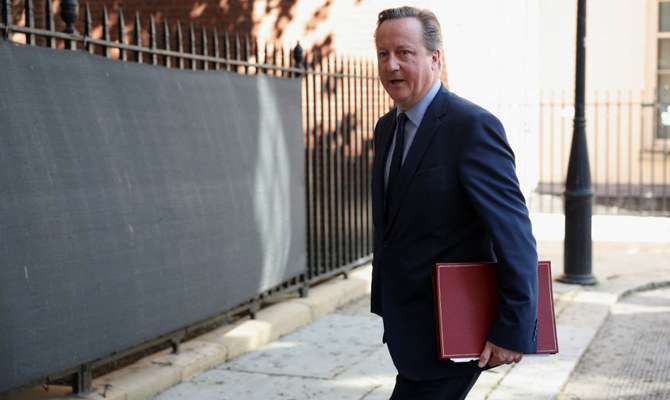
LONDON: Stopping British arms sales to Israel if it launches a ground assault on Rafah in the Gaza Strip would strengthen Hamas, Britain’s Foreign Secretary David Cameron said on Sunday.
Israel ordered Palestinians to evacuate more of the southern city on Saturday in an indication it was pressing ahead with its plans for a ground attack, despite US President Joe Biden’s threat to withhold the supply of some weapons if it did so.
Cameron said he did not support an operation in Rafah in the absence of a plan to protect hundreds of thousands of civilians sheltering in the southern border city.
However, Britain was in a “completely different position” to the United States in terms of providing arms to Israel, he said, noting that the less than 1 percent of Israel’s weapons that came from Britain were already controlled by a strict licensing system.
“We could, if we chose to, make a sort of political message and say we are going to take that political step,” he told the BBC’s Laura Kuenssberg.
“The last time I was urged to do that (...), just a few days later there was a brutal attack by Iran on Israel, including 140 cruise missiles,” he added.
Cameron said the “better answer” would be for Hamas, which controls Gaza, to accept a hostage deal.
“Just to simply announce today we’re going to change our whole approach to arms exports rather than go through our careful process, it would strengthen Hamas, it would make a hostage deal less likely, I don’t think it would be the right approach,” he said.
Hamas attacked southern Israel on Oct. 7, killing some 1,200 people and taking more than 250 people hostage, according to Israeli tallies.
Israel’s military response in Gaza has killed close to 35,000 Palestinians, according to Gaza’s health ministry.

Banning UK arms exports to Israel would strengthen Hamas, UK’s Cameron says
https://arab.news/9wkrk
Banning UK arms exports to Israel would strengthen Hamas, UK’s Cameron says
- Cameron said he did not support an operation in Rafah in the absence of a plan to protect hundreds of thousands of civilians
Only 4% women on ballot as Bangladesh prepares for post-Hasina vote
- Women PMs have ruled Bangladesh for over half of its independent history
- For 2026 vote, only 20 out of 51 political parties nominated female candidates
DHAKA: As Bangladesh prepares for the first election since the ouster of its long-serving ex-prime minister Sheikh Hasina, only 4 percent of the registered candidates are women, as more than half of the political parties did not field female candidates.
The vote on Feb. 12 will bring in new leadership after an 18-month rule of the caretaker administration that took control following the student-led uprising that ended 15 years in power of Hasina’s Awami League party.
Nearly 128 million Bangladeshis will head to the polls, but while more than 62 million of them are women, the percentage of female candidates in the race is incomparably lower, despite last year’s consensus reached by political parties to have at least 5 percent women on their lists.
According to the Election Commission, among 1,981 candidates only 81 are women, in a country that in its 54 years of independence had for 32 years been led by women prime ministers — Hasina and her late rival Khaleda Zia.
According to Dr. Rasheda Rawnak Khan from the Department of Anthropology at Dhaka University, women’s political participation was neither reflected by the rule of Hasina nor Zia.
“Bangladesh has had women rulers, not women’s rule,” Khan told Arab News. “The structure of party politics in Bangladesh is deeply patriarchal.”
Only 20 out of 51 political parties nominated female candidates for the 2026 vote. Percentage-wise, the Bangladesh Socialist Party was leading with nine women, or 34 percent of its candidates.
The election’s main contender, the Bangladesh Nationalist Party, whose former leader Zia in 1991 became the second woman prime minister of a predominantly Muslim nation — after Pakistan’s Benazir Bhutto — was the party that last year put forward the 5 percent quota for women.
For the upcoming vote, however, it ended up nominating only 10 women, or 3.5 percent of its 288 candidates.
The second-largest party, Jamaat-e-Islami, has not nominated a single woman.
The 4 percent participation is lower than in the previous election in 2024, when it was slightly above 5 percent, but there was no decreasing trend. In 2019, the rate was 5.9 percent, and 4 percent in 2014.
“We have not seen any independent women’s political movement or institutional activities earlier, from where women could now participate in the election independently,” Khan said.
“Real political participation is different and difficult as well in this patriarchal society, where we need to establish internal party democracy, protection from political violence, ensure direct election, and cultural shifts around female leadership.”
While the 2024 student-led uprising featured a prominent presence of women activists, Election Commission data shows that this has not translated into their political participation, with very few women contesting the upcoming polls.
“In the student movement, women were recruited because they were useful, presentable for rallies and protests both on campus and in the field of political legitimacy. Women were kept at the forefront for exhibiting some sort of ‘inclusive’ images to the media and the people,” Khan said.
“To become a candidate in the general election, one needs to have a powerful mentor, money, muscle power, control over party people, activists, and locals. Within the male-dominated networks, it’s very difficult for women to get all these things.”


