
RIYADH: Saudi Arabia, with its rich cultural heritage and burgeoning economy, presents a complex study of contrasts and traditions, particularly in its luxury perfume market.
This sector, deeply ingrained in Saudi society, mirrors the Kingdom’s opulent lifestyle and its people’s historical connection to scents.
With the market’s valuation at $1.8 billion in 2023 and anticipated growth to $2.6 billion by 2032, the Kingdom’s perfume industry is a testament to the cultural significance of fragrance.
According to data from the Ministry of Commerce, exports amounted to SR416 million ($110.9 million) for 10 months of 2023, compared to imports, mostly from European countries, amounting to SR1.1 billion during the same period.
The rise of locally produced Saudi perfumes poses an opportunity for investors no longer restricted to international brands.
The number of commercial registrations granted to practice the manufacturing and bottling of perfumes in Saudi Arabia further demonstrates the rising tendency of citizens to invest in the industry.
According to data from the ministry, the number of existing commercial records for perfume manufacturing activity in the Kingdom reached 1,263 by the end of 2023.
Moreover, the push for female empowerment and increased tourism are expected to buoy the market further, making it an appealing sector for investors and entrepreneurs.
An inclination toward luxury and tradition
In the heart of Saudi Arabia’s scent market lies a preference for luxury and tradition. Premium products dominate the scene, reflecting a societal penchant for high-quality ingredients and prestigious brand associations.
Chandra Mohan, the assistant vice president at research firm P&S Intelligence, told Arab News that the demand for premium fragrances is increasing due to rising personal disposable income and surging consumer awareness about the benefits of using extravagant perfumes.
Data gathered by his firm revealed that the luxury category held the larger share of the Kingdom’s scent market in 2022, accounting for almost the entirety of the sector at 90.9 percent.

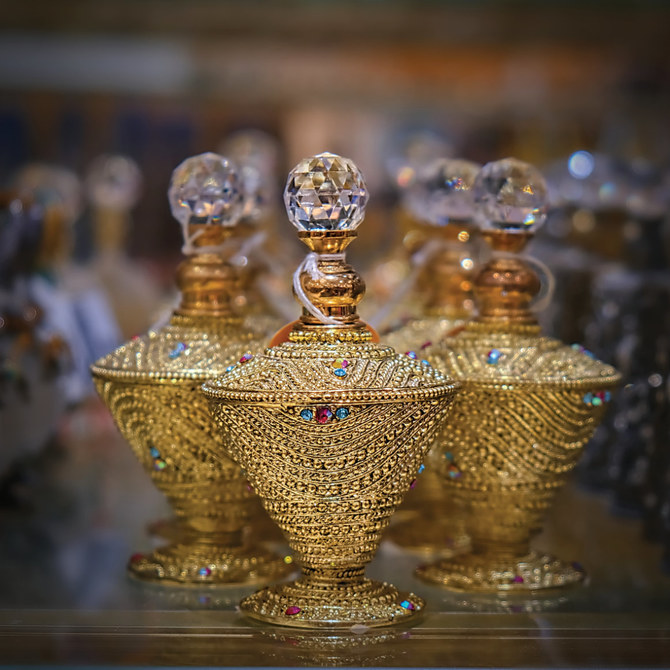
With their complex profiles and traditional ingredients, Arabic perfumes command a significant market share. (Shutterstock)
“Premium perfumes are made up of high-quality ingredients, which differentiate them from other cheap products. These are also concentrated and long-lasting and are designed to evolve and offer more sophisticated and refined experience,” Mohan explained.
“Nowadays, people are also becoming more conscious about brands and shifting toward quality and premium products, as they have high spending power. Thus, the growing usage of premium products is contributing to the growth of the market in the country,” he added.
The inherent quality and luxury of the Saudi perfume market, driven by the cultural significance of scents such as oud and musk, have contributed to the industry’s success.
With their complex profiles and traditional ingredients, Arabic perfumes command a significant market share.
Their popularity is a nod to the region’s cultural heritage, where these fragrances are more than just scents: They are a bridge to the past and a celebration of Arab identity.
Demonstrating this, oriental perfumes accounted for the largest revenue share of the Saudi perfume market, accounting for 65.77 percent in 2022, according to a report by P&S Intelligence.
The report further noted that this category is expected to grow by 6 percent from 2023 to 2030.
FASTFACTS
• With the market’s valuation at $1.8 billion in 2023 and anticipated growth to $2.6 billion by 2032, the Kingdom’s perfume industry is a testament to the cultural significance of fragrance.
• The number of commercial registrations granted to practice the manufacturing and bottling of perfumes in Saudi Arabia further demonstrates the rising tendency of citizens to invest in the industry.
The craftsmanship behind these fragrances, often passed down through generations, adds layers of depth and sophistication, making them highly sought after locally and internationally.
The inclination toward premium fragrances connects back to deep-rooted cultural practices where perfumes served as an extension of personal identity and social standing, the owner of Saudi perfume brand “Nabdh,” Zaynah Al-Hamza, told Arab News.
The digital age and celebrity branding
The digital landscape has transformed how perfumes are marketed and sold in Saudi Arabia.
E-commerce, bolstered by the pandemic, has become a critical channel for reaching consumers, with many brands expanding their online presence.
“In recent times, developments in information and communication technologies, particularly social media, have revolutionized the way marketing activities take place. Social media has surfaced as a cost-effective and efficient information exchange platform for all,” Mohan said.
“Celebrities are also promoting several brands on social media and people are increasingly buying those products because of celebrity influence,” he added.
In March 2023, Portuguese influencer Georgina Rodriguez starred in social media adverts for Saudi fragrance brand Laverne, which later collaborated with global supermodel Taylor Hill.

The push for female empowerment and increased tourism are expected to buoy the market further. (Supplied)
Perfume companies partner with celebrities to increase brand awareness and drive website traffic and sales, the P&S global report said, adding that this tactic also aids in generating engagement, creating a community, and serving as a channel for customers.
This shift has made the Saudi luxury perfume market more accessible and has opened up new avenues for brands to engage with their audience through social media and online marketing.
The interplay between tradition and modernity and embracing digital methods sets the stage for a dynamic future in the Saudi fragrance industry.
The unisex phenomenon
Unisex fragrances, capturing the largest market share, indicate a progressive shift in consumer behavior. This trend underscores a growing acceptance of products that transcend traditional boundaries, with scents like oud, musk, and amber being used for scents that appeal to all customers.
“Another key trend observed in the market is the rising demand for unisex perfumes. This is because people have different tastes and a large number of individuals are looking for an aroma that is not only feminine but also masculine,” the P&S analyst said.
“Moreover, anyone can wear them, and it allows sharing and swapping collections among different genders. Furthermore, unisex perfumes are neutral in odor and millennial consumers are mostly choosing products with inimitable fragrances in order to build up their personality and individuality,” he added.
These preferences highlight the changing landscape of the Saudi market, which, despite its traditional foundations, is receptive to modern influences.