

Pakistan health ministry to launch national program to address malnutrition in country

1 / 2
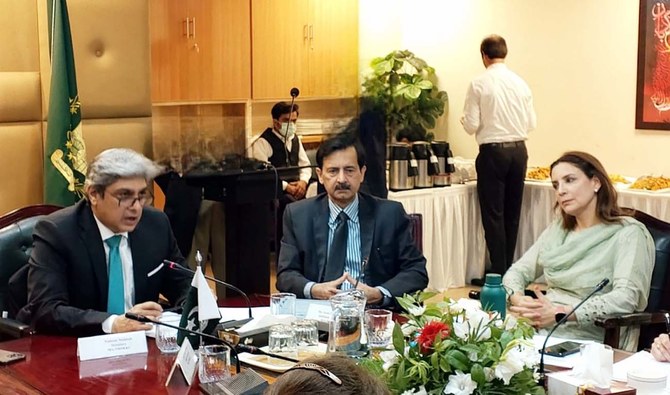
Federal Health Secretary Nadeem Mahbub chairs the inaugural meeting of the National Nutrition Task Force in Islamabad, Pakistan on May 11, 2024. (Photo courtesy: Ministry of Health)
2 / 2
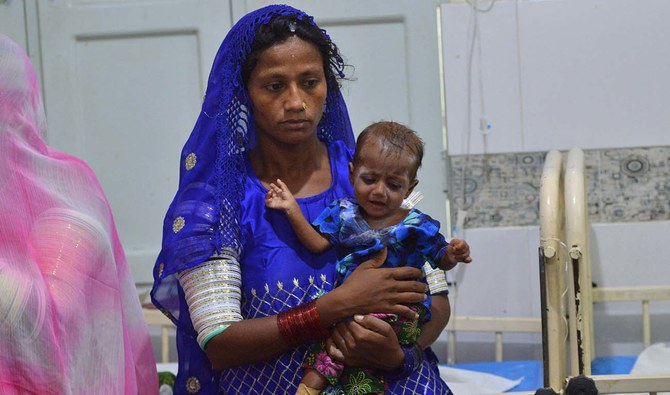
In this picture taken on May 25, 2018, a Pakistani mother holds her baby girl at Mithi Civil Hospital in Mithi, a remote town in southern Pakistan. (AFP/File)
Short Url
Updated 11 May 2024
Follow

Pakistan health ministry to launch national program to address malnutrition in country

  • Pakistan has witnessed extensive consequences of malnutrition, including birth defects, impaired brain development, reduced work capacity
  • Ministry says the government is cognizant of serious situation of malnutrition aggravated by global conflicts, climate change leading to food insecurity

ISLAMABAD: Pakistan’s national health ministry said on Saturday it had decided to launch a national nutrition program to address the issue of malnutrition in the country, in coordination with the planning ministry and provincial governments.

The decision was made at a maiden meeting of the National Nutrition Task Force, presided over by Health Secretary Nadeem Mahbub. The high-level task force was constituted on the directives of Prime Minister Shehbaz Sharif.

Pakistan has witnessed extensive consequences of malnutrition, including devastating birth defects for babies, impaired brain development in young children, and reduced work capacity among adults. 

The health ministry said the incumbent government was cognizant of the serious situation of malnutrition aggravated by global conflicts and climate change leading to food insecurity and high inflation.

“The [task force] has been constituted to provide technical oversight and guidance on Nutrition Policy and programming, developing future directions and roadmaps for nutrition landscape in the country and facilitate and carry out inter-sectoral and multisectoral coordination and advocacy around nutrition,” it said in a statement.

The ministry said it had directed its nutrition wing to prepare a new PC1, planning tool for the development of a project, in coordination with the Planning Commission and the Benazir Income Support Program (BISP) to avoid duplication and cover the areas and interventions which were not covered previously.

In his remarks, Additional Health Secretary Syed Moazzam Ali highlighted the importance of fresh data on malnutrition for proper policy and programming and stressed the need to carry out the National Nutrition Survey as soon as possible.

“Provinces are the real game changers in the success of any program and their strong collaboration and commitment toward nutrition programming is pivotal to address malnutrition in the country,” he said.

Special Health Secretary Syed Waqar-ul Hassan stressed upon the need for convergence of all sectors and stakeholders to address the root cause of malnutrition, highlighting that the ministry alone could not eliminate malnutrition.

The meeting was attended by country representatives of the United Nations World Food Program (WFP), United Nations Children’s Fund (UNICEF), representatives from donor and UN organizations, international and national NGOs, line ministries and provincial government representatives along with academia.

Dr. Mehreen Mujtaba, nutrition director at the health ministry, shared Pakistan would hold its first-ever National Nutrition Conference in June-July, this year to get the guidance of local and international experts in the fields of health and nutrition, thanking participants for their valuable contributions to the meeting.


Police arrest 49 suspected militants in Pakistan’s Punjab in a month

Updated 6 sec ago
Follow

Police arrest 49 suspected militants in Pakistan’s Punjab in a month

  • The development follows a steep rise in militancy-related deaths in Pakistan last year
  • Authorities have lodged cases against the arrested suspects affiliated with banned outfits

ISLAMABAD: The counter-terrorism department (CTD) of Punjab police has arrested 49 militants in different areas of Pakistan’s most populous province in a month and foiled a major terror plan, the CTD said on Saturday.

Pakistan is currently facing an uptick in militant attacks, mainly by the Tehreek-e-Taliban Pakistan (TTP), in its northwestern Khyber Pakhtunkhwa (KP) province, which borders Punjab.

The attacks in KP have forced authorities in Punjab to heighten security and take pre-emptive measures in view of potential spillover of militants into the country’s most populous province.

CTD officials arrested these militants in 425 intelligence-based operations and seized weapons, explosives and other prohibited materials from the arrestees, according to a CTD spokesperson.

“Forty-four cases have been registered against the arrested terrorists and further investigation is being carried out,” the spokesperson said in a statement.

The development comes a steep rise in militancy-related deaths in Pakistan in 2025. According to statistics released by the Pakistan Institute for Conflict and Security Studies (PICSS) last month, combat-related deaths in 2025 rose 73 percent to 3,387. These included 2,115 militants, 664 security forces personnel, 580 civilians and 28 members of pro-government peace committees, the think tank said.

CTD conducted 6,131 combing operations in the province and arrested 599 suspects, according to the statement. Around 570 police reports were registered against these suspects, which led to 477 recoveries.

In Nov., the Punjab government had launched the country’s “first” mobile counterterrorism unit to monitor complex security operations in real time, while in Sept. the province announced the arrest of 90 suspected militants in a three-month counter-terrorism sweep.

Pakistan has struggled to contain the surging in militancy in KP since a fragile truce between the Pakistani Taliban and Islamabad broke down in Nov. 2022. The country faces another decades-long insurgency by Baloch separatists in its southwestern Balochistan province.

Islamabad has frequently accused Afghanistan of allowing the use of its soil and India of backing militant groups for attacks against Pakistan. Kabul and New Delhi deny the allegation.