CAPE CANAVERAL, Florida: An unusually strong solar storm hitting Earth could produce northern lights in the US this weekend and potentially disrupt power and communications.
The National Oceanic and Atmospheric Administration issued a rare severe geomagnetic storm warning when a solar outburst reached Earth on Friday afternoon, hours sooner than anticipated. The effects were due to last through the weekend and possibly into next week.
NOAA alerted operators of power plants and spacecraft in orbit to take precautions, as well as the Federal Emergency Management Agency.
“For most people here on planet Earth, they won’t have to do anything,” said Rob Steenburgh, a scientist with NOAA’s Space Weather Prediction Center.
The storm could produce northern lights as far south in the US as Alabama and Northern California, according to NOAA. But it was hard to predict and experts stressed it would not be the dramatic curtains of color normally associated with the northern lights, but more like splashes of greenish hues.
“That’s really the gift from space weather — the aurora,” said Steenburgh. He and his colleagues said the best aurora views may come from phone cameras, which are better at capturing light than the naked eye.
Snap a picture of the sky and “there might be actually a nice little treat there for you,” said Mike Bettwy, operations chief for the prediction center.
The most intense solar storm in recorded history, in 1859, prompted auroras in central America and possibly even Hawaii. “We are not anticipating that” but it could come close, said NOAA space weather forecaster Shawn Dahl.
This storm — ranked 4 on a scale of 1 to 5 — poses a risk for high-voltage transmission lines for power grids, not the electrical lines ordinarily found in people’s homes, Dahl told reporters. Satellites also could be affected, which in turn could disrupt navigation and communication services here on Earth.
An extreme geomagnetic storm in 2003, for example, took out power in Sweden and damaged power transformers in South Africa.
Even when the storm is over, signals between GPS satellites and ground receivers could be scrambled or lost, according to NOAA. But there are so many navigation satellites that any outages should not last long, Steenburgh noted.
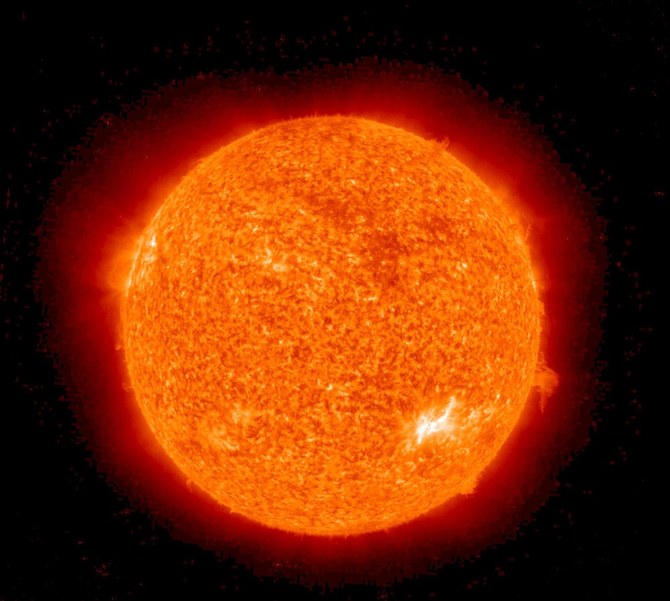
The sun has produced strong solar flares since Wednesday, resulting in at least seven outbursts of plasma. Each eruption — known as a coronal mass ejection — can contain billions of tons of plasma and magnetic field from the sun’s outer atmosphere, or corona.
The flares seem to be associated with a sunspot that’s 16 times the diameter of Earth, according to NOAA. It’s all part of the solar activity that’s ramping up as the sun approaches the peak of its 11-year cycle.
NASA said the storm posed no serious threat to the seven astronauts aboard the International Space Station. The biggest concern is the increased radiation levels, and the crew could move to a better shielded part of the station if necessary, according to Steenburgh.
Increased radiation also could threaten some of NASA’s science satellites. Extremely sensitive instruments will be turned off, if necessary, to avoid damage, said Antti Pulkkinen, director of the space agency’s heliophysics science division.
Several sun-focused spacecraft are monitoring all the action.
“This is exactly the kinds of things we want to observe,” Pulkkinen said.


![]()


Strong solar storm hits Earth, could disrupt communications and produce northern lights in US
Short Url
https://arab.news/vwpye
Strong solar storm hits Earth, could disrupt communications and produce northern lights in US
UN rights chief appeals for $400 million as crises mount and funding shrinks
- The UN office is appealing for $100 million less than last year, after a significant scale back of its work in some areas
- Volker Turk’s office undertook less than half the number of human rights monitoring missions compared to 2024
GENEVA: UN human rights chief Volker Turk appealed for $400 million on Thursday to address mounting human rights needs in countries such as Sudan and Myanmar, after donor funding cuts drastically reduced the work of his office and left it in “survival mode.”
The UN office is appealing for $100 million less than last year, after a significant scale back of its work in some areas due to a fall in contributions from countries including the US and Europe.
“We are currently in survival mode, delivering under strain,” Turk told delegates in a speech in Geneva, urging countries to step up support.
In the last year, Turk’s office raised alarm about human rights violations in Gaza, Sudan, the Democratic Republic of the Congo, Ukraine, and Myanmar, among others.
However, due to slashes in funding, Turk’s office undertook less than half the number of human rights monitoring missions compared to 2024, and reduced its presence in 17 countries, he said. Last year it received $90 million less in funding than it needed, which resulted in 300 job cuts, directly impacting the office’s work, Turk said in December.
“We cannot afford a human rights system in crisis,” he stated.
Turk listed examples of the impacts of cuts, noting the Myanmar program was cut by more than 60 percent in the last year, limiting its ability to gather evidence.
A UN probe into possible war crimes in the Democratic Republic of the Congo is also struggling to become fully operational due to limited funding, while work to prevent gender-based violence and protect the rights of LGBTIQ+ people globally has been cut up to 75 percent, the office said.
“This means more hate speech and attacks, and fewer laws to stop them,” Turk stated.
The UN human rights office is responsible for investigating rights violations. Its work contributes to UN Security Council deliberations and is widely used by international courts, according to the office.
The UN office is appealing for $100 million less than last year, after a significant scale back of its work in some areas due to a fall in contributions from countries including the US and Europe.
“We are currently in survival mode, delivering under strain,” Turk told delegates in a speech in Geneva, urging countries to step up support.
In the last year, Turk’s office raised alarm about human rights violations in Gaza, Sudan, the Democratic Republic of the Congo, Ukraine, and Myanmar, among others.
However, due to slashes in funding, Turk’s office undertook less than half the number of human rights monitoring missions compared to 2024, and reduced its presence in 17 countries, he said. Last year it received $90 million less in funding than it needed, which resulted in 300 job cuts, directly impacting the office’s work, Turk said in December.
“We cannot afford a human rights system in crisis,” he stated.
Turk listed examples of the impacts of cuts, noting the Myanmar program was cut by more than 60 percent in the last year, limiting its ability to gather evidence.
A UN probe into possible war crimes in the Democratic Republic of the Congo is also struggling to become fully operational due to limited funding, while work to prevent gender-based violence and protect the rights of LGBTIQ+ people globally has been cut up to 75 percent, the office said.
“This means more hate speech and attacks, and fewer laws to stop them,” Turk stated.
The UN human rights office is responsible for investigating rights violations. Its work contributes to UN Security Council deliberations and is widely used by international courts, according to the office.
Latest updates


Recommended


© 2026 SAUDI RESEARCH & PUBLISHING COMPANY, All Rights Reserved And subject to Terms of Use Agreement.