

US announces a new $400 million package of weapons for Ukraine to try to hold off Russian advances

1 / 2
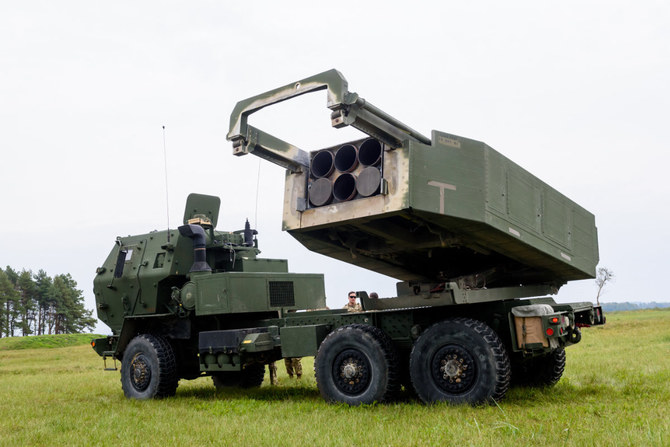
The High Mobility Artillery Rocket Systems (HIMARS) is pictured during the military exercise “Namejs 2022” on September 26, 2022 in Skede, Latvia. (AFP)
2 / 2
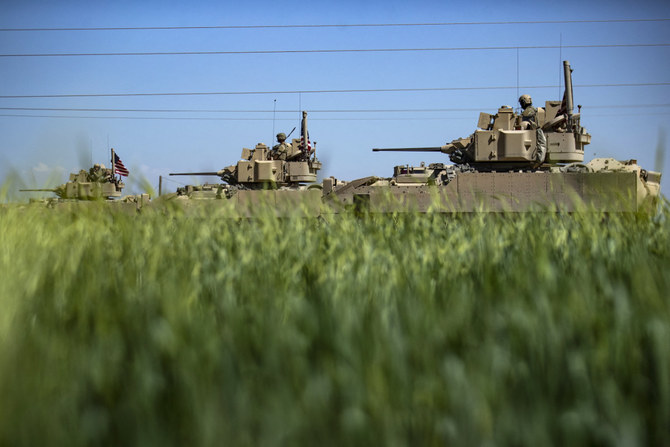
US Bradley Fighting Vehicles (BFV) had been used effectively by Ukrainain troops in their fight against Russian invaders. (AFP)
Short Url
Updated 11 May 2024
Follow

US announces a new $400 million package of weapons for Ukraine to try to hold off Russian advances

WASHINGTON: The US announced a new $400 million package of military aid for Ukraine on Friday, as Kyiv struggles to hold off advances by Russian troops in the northeast Kharkiv region.
This is the third tranche of aid for Ukraine since Congress passed supplemental funding in late April after months of gridlock. Ukrainian President Volodymyr Zelensky had warned Thursday that his country was facing “a really difficult situation” in the east, but said a new supply of US weapons was coming and “we will be able to stop them.”
The package includes High Mobility Artillery Rocket Systems and rockets for them, as well as munitions for Patriot and National Advanced Surface-to-Air Missile Systems, artillery, anti-aircraft and anti-tank munitions, and an array of armored vehicles, such as Bradley and Mine Resistant Ambush Protected vehicles.

It will also provide a number of coastal and riverine patrol boats, trailers, demolition munitions, high-speed anti-radiation missiles, protective gear, spare parts and other weapons and equipment. The weapons are being sent through presidential drawdown authority, which pulls systems and munitions from existing US stockpiles so they can go quickly to the war front.
White House national security spokesman John Kirby said Friday that the latest military aid was intended, in part, to help Ukraine fend off the surging Russian effort to capture Kharkiv, Ukraine’s second largest city.
Kirby noted that Russia has already launched initial incursions into areas around the towns of Vovchansk and Lyptsi, near Kharkiv.
“It is possible that Russia will make further advances in the coming weeks, but we do not anticipate any major breakthroughs,” Kirby said. “And over time, the influx of US assistance will enable Ukraine to withstand these attacks over the course of 2024.”
The US has now provided about $50.6 billion in military assistance to Ukraine since Russia invaded in February 2022.
Almost immediately after President Joe Biden signed the $95 billion foreign aid package, the Pentagon announced it was sending $1 billion in weapons through that drawdown authority,. And just days later the Biden administration announced a $6 billion package funded through the Ukraine Security Assistance Initiative, which pays for longer-term contracts with the defense industry and means that the weapons could take many months or years to arrive.
Russia has sought to exploit Ukraine’s shortages of ammunition and manpower as the flow of Western supplies since the outbreak of the war petered out while Congress struggled to pass the bill. Moscow has assembled large troop concentrations in the east as well as in the north and has been gaining an edge on the battlefield, Zelensky said.
Officials did not say if the latest package includes more of the long-range ballistic missiles — known as the Army Tactical Missile System — that Ukraine has repeatedly requested. The US secretly sent a number of the missiles to Ukraine for the first time this spring and the White House has said it would send more. In one case, Ukraine used them to bomb a Russian military airfield in Crimea.
The new missiles give Ukraine nearly double the striking distance — up to 300 kilometers (190 miles) — than it had with the mid-range version of the weapon that it received from the US in October.


In Ethiopia, Tigrayans fear return to ‘full-scale war’

Updated 02 February 2026
Follow

In Ethiopia, Tigrayans fear return to ‘full-scale war’

  • Flights have been suspended into Tigray since Thursday and local authorities reported drone strikes on goods lorries
  • The international community fears the fighting could turn into an international conflict between Ethiopia and Eritrea

ADDIS ABABA: Tigrayans in northern Ethiopia fear a return to all-out war amid reports that clashes were continuing between local and federal forces on Monday, barely three years after the last devastating conflict in the region.
The civil war of 2020-2022 between the Ethiopian government and Tigray forces killed more than 600,000 people and a peace deal known as the Pretoria Agreement has never fully resolved the tensions.
Fighting broke out again last week in a disputed area of western Tigray called Tselemt and the Afar region to the east of Tigray.
Abel, 38, a teacher in Tigray’s second city Adigrat, said he still hadn’t recovered from the trauma of the last war and had now “entered into another round of high anxiety.”
“If war breaks out now... it could lead to an endless conflict that can even be dangerous to the larger east African region,” added Abel, whose name has been changed along with other interviewees to protect their identity.
Flights have been suspended into Tigray since Thursday and local authorities reported drone strikes on goods lorries on Saturday that killed at least one driver.
In Afar, a humanitarian worker, speaking to AFP on condition of anonymity, said there had been air strikes on Tigrayan forces and that clashes were ongoing on Monday, with tens of thousands of people displaced.
AFP could not independently verify the claims and the government has yet to give any comment on the clashes.
In the regional capital Mekele, Nahom, 35, said many people were booking bus tickets this weekend to leave, fearing that land transport would also be restricted soon.
“My greatest fear is the latest clashes turning into full-scale war and complete siege like what happened before,” he told AFP by phone, adding that he, too, would leave if he could afford it.
Gebremedhin, a 40-year-old civil servant in the city of Axum, said banks had stopped distributing cash and there were shortages in grocery stores.
“This isn’t only a problem of lack of supplies but also hoarding by traders who fear return of conflict and siege,” he said.
The region was placed under a strict lockdown during the last war, with flights suspended, and banking and communications cut off.
The international community fears the fighting could turn into an international conflict between Ethiopia and Eritrea, whose relations have been increasingly tense in recent months.
The Ethiopian government accuses the Tigrayan authorities and Eritrea of forging closer ties.
United Nations Secretary-General Antonio Guterres is “deeply concerned about... the risk of a return to a wider conflict in a region still working to rebuild and recover,” his spokesman said.
The EU said that an “immediate de-escalation is imperative to prevent a renewed conflict.”