

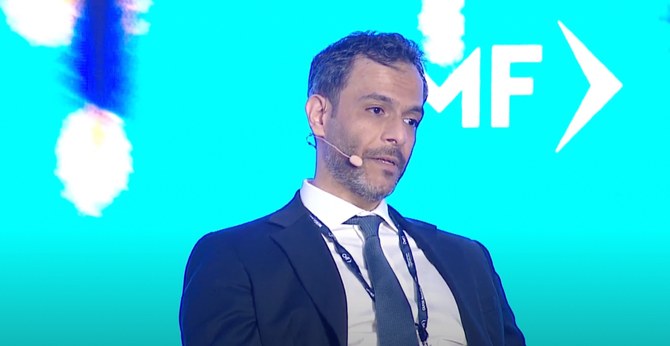

RIYADH: An array of robust and diverse initial public offerings are poised for the Saudi Exchange thanks to new initiatives aimed at attracting international investors, the bourse’s CEO has revealed.
Addressing a panel discussion themed “Expanding Frontiers: Uncovering Investment Potential in Saudi Arabia and China” at the Capital Market Forum — CONNECT Hong Kong, Mohammed Al-Rumaih expressed confidence in the future trajectory of the Saudi Exchange.
"We can see a very healthy pipeline of IPOs, not just small or large ones, but across different sectors and cycles, tracing their journey from being private to going public," Al-Rumaih said.
The CEO attributed this to the Saudi Exchange’s new measures aimed at attracting international investors.
“We’ve been doing a lot of work in the past few years, major projects every year, to accommodate the needs of international investors and the asset managers,” he explained.
These include the introduction of Market Making and the debut of Single Stock Options.
In 2022, it launched a market-making framework for its stock and derivatives markets, aimed at enhancing liquidity and improving price determination efficiency.
Al-Rumaih also highlighted the upcoming launch of the second phase of the Saudi Exchange’s post-trade development program, expected in the third quarter of 2024.
Moreover, the CEO elaborated on Tadawul’s close collaboration with the Kingdom’s Capital Market Authority.
“So, when it comes to technology, we have state-of-the-art infrastructure similar to global exchanges, but it’s not only about technology; there’s a major element which is the regulations. We’ve been working closely with regulators, particularly the CMA because they are leading the development of the capital market,” he stressed.
In addition, Al-Rumaih also addressed how the Saudi Exchange views Hong Kong as an ally.
“We believe Hong Kong is a great partner for us. They’ve been doing a great job in the past few years, and I think they’ve established themselves as a destination for international investors looking to invest in Asia,” the CEO affirmed.
“So, for us, as a country that is gearing up to become thriving economy and having the biggest stock market, or the biggest skeletal market, within that time zone, I think Hong Kong is a great partner to connect the Middle East with the East,” he underlined.
Also speaking at the same panel, Loai Bafaqeeh, head of securities at SNB Capital, explained what the Kingdom is doing to encourage international investors.
“With the market evolving and focusing on listing companies and bringing more and more companies to the market, I think what’s happening in Saudi in terms of encouraging international investors basically we are addressing some of the key fundamentals that international investors are looking for,” Bafaqeeh said.
He added: “One thing, for instance, is the introduction of Market Making. Today, if you want to get an ETF or another product, or if you want to ensure good liquidity in the market, your first question should be: ‘Do you have a Market Making?’”
During the same panel discussion, Ding Chen, CEO of CSOP Asset Management Limited, talked about the emergence of the Kingdom as an investment prospect.
“Saudi Arabia, the Kingdom, has already done a great job promoting itself and also bringing itself in the spotlight globally by providing quite a lot of conference and events; nowadays, a lot of people travel to Riyadh,” Chen underscored.
“But we constantly do seminars and also do client educations with clients,” the CEO added.
She went on to note that in order to provide Saudi Arabia with more opportunities and make it more appealing to regional investors, conducting massive education sessions for clients is crucial.
“CSOP probably will do around 2,000 seminars annually, and we hope that through doing this continually client education, we can make more people know more about Saudi opportunities,” Chen concluded.
Saudi Arabia’s Capital Market Forum aims to bolster connections with China’s capital markets by extending its reach beyond borders to host the event in Hong Kong.
In 2023, the Saudi Exchange saw a significant influx of IPOs and listings, introducing various industries to the Main Market and the Nomu Parallel Market.
On the Main Market, nine IPOs raised SR11.6 billion ($3 billion), with an additional SR5.04 billion raised across nine further offerings. Meanwhile, the Nomu Parallel Market saw 27 IPO listings raising SR1.2 billion, along with six companies completing direct listings.
In April, the Saudi Exchange welcomed its 400th listing across all securities, underlining the growing prominence of the bourse in the capital market.
As of March 27, the exchange had 216 securities listed on the Tadawul All Share Index, with the parallel market Nomu featuring 83 listings.


