SURREY, British Columbia: Three Indian men charged with killing Sikh separatist leader Hardeep Singh Nijjar in British Columbia last year have appeared in court in the case that set off a diplomatic spat after Canadian Prime Minister Justin Trudeau said there were “credible allegations” of Indian involvement.
Canadian police had arrested the three Indian men last week in Edmonton, Alberta, and they have been charged with first-degree murder and conspiracy to commit murder.
Canadian Mounted Police Superintendent Mandeep Mooker said Friday that the investigation into whether the men had ties to India’s government was ongoing.
Nijjar, 45, was shot to death in his pickup truck last June after he left the Sikh temple he led in the city of Surrey. An Indian-born citizen of Canada, he owned a plumbing business and was a leader in what remains of a once-strong movement to create an independent Sikh homeland. India designated him a terrorist in 2020 and at the time of his death had been seeking his arrest for alleged involvement in an attack on a Hindu priest.
India has denied involvement in the slaying. In response to the allegations, India told Canada last year to remove 41 of its 62 diplomats in the country. Tensions remain but have somewhat eased since.
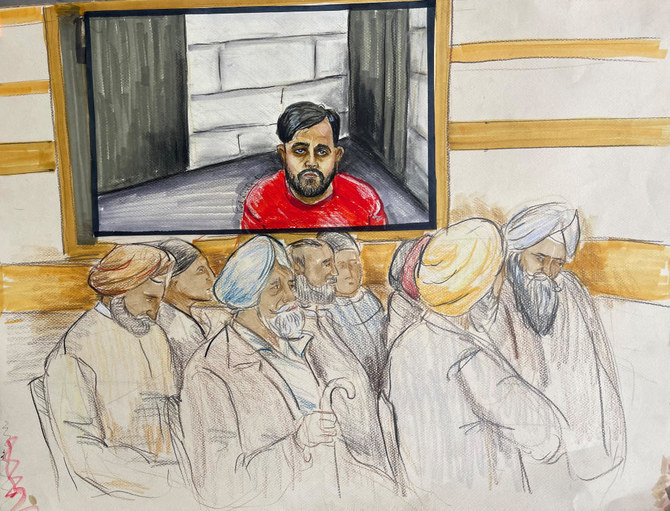
The arrested men — Kamalpreet Singh, 22, Karan Brar, 22, and Karanpreet Singh, 28 — appeared in court Tuesday via a video link and agreed to a trial in English. They were ordered to appear in British Columbia Provincial Court again on May 21.
Brar and Karanpreet Singh appeared in the morning. Kamalpreet’s appearance was delayed until the afternoon as he waited to speak to a lawyer.
The small provincial courtroom was filled with spectators during the morning session. Others crowded into an overflow room to watch the proceedings via video.
Richard Fowler, the defense lawyer representing Brar, said the case will eventually be moved to the Supreme Court and combined into one case.
About 100 people gathered outside the courthouse waving yellow flags and holding photos of Indian government officials whom they accuse of being involved in Nijjar’s killing.
Canadian police say the three suspects had been living in Canada as non-permanent residents.
A bloody decadelong Sikh insurgency shook north India in the 1970s and 1980s until it was crushed in a government crackdown in which thousands of people were killed, including prominent Sikh leaders.
The Khalistan homeland movement has lost much of its political power but still has supporters in the Indian state of Punjab, as well as in the sizable overseas Sikh diaspora. While the active insurgency ended years ago, the Indian government has repeatedly warned that Sikh separatists were trying to make a comeback.

3 Indian men charged with killing Sikh separatist leader in Canada appear in court
https://arab.news/bpjgk
3 Indian men charged with killing Sikh separatist leader in Canada appear in court
Palestinian envoy pledges return to UN’s founding ideals in his bid for presidency of General Assembly
- Riyad Mansour presents a vision for his candidacy grounded in the 3 core pillars of the UN: human rights, development, and peace and security
- World of today ‘needs more, not less, United Nations,’ he says. ‘It needs us to honor our commitments … uphold our responsibilities … respect the rules of international law’
As Palestine’s envoy to the UN, Riyad Mansour, launched his candidacy for president of the 81st session of the UN General Assembly, he urged member states to recommit, at this time of growing global division, to multilateral cooperation, the principles of international law and the founding ideals of the UN.
Mansour, whose candidacy was endorsed by the UN’s Arab Group, presented a vision grounded in the three core pillars of the UN: human rights, development, and peace and security.
In his vision statement, he said: “The world we live in today needs more, not less, United Nations. It needs us to honor our commitments, not renege on them; to uphold our responsibilities, not abandon them; to respect the rules of international law, not grow accustomed to their breach.”
The 81st session of the UN General Assembly begins in September, and the election of its president will take place on June 2 in the General Assembly Hall at the UN headquarters in New York. In accordance with the established regional rotation of the position, the next president will be chosen from among the Asia-Pacific group of states.
Two others candidates have announced their intentions to stand so far: veteran diplomats Touhid Hossain from Bangladesh and Andreas S. Kakouris from Cyprus.
Mansour, who has served as the permanent observer of the State of Palestine to the UN since 2005, framed his candidacy through the lens of personal experience, describing himself as “a refugee, a migrant, the son of a steelworker,” who had lived through conflict, poverty and displacement.
“I know what it means when the United Nations is at its best, and I know only too well its shortcomings,” he said.
In his vision, Mansour reflected on the origins of the UN in the aftermath of a global conflict, describing the institution as a response to humanity’s “darkest moments” and a platform designed to replace war with cooperation.
He credited the General Assembly with enabling collective action that has delivered tangible gains, including advances in development, health, human rights and environmental protections.
“Together, we rejected the impulses of war and destruction and chose cooperation, common security and shared prosperity,” he said, citing milestones such as the Millennium Development Goals, the 2030 Agenda for Sustainable Development, and international agreements on climate change, disarmament and gender equality.
Despite those achievements, however, Mansour warned that many pledges have not been kept and trust in the international system is eroding.
“Too many promises remain unfulfilled, and too much suffering continues,” he said. “The international order has grown increasingly uncertain, and the ideals of the United Nations are too often left unenforced.”
He cautioned against a return to a world in which “conflict prevails over dialogue” and “coercion replaces diplomacy,” arguing that the scale of present-day crises — from armed conflict and humanitarian emergencies to climate change and technological risks — requires a renewed, collective resolve.
“We cannot risk a return to a world where disorder undermines the rule of international law,” Mansour said. “We must rise above division and recommit to partnership.”
He called for reforms within the UN system itself with the aim of improving efficiency, inclusivity and engagement, saying that such changes were necessary to restore confidence in the organization’s ability to deliver peace and security.
“This moment demands engagement grounded in mutual interest and sustained by persistent action,” he said, adding that reform was essential “to restore trust in our United Nations and its enduring capacity to contribute to international peace and security.”
He described his vision as pragmatic rather than ideological, shaped by decades of multilateral diplomacy and a belief in the UN as “an anchor for a more peaceful and just world.”
He continued: “At a time of profound strain on the multilateral system, my vision seeks to mobilize member states and stakeholders to preserve and safeguard what we have accomplished, and to pursue progress with urgency, so that dignity, opportunity and hope are extended to all.”
The president of the General Assembly is elected annually and is responsible for presiding over its sessions, representing its decisions, and facilitating negotiations among member states.