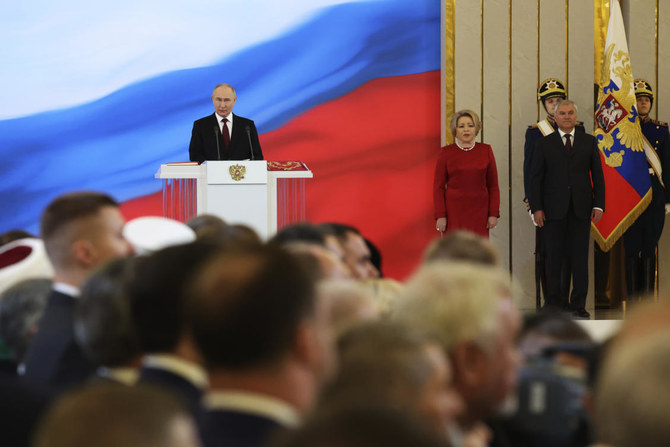
MOSCOW: Russian President Vladimir Putin said it was up the West to choose between confrontation and cooperation as he was sworn in for a new six-year term on Tuesday at a Kremlin ceremony that was boycotted by the United States and many of its allies.
More than two years into the war in Ukraine, Putin said he wanted to “bow” before Russia’s soldiers there and declared in his inauguration speech that his landslide re-election in March was proof the country was united and on the right track.
“You, citizens of Russia, have confirmed the correctness of the country’s course. This is of great importance right now, when we are faced with serious challenges,” he told dignitaries in a gilded Kremlin hall where a trumpet fanfare sounded to greet his arrival.
“I see in this a deep understanding of our common historical goals, a determination to adamantly defend our choice, our values, freedom and the national interests of Russia.”
At 71, Putin dominates the domestic political landscape. Leading opposition figures are in prison or exile, and his best known critic, Alexei Navalny, died suddenly in an Arctic penal colony in February.
Yulia Navalnaya, the late dissident’s wife, urged supporters in a video on Tuesday to keep up the struggle against Putin. “With each of his terms, everything only gets worse, and its’ frightening to imagine what else will happen while Putin remains in power,” she said.
On the international stage, Putin is locked in a confrontation with Western countries he accuses of using Ukraine as a vehicle to try to defeat and dismember Russia.
Putin told Russia’s political elite after being sworn in that he was not rejecting dialogue with the West, including on nuclear weapons.
“The choice is theirs: do they intend to continue trying to restrain the development of Russia, continue the policy of aggression, incessant pressure on our country for years, or look for a path to cooperation and peace?” he said.
With Russia’s troops advancing gradually in eastern Ukraine, the top US intelligence official said last week that Putin appeared to see domestic and international developments trending in his favor and the conflict was unlikely to end anytime soon.
It remains unclear how far Putin will seek to press the war and on what terms he might discuss ending it — decisions that will depend in part on whether Joe Biden or Donald Trump wins the US presidential election in November. Ukraine says peace can only come with a full withdrawal of Russia’s troops, who control nearly 20 percent of its territory.
Western absentees
Putin, in power as president or prime minister since 1999, will surpass Soviet leader Josef Stalin and become Russia’s longest-serving ruler since 18th century Empress Catherine the Great if he completes a new six-year term. He would then be eligible to seek re-election again.
He won victory by a record margin in a tightly controlled election from which two anti-war candidates were barred on technical grounds. The opposition called it a sham.
The United States, which said it did not consider his re-election free and fair, stayed away from Tuesday’s ceremony.
Britain, Canada and most EU nations also decided to boycott the swearing-in, but France said it would send its ambassador.
Ukraine said the event sought to create “the illusion of legality for the nearly lifelong stay in power of a person who has turned the Russian Federation into an aggressor state and the ruling regime into a dictatorship.”
Sergei Chemezov, a Putin ally, told Reuters before the ceremony, that Putin brought stability, something which even his critics should welcome.
“For Russia, this is the continuation of our path, this is stability – you can ask any citizen on the street,” he said.
Nuclear tensions
Russia’s relations with the United States and its allies are at their lowest point since the Cuban Missile Crisis of 1962, when the world came to the brink of nuclear war.
The West has provided Ukraine with artillery, tanks and long-range missiles, but NATO troops have not joined the conflict directly, something that both Putin and Biden have warned could lead to World War Three.
Underscoring the rise in nuclear tensions, Russia said on Monday it would practice the deployment of tactical nuclear weapons as part of a military exercise, after what it said were threats from France, Britain and the United States.
One of the decisions awaiting Putin in his new term will be whether to seek to renew or replace the last remaining treaty that limits Russian and US strategic nuclear warheads. The New START agreement is due to expire in 2026.
In line with the constitution, the government resigned at the start of the new presidential term. Putin ordered it to remain in office while he appoints a new one which is expected to include many of the same faces.


![]()

Putin starts new six-year term with challenge to the West
Short Url
https://arab.news/ct4xa
Putin starts new six-year term with challenge to the West
- Putin is sworn in for fifth term
- US and many EU states stay away
- Putin says he’s not ending dialogue with West


Latest updates


© 2026 SAUDI RESEARCH & PUBLISHING COMPANY, All Rights Reserved And subject to Terms of Use Agreement.