Pakistani startups introduce Hajj cards to help pilgrims experience cashless pilgrimage

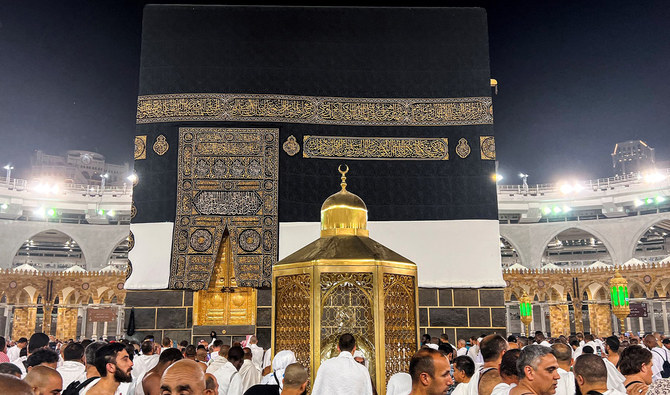
Muslim worshippers and pilgrims gather around the Kaaba, Islam's holiest shrine, at the Grand Mosque in the holy city of Mecca on June 22, 2023, as they arrive for the annual Hajj pilgrimage. (AFP/File)
Short Url
Updated 07 May 2024
Follow

Pakistani startups introduce Hajj cards to help pilgrims experience cashless pilgrimage

  • The card offers seamless transactions in Saudi Arabia with lower charges and minimal international taxes
  • This innovative card will be launched for public on May 15, with applications opening through the MyTM app

ISLAMABAD: Pakistani startups, MyTM and Zindigi, have partnered with JS Bank and MasterCard to unveil the Sullis Hajj Card, a “revolutionary” financial product designed to provide pilgrims a cashless experience during their spiritual journey, a senior MyTM official said on Monday.

MyTM, a Pakistan-based startup with operations in the Kingdom, offers digital payments and financial services, while Zindigi is one of the first fully digital banks of Pakistan that offers unprecedented personalization to its customers.

Traditionally, the Hajj journey involves numerous financial transactions from visa fees to accommodation and transportation. The Sullis Hajj Card encapsulates the concept of internationally enabling pilgrims to manage their expenses without the need to carry cash.

“For the first time in Pakistan, this initiative enables a cashless Hajj in the first phase and later on Umrah experience, offering ease of transactions with reduced charges and almost no taxes otherwise applicable on all traditional cards during international transactions,” Jawad Mahmood, chief executive officer of MyTM Saudi Arabia, told Arab News on the sidelines of the Sullis Hajj Card launch in Islamabad.
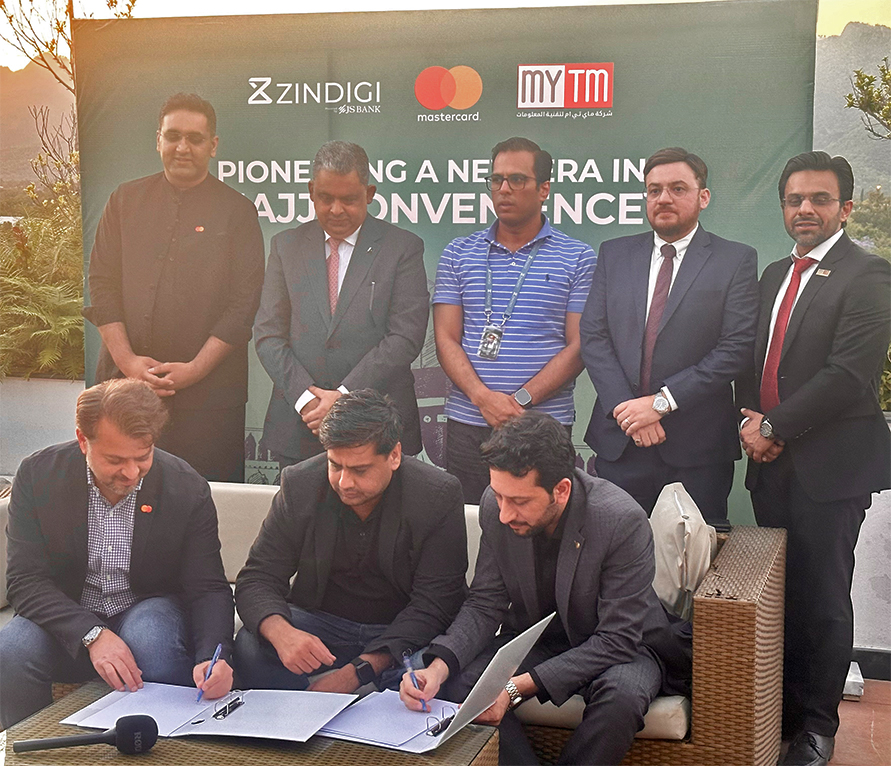


Officials from Pakistani startup MyTM, JS Bank, Zindigi, and Mastercard launched the Sullis Hajj Card in Islamabad, Pakistan on May 6, 2024, to provide pilgrims with a cashless experience during the annual pilgrimage. (AN Photo) 

Through this card, he said, MyTM, Zindigi, JS Bank, and MasterCard were collaborating to offer pilgrims favorable exchange rates, easy money withdrawal and a wide acceptability across Saudi Arabia and other parts of the world.

Hajj is one of the five pillars of Islam and requires every adult Muslim to undertake the journey to the holy Islamic sites in Makkah at least once in their lifetime if they are financially and physically able.

Pakistan has a Hajj quota of 179,210 pilgrims this year. Of them, 63,805 pilgrims will be performing the pilgrimage under the government scheme, while the rest would be accommodated by private tour operators, according to the Pakistani religious affairs ministry.

The Hajj card will be launched for public on May 15, with applications opening through the MyTM app, according to the MyTM Saudi Arabia official. The innovative financial product is a great example of moving forward on Pakistan’s national financial inclusion policy and Saudi Arabia’s Vision 2030 as both governments are currently focusing on digital economy.

“Right now, a lot of people who are going there face a lot of issues sometimes they have some currency exchange issues, sometimes they get high rates and sometimes they lose their money,” Mahmood said, adding the initiative would not only enhance convenience but also increase financial security of pilgrims performing Hajj and Umrah.

Rizwan Saeed Qureshi, an additional secretary for the Middle East in Pakistan’s foreign ministry, termed the Hajj card a “good omen” for Pakistan’s fintech sector.

“This is the first-ever pilot to the best of our understanding for cashless Hajj to start with and certainly subsequently Umrah,” he told Arab News.

“Hopefully it will succeed as a pilot and then expand in terms of its implementation, in terms of its application, in terms of its coverage to the entire Hajj operation.”

This year’s pilgrimage is expected to run from June 14 till June 19.


Pakistan among Arab, Muslim nations slamming US envoy’s remarks on Israel’s right to Mideast land

Updated 6 sec ago
Follow

Pakistan among Arab, Muslim nations slamming US envoy’s remarks on Israel’s right to Mideast land

  • Huckabee suggested Israel could claim land stretching across parts of the Middle East
  • Pakistan and Arab states say comments violate international law, threaten Gaza de-escalation

JERUSALEM: Arab and Islamic countries issued a joint condemnation on Sunday of remarks by US ambassador to Israel Mike Huckabee, who suggested Israel had a biblical right to a vast swath of the Middle East.

Huckabee, a former Baptist minister and a fervent Israel supporter, was speaking on the podcast of far-right commentator and Israel critic Tucker Carlson.

In an episode released Friday, Carlson pushed Huckabee on the meaning of a biblical verse sometimes interpreted as saying that Israel is entitled to the land between the river Nile in Egypt and the Euphrates in Syria and Iraq.

In response, Huckabee said: “It would be fine if they took it all.”

When pressed, however, he continued that Israel was “not asking to take all of that,” adding: “It was somewhat of a hyperbolic statement.”

The backlash widened sharply on Sunday as more than a dozen Arab and Islamic governments — alongside three major regional organizations — issued a joint statement denouncing the US diplomat’s comments as “dangerous and inflammatory.”

The statement, released by the United Arab Emirates’ foreign ministry, was signed by the UAE, Egypt, Jordan, Indonesia, Pakistan, Turkiye, Saudi Arabia, Qatar, Kuwait, Oman, Bahrain, Lebanon, Syria and the State of Palestine, as well as the Organization of Islamic Cooperation, the Arab League and the Gulf Cooperation Council.

They said the comments contravene the UN Charter and efforts to de-escalate the Gaza war and advance a political horizon for a comprehensive settlement.

Iran joined the chorus with its foreign ministry accusing Huckabee on X of revealing “American active complicity” in what it called Israel’s “expansionist wars of aggression” against Palestinians.

Earlier, several Arab states had issued unilateral condemnations.

Saudi Arabia described the ambassador’s words as “reckless” and “irresponsible,” while Jordan said it was “an assault on the sovereignty of the countries of the region.”

Kuwait decried what it called a “flagrant violation of the principles of international law,” while Oman said the comments “threatened the prospects for peace” and stability in the region.

Egypt’s foreign ministry reaffirmed “that Israel has no sovereignty over the occupied Palestinian territory or any other Arab lands.”

The Palestinian Authority said on X that Huckabee’s words “contradict US President Donald Trump’s rejection of (Israel) annexing the West Bank.”

On Saturday, Huckabee published two posts on X further clarifying his position on other topics touched upon in the interview, but did not address his remark about the biblical verse.

The speaker of the Israeli parliament, Amir Ohana, praised Huckabee on X for his general pro-Israel stance in the interview, and accused Carlson of “falsehoods and manipulations.”

Carlson has recently found himself facing accusations of antisemitism, particularly following a lengthy, uncritical interview with self-described white nationalist Nick Fuentes — a figure who has praised Hitler, denied the Holocaust and branded American Jews as disloyal.