Pakistan, 13 Muslim nations condemn US envoy’s remarks on Israel’s right to Middle East land

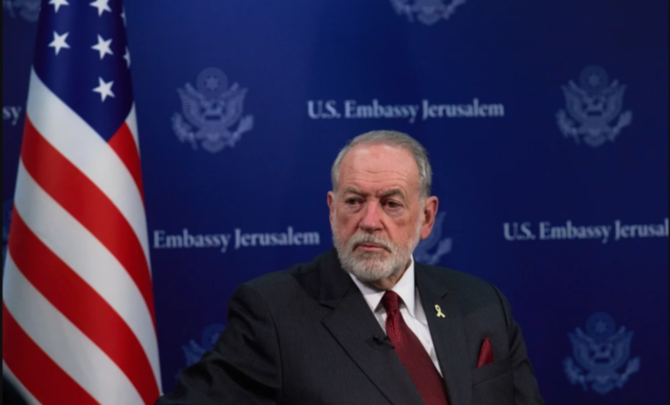
US ambassador to Israel Mike Huckabee is seen during an interview in Jerusalem on August 20, 2025. (AP/File)
Short Url
Updated 22 February 2026
Follow

Pakistan, 13 Muslim nations condemn US envoy’s remarks on Israel’s right to Middle East land

  • US ambassador to Israel Mike Huckabee suggested Israel could claim land stretching across parts of Middle East
  • Joint statement says remarks contradict US President Donald Trump’s vision to ensure peace in the Middle East

ISLAMABAD: The foreign ministers of Pakistan, 13 other Arab and Islamic nations issued a joint statement on Sunday condemning recent remarks by US ambassador to Israel Mike Huckabee, who suggested Israel had a biblical right to the Middle East.

Huckabee said on Saturday that it would be acceptable if Israel took control of the entire Middle East, including the West Bank, drawing anger and condemnation from several Muslim nations. 

The foreign ministers of Pakistan, Egypt, Jordan, UAE, Indonesia, Turkiye, Saudi Arabia, Qatar, Kuwait, Oman, Bahrain, Lebanon Syria, Palestine, and the secretariats of the Organization of Islamic Cooperation (OIC), the League of Arab States (LAS), and the Gulf Cooperation Council (GCC) expressed their” strong condemnation and profound concern” over Huckabees’ comments in a joint statement late Saturday night. 

“They affirm their countries’ categorical rejection of such dangerous and inflammatory remarks, which constitute a flagrant violation of the principles of international law and the Charter of the United Nations, and pose a grave threat to the security and stability of the region,” the joint statement read. 

The statement said that these comments were in contradiction of US President Donald Trump’s vision for peace in Gaza and his efforts to contain escalation there and create a “political horizon” for a comprehensive settlement for a separate Palestinian state.

“The Ministries reaffirmed that Israel has no sovereignty whatsoever over the Occupied Palestinian Territory or any other occupied Arab lands,” the statement said.

“They reiterated their firm rejection of any attempts to annex the West Bank or separate it from the Gaza Strip, their strong opposition to the expansion of settlement activities in the Occupied Palestinian Territory, and their categorical rejection of any threat to the sovereignty of Arab states.”

The statement warned that Israel’s continuation of its “expansionist policies” would only inflame violence and conflict in the region. 

Huckabees’ statement comes amid Israel’s move earlier this month to register lands in the West Bank, which is seen by several Muslim states and the Palestinian Authority as an attempt to annex lands in the Palestinian territory. 

The move drew sharp condemnation from several Muslim states earlier this week, who called on the international community to intervene and stop Israel from pursuing “illegal settlement” activity. 


Pakistan blocks ‘thousands’ of passports in crackdown on overseas begging in Gulf countries

Updated 5 sec ago
Follow

Pakistan blocks ‘thousands’ of passports in crackdown on overseas begging in Gulf countries

  • Authorities impose five- to 10-year passport restrictions on deported offenders, report sharp decline in cases
  • Government links enforcement drive to broader push for skilled labor exports and record remittance inflows

ISLAMABAD: Pakistan has blocked “several thousand passports” and imposed long-term travel restrictions on citizens involved in begging abroad, the country’s overseas minister said on Wednesday, reporting a sharp decline in such cases following enforcement reforms.

Last August, the government announced a sweeping crackdown on what it described as a “beggar mafia” accused of exploiting visas to solicit money in Saudi Arabia and other Middle Eastern states. The practice had drawn complaints from Riyadh, prompting Islamabad to direct the Federal Investigation Agency (FIA) to curb the trend.

Federal Minister for Overseas Pakistanis Chaudhry Salik Hussain said authorities were targeting individuals who misuse Umrah and other visit visas to beg overseas, particularly in Gulf countries.

“We are not sending the beggars abroad,” he said at the Pakistan Governance Forum 2026 in the federal capital. “It is not written on the face of the beggar that he is a beggar. They go through the normal process of getting a visa for Umrah and then start this work on the side.”

Hussain said passports of deported individuals involved in begging or criminal activity were being blocked to prevent repeat travel.

“For that we can only do that if someone is involved in this work and he is caught and when he is deported, then at least we block his passport, which is happening,” he said. “Believe me, there has been a drastic drop in this.”

“There is no visa for begging. They go on a normal visa. Every document is 100 percent correct,” he added.

According to Hussain, the FIA is imposing passport restrictions of five to 10 years on offenders, preventing them from obtaining new travel documents.

He added that “several thousand passports” had so far been blocked.

Pakistan, which relies heavily on remittances from its overseas workforce, is also seeking to improve the quality of labor exports following meetings with labor ministers in Qatar, Bahrain, Saudi Arabia and the United Arab Emirates.

“We want our workforce to go there. The quantity is increasing but the quality element is very important,” he said, adding that the government plans to make soft skills training compulsory for Pakistanis going abroad “from the labor class to the undergraduates” so they better understand local norms and regulations.

The minister said exporting skilled labor helps ease unemployment pressures driven by Pakistan’s growing youth population while boosting remittances, which recently hit an all-time high.

“I think this is one of the reasons because our youth bulge is very high in Pakistan and local industries are not enough to cater to that. So we should at least find good jobs in foreign countries and send them there,” he said, adding that overseas workers “not only get employed but also send valuable remittances back home.”

Hussain said broader reforms were also under way to digitize overseas employment processes and reduce corruption.

“We are moving toward maximum digitization,” he said. “Problems and issues arise where humans interact with humans. We are moving toward digitization very quickly.”