

What’s in the three-phase ceasefire deal Hamas backs, but Israel does not?

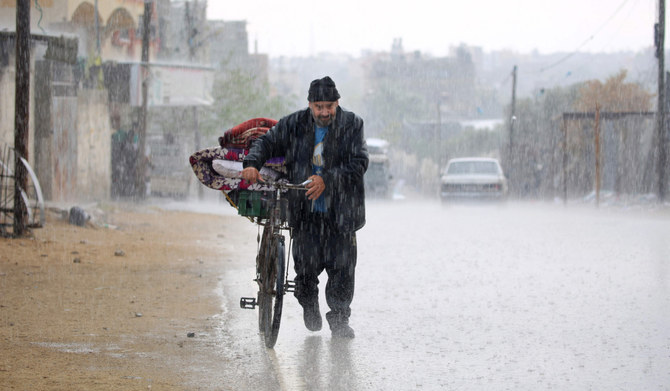
A displaced Palestinian man pushes a bycicle bearing his belongings in the rain in Rafah in the southern Gaza Strip following an evacuation order by the Israeli army on May 6, 2024, amid the ongoing conflict between Israel and the Palestinian Hamas movement. (AFP)
Short Url
Updated 07 May 2024
Follow

What’s in the three-phase ceasefire deal Hamas backs, but Israel does not?

  • Israel has killed more than 34,000 Palestinians, according to Gaza’s Health Ministry

CAIRO: Palestinian Islamist group Hamas said on Monday it had agreed to a three-phased deal for a ceasefire and hostages-for-prisoners swap, although an Israeli official said the deal was not acceptable to Israel because terms had been “softened.”
The United States, which alongside Qatar and Egypt has played a mediation role in the talks, said it was studying the Hamas response and would discuss it with Middle East allies.
Based on details announced so far by Hamas officials and an official briefed on the talks, the deal that the Palestinian group said it had agreed to included the following:

PHASE ONE
• 42-day ceasefire period
• Hamas releases 33 Israeli hostages in return for Israel releasing Palestinians from Israeli jails.
• Israel partially withdraws troops from Gaza and allows free movement of Palestinians from south to north Gaza.

PHASE TWO
• Another 42-day period that features an agreement to restore a “sustainable calm” to Gaza, language that an official briefed on the talks said Hamas and Israel had agreed in order to take discussion of a “permanent ceasefire” off the table.
• The complete withdrawal of most Israeli troops from Gaza.
• Hamas releases Israeli reservists and some soldiers in return for Israel releasing Palestinians from jail.

PHASE THREE
• The completion of exchanging bodies and starting the implementation of reconstruction according to the plan overseen by Qatar, Egypt and the United Nations.
• Ending the complete blockade on the Gaza Strip.


UK condemns drone strikes across Sudan and blocking of aid as famine continues to rage

Updated 59 min 37 sec ago
Follow

UK condemns drone strikes across Sudan and blocking of aid as famine continues to rage

  • Drone attacks by Rapid Support Forces include strike on humanitarian convoy that killed aid worker, and another in North Kordofan that killed 24 people, including 8 children
  • Famine conditions reported in Darfur towns of Um Baru and Kernoi; British ambassador calls this a ‘devastating indictment’ of how warring factions ‘continue to block life-saving aid’

NEW YORK CITY: The UK on Friday condemned drone strikes by the Rapid Support Forces, one of the warring military factions in Sudan, and accused the group and its rival, the Sudanese Armed Forces, of blocking life-saving aid while parts of Sudan’s Darfur region descend into famine.

Speaking ahead of a UN Security Council meeting to discuss the situation in Sudan, requested by Britain, Bahrain and Denmark, the UK’s deputy ambassador, James Kariuki, told reporters that the latest alert from the Integrated Food Security Phase Classification warned of famine conditions in the Darfur towns of Um Baru and Kernoi.

“This is a devastating indictment of how the SAF and RSF continue to block life-saving aid,” he added.

The ways in which they are doing this include blocking trade routes, disrupting supply chains and restricting humanitarian access, Kariuki said. Such actions are deliberately exacerbating the crisis, he warned, and constitute violations of international humanitarian law under UN Security Council Resolution 2417.

“Starvation must never be used as a weapon of war,” he added.

More than 33 million people across the country are now in urgent need of humanitarian assistance, Kariuki said, making the humanitarian crisis in Sudan the worst in the world.

The UK also condemned recent RSF drone strikes across the country, including a reported attack on a World Food Programme convoy on Friday that killed an aid worker. Another RSF drone strike in North Kordofan had killed 24 people, including eight children, Kariuki said.

“Humanitarian workers must be able to deliver the response on the ground without obstruction and without retaliation,” he told the Security Council.

The civil war in Sudan began in April 2023 when fighting erupted between the SAF, led by army chief Abdel Fattah Al-Burhan, and the paramilitary RSF, commanded by Mohammed Hamdan Dagalo, also known as Hemedti.

Kariuki said authorities in the UK had imposed fresh sanctions last Thursday targeting six individuals suspected of committing atrocities or fueling the conflict in Sudan by supplying mercenaries and military equipment.

“These sanctions send a clear message that all those who perpetrate or profit from the brutal violence in Sudan will be held accountable, no matter how long it takes,” he added.
