Iran, Pakistan seek ways to complete gas pipeline project

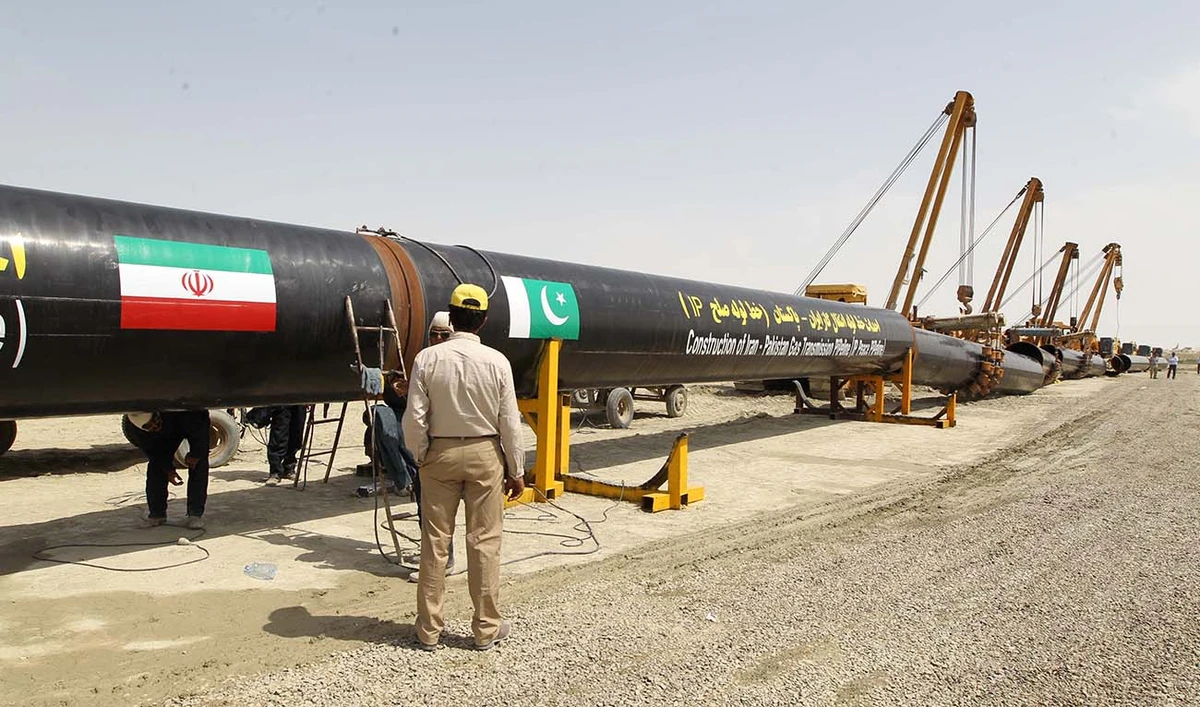
An Iranian worker stands in front of a section of a pipeline after the project was launched during a ceremony with presidents of Iran and Pakistan on March 11, 2013 in the Iranian border city of Chah Bahar. (AFP/File)
Short Url
Updated 06 May 2024
Follow

Iran, Pakistan seek ways to complete gas pipeline project

  • Both countries signed agreement to construct the pipeline from Iran’s South Fars gas field to Pakistan’s Balochistan, Sindh
  • Tehran says has invested $2 bln to construct pipeline, but work on Pakistan side has been held up due to fears of US sanctions

KARACHI: Iran and Pakistan are looking at ways to complete a long-delayed gas pipeline project between the two countries, Iran’s Consul General to Pakistan, Hassan Nourian, said on Monday.

“We see political determination from Pakistan to complete the project,” he told reporters in the southern city of Karachi.

The countries signed an agreement to construct the pipeline from Iran’s South Fars gas field to Pakistan’s Balochistan and Sindh provinces in 2010, but work on Pakistan’s portion has been held up due to fears of US sanctions.

The 1,900 kilometer (1,180 mile) pipeline was meant to supply 750 million to one billion cubic feet per day of natural gas for 25 years to meet Pakistan’s rising energy needs.

Tehran says it has invested $2 billion to construct the pipeline on its territory. Pakistan, however, did not begin construction, citing international sanctions on Iran as the reason.

In 2014, Islamabad asked for a 10-year extension to build the pipeline, which expires in September this year. Iran can take Pakistan to international court, industry watchers have said.

Faced with potential legal action, Pakistan’s caretaker administration this year gave the go ahead in principal to commence plans to build an 80km segment of the pipeline.

In March, Islamabad said it would seek a US sanctions waiver for the pipeline. The US, however, said it did not support the project and cautioned about the risk of sanctions in doing business with Tehran.

Nourian on Monday said the pipeline did not come under international restrictions, and that the two countries were discussing the issue.

He did not answer a question about the potential for Iran to take legal action against Pakistan if it did not complete its side of the pipeline this year.

Pakistan, whose domestic and industrial users rely on natural gas for heating and energy needs, is in dire need for cheap gas with its own reserves dwindling fast and LNG deals making supplies expensive amidst high inflation.

Iran has the world’s second-largest gas reserves after Russia, according to BP’s Statistical Review of World Energy, but sanctions by the West, political turmoil and construction delays have slowed its development as an exporter.

Pakistan says over 44.3 million children vaccinated as year’s first anti-polio drive concludes

Updated 4 sec ago
Follow

Pakistan says over 44.3 million children vaccinated as year’s first anti-polio drive concludes

  • Pakistan launched this year’s first week-long anti-polio nationwide campaign on Feb. 2, targeting over 45 million children
  • Pakistan’s attempts to eliminate polio have been hindered in past by militant attacks targeting polio workers, security teams 

ISLAMABAD: Pakistani health authorities have vaccinated over 44.3 million children during the week-long anti-polio nationwide campaign, the first of this year which concluded last week, the National Emergency Operations Center (NEOC) said on Monday. 

Pakistan launched the first anti-polio nationwide campaign on Feb. 2 to target over 45 million children. Over 400,000 trained polio workers took part in the door-to-door campaign to vaccinate children under the age of five against the disease, the government said. 

“More than 44.3 million children were administered polio vaccine drops during the campaign,” the NEOC said in a statement. 

The anti-polio campaign, which concluded on Sunday, saw over 22.9 million vaccinated in Pakistan’s eastern Punjab province. In Sindh, over 10.5 million children were vaccinated, in Khyber Pakhtunkhwa (KP) 7.13 million, in Balochistan 2.36 million, in Islamabad over 455,000, in Gilgit-Baltistan over 261,000 and in Azad Kashmir over 673,000 in seven days, data shared by the NEOC said. 

The center said that the campaign was conducted in Pakistan and Afghanistan simultaneously, the only two countries were the disease remains endemic. 

Last year, Pakistan reported 31 polio cases, a significant drop from the alarming 74 cases reported in the country in 2024. The South Asian nation reported six cases in 2023 and only one in 2021, but saw a sharp resurgence in 2024.

Pakistan’s polio program began in 1994, but efforts to eradicate the virus have been repeatedly undermined by vaccine misinformation and resistance from some religious hard-liners who claim that immunization is a foreign plot to sterilize Muslim children or a cover for Western espionage.

Militant groups have also frequently targeted polio vaccination teams and the security personnel assigned to protect them, often resulting in deadly attacks, particularly in KP and Balochistan.

“Polio workers and security personnel who performed duties during the campaign are the nation’s true heroes,” the NEOC said.