

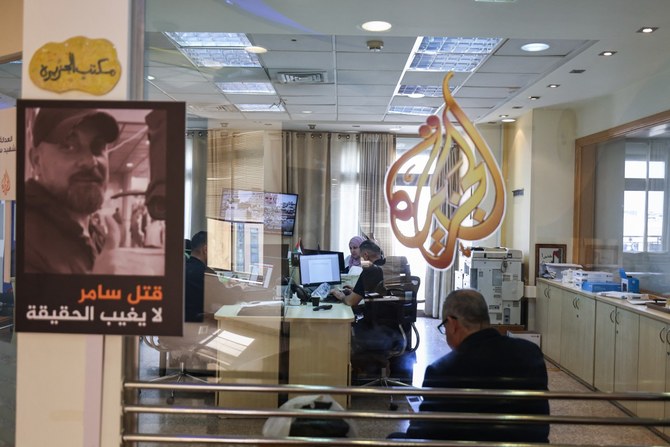
Media watchdogs raise alarm over Al Jazeera ban, call for it to be lifted

There has also been criticism of the decision from within the country, with the Association for Civil Rights in Israel filing a request to the Supreme Court to overturn the ban. (AFP/File)
Short Url
Updated 06 May 2024
Follow

Media watchdogs raise alarm over Al Jazeera ban, call for it to be lifted

  • Israel’s decision sets ‘dangerous precedent,’ Committee to Protect Journalists says
  • News channel vows to continue Gaza coverage, will pursue ‘every legal step’ to fight block

LONDON: Media watchdogs have condemned Israel’s decision to block Al Jazeera, raising concerns about the erosion of media freedom in the country, especially amid the ongoing conflict in Gaza.

The US-based Committee to Protect Journalists said the government’s decision set a dangerous precedent for other international media outlets operating in Israel.

“CPJ condemns the closure of Al Jazeera’s office in Israel and the blocking of the channel’s websites,” program director Carlos Martinez de la Serna said in New York.

Israel should allow Al Jazeera and all international media outlets to operate freely, particularly during wartime, he said.

Israel’s executive authority voted on Sunday to pass a law allowing the temporary shutdown of a foreign channel’s broadcasts if the content was deemed to be a threat to security during the ongoing war.

Soon after Prime Minister Benjamin Netanyahu announced the decision, reports emerged of raids on the offices of the Qatar-backed broadcaster.

The Foreign Press Association released a statement condemning the decision as a “dark day for the media” and accused Israel of joining “a dubious club of authoritarian governments” by banning the broadcasts.

The UN’s Human Rights office also urged the Israeli government to reverse the ban

“A free & independent media is essential to ensuring transparency & accountability. Now, even more so given tight restrictions on reporting from Gaza,” it said on X.

There has also been criticism of the decision from within the country, with the Association for Civil Rights in Israel filing a request to the Supreme Court to overturn the ban.

The news came amid a yearslong campaign waged against Al Jazeera by the Israeli government, which accuses it of anti-Israeli bias and “being a mouthpiece for Hamas.”

The broadcaster rejected the claims and said it would “pursue every legal step” to fight the decision.

Al Jazeera also vowed to continue its coverage from Gaza, as it remains one of the few networks with a strong presence on the ground, as foreign journalists are banned from entering the Strip without Israeli army supervision.

The network accused Israel of deliberately targeting its staff in an attempt to silence them.

“Israel’s suppression of free press to cover up its crimes by killing and arresting journalists has not deterred us from performing our duty,” it said in its response to Sunday’s ban.

Despite the ruling, the channel remains accessible through Facebook in Israel.


Grok faces more scrutiny over deepfakes as Irish regulator opens EU privacy investigation

Updated 17 February 2026
Follow

Grok faces more scrutiny over deepfakes as Irish regulator opens EU privacy investigation

  • The regulator says Grok has created and shared sexualized images of real people, including children. Researchers say some examples appear to involve minors
  • X also faces other probes in Europe over illegal content and user safety

LONDON: Elon Musk’s social media platform X faces a European Union privacy investigation after its Grok AI chatbot started spitting out nonconsensual deepfake images, Ireland’s data privacy regulator said Tuesday.
Ireland’s Data Protection Commission said it notified X on Monday that it was opening the inquiry under the 27-nation EU’s strict data privacy regulations, adding to the scrutiny X is facing in Europe and other parts of the world over Grok’s behavior.
Grok sparked a global backlash last month after it started granting requests from X users to undress people with its AI image generation and editing capabilities, including putting females in transparent bikinis or revealing clothing. Researchers said some images appeared to include children. The company later introduced some restrictions on Grok, though authorities in Europe weren’t satisfied.
The Irish watchdog said its investigation focuses on the apparent creation and posting on X of “potentially harmful” nonconsensual intimate or sexualized images containing or involving personal data from Europeans, including children.
X did not respond to a request for comment.
Grok was built by Musk’s artificial intelligence company xAI and is available through X, where its responses to user requests are publicly visible.
The watchdog said the investigation will seek to determine whether X complied with the EU data privacy rules known as GDPR, or the General Data Protection Regulation. Under the rules, the Irish regulator takes the lead on enforcing the bloc’s privacy rules because X’s European headquarters is in Dublin. Violations can result in hefty fines.
The regulator “has been engaging” with X since media reports started circulating weeks earlier about “the alleged ability of X users to prompt the @Grok account on X to generate sexualized images of real people, including children,” Deputy Commissioner Graham Doyle said in a press statement.
Spain’s government has ordered prosecutors to investigate X, Meta and TikTok for alleged crimes related to the creation and proliferation of AI-generated child sex abuse material on their platforms, Spanish Prime Minister Pedro Sánchez said on Tuesday.
“These platforms are attacking the mental health, dignity and rights of our sons and daughters,” Sánchez wrote on X.
Spain announced earlier this month that it was pursuing a ban on access to social media platforms for under-16s.
Earlier this month, French prosecutors raided X’s Paris offices and summoned Musk for questioning. Meanwhile, the data privacy and media regulators in Britain, which has left the EU, have opened their own investigations into X.
The platform is already facing a separate EU investigation from Brussels over whether it has been complying with the bloc’s digital rulebook for protecting social media users that requires platforms to curb the spread of illegal content such as child sexual abuse material.