

Israeli army tells Palestinians to evacuate parts of Gaza’s Rafah ahead of an expected assault

1 / 6
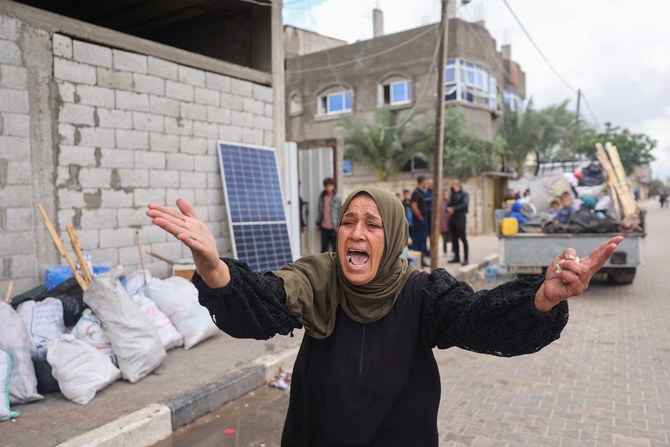
Israel’s army said on the social platform X that it would act with “extreme force” against militants. (AFP)
2 / 6
Displaced Palestinians, who fled their house due to Israeli strikes, shelter at a tent camp in Rafah in the southern Gaza Strip on May 5, 2024. (Reuters)
3 / 6
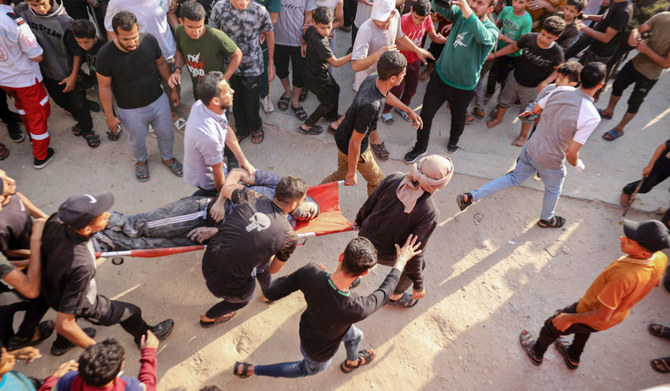
Palestinians transport an injured man pulled from the rubble of a house destroyed in an Israeli strike in the center of Rafah in the southern Gaza Strip on May 5, 2024, amid the ongoing conflict between Israel and the Palestinian Hamas movement. (AFP)
4 / 6
Palestinians transport an injured man pulled from the rubble of a house destroyed in an Israeli strike in the center of Rafah in the southern Gaza Strip on May 5, 2024, amid the ongoing conflict between Israel and the Palestinian Hamas movement. (AFP)
5 / 6
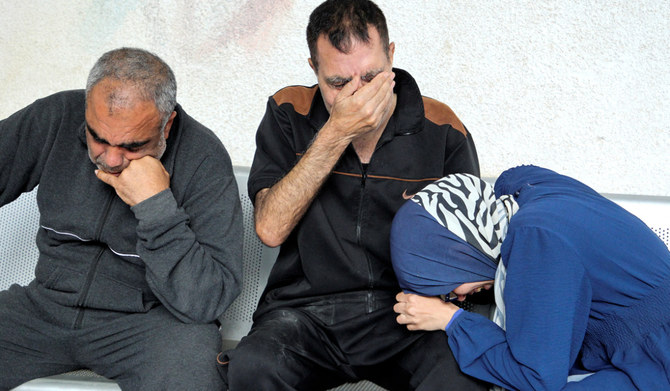
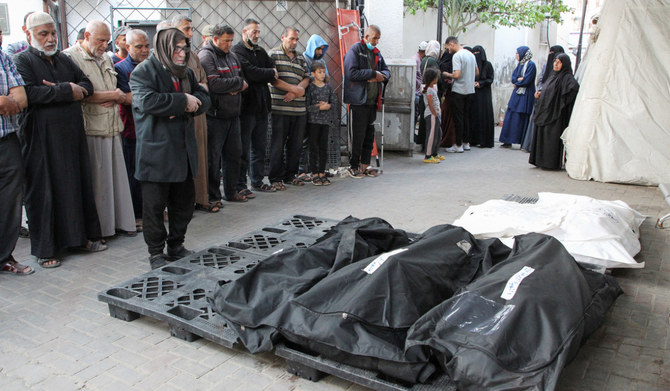
Mourners react near to the bodies of Palestinians killed in an Israeli strike, amid the ongoing conflict between Israel and the Palestinians, at Abu Yousef al-Najjar hospital in Rafah, in the southern Gaza Strip, May 5, 2024. (REUTERS)
6 / 6
Mourners react next to the bodies of Palestinians killed in an Israeli strike, amid the ongoing conflict between Israel and the Palestinians, at Abu Yousef al-Najjar hospital in Rafah, in the southern Gaza Strip, May 5, 2024. (REUTERS)
Short Url
Updated 06 May 2024
Follow

Israeli army tells Palestinians to evacuate parts of Gaza’s Rafah ahead of an expected assault

  • EU foreign affairs chief Josep Borrell condemn Israel’s evacuation order
  • Israeli leaders have repeatedly said the invasion is necessary to defeat Hamas

JERUSALEM: The Israeli army on Monday ordered tens of thousands of Palestinians in Gaza’s southern city of Rafah to start evacuating from the area, signaling that a long-promised ground invasion there could be imminent.
The announcement complicates last-ditch efforts by international mediators, including the director of the CIA, to broker a ceasefire. The militant Hamas group and Qatar, a key mediator, have warned that invading Rafah — along the border with Egypt — could derail the talks, and the United States has repeatedly urged Israel against the invasion.
However, Israel has described Rafah as the last significant Hamas stronghold after seven months of war, and its leaders have repeatedly said the invasion is necessary to defeat the Islamic militant group.
Lt. Col. Nadav Shoshani, an army spokesman, said some 100,000 people were being ordered to move to a nearby Israel-declared humanitarian zone called Muwasi. He said Israel was preparing a “limited scope operation” and would not say whether this was the beginning of a broader invasion of the city. But after Oct. 7 and the unprecedented attack on southern Israel by Hamas, Israel did not formally announce the launch of a ground invasion that continues to this day.

EU foreign affairs chief Josep Borrell on Monday condemned Israel’s order for Palestinians living in eastern Rafah to flee the Gazan city.
“Israel’s evacuation orders to civilians in Rafah portend the worst: more war and famine. It is unacceptable. Israel must renounce to a ground offensive,” Borrell said in a social media post.
Overnight, Defense Minister, Yoav Gallant, told US Secretary of Defense, Lloyd Austin that Israel had no choice but to act in Rafah. On Sunday, Hamas carried out a deadly rocket attack from the Rafah area that killed four Israeli soldiers.
Shoshani said Israel published a map of the evacuation area, and that orders were being issued through air-dropped leaflets, text messages and radio broadcasts. He said Israel has expanded humanitarian aid into Muwasi, including field hospitals, tents, food and water.
Israel’s army said on the social platform X that it would act with “extreme force” against militants, and urged the population to evacuate immediately for their safety.
Israel’s plan to invade Rafah has raised global alarm because of the potential for harm to more than a million Palestinian civilians sheltering there.
About 1.4 million Palestinians — more than half of Gaza’s population — are jammed into the city and its surroundings. Most of them fled their homes elsewhere in the territory to escape Israel’s onslaught and now face another wrenching move or the danger of staying under a new assault. They live in densely packed tent camps, overflowing UN shelters or crowded apartments, and are dependent on international aid for food, with sanitation systems and medical facilities infrastructure crippled.
The UN agency that has helped millions of Palestinians in Gaza and the West Bank for decades, known as UNRWA, warned Monday of devastating consequences of a Rafah offensive, including more civilian suffering and deaths. The agency said it would not leave but stay in Rafah as long as possible to continue providing lifesaving assistance.
Egypt’s Rafah crossing, a main transfer point for aid going into Gaza, lies in the evacuation zone. The crossing remained open on Monday after the Israeli order.
But even as the US, Egypt and Qatar have pushed for a ceasefire agreement, Israeli Prime Minister Benjamin Netanyahu repeated last week that the military would move on the city “with or without a deal” to achieve its goal of destroying the Hamas militant group.
On Monday, Netanyahu accused Hamas of “torpedoing” the hostage deal and not budging from its “extreme demands” while vowing to stop the militants from retaking control of Gaza. In a fiery speech Sunday evening marking the country’s annual Holocaust memorial day, he rejected international pressure to halt the war, saying that “if Israel is forced to stand alone, Israel will stand alone.”
A Hamas official told The Associated Press that Israel is trying to pressure the group into making concessions on the ceasefire, but that it won’t change its demands. Hamas wants a full end to the war, withdrawal of Israeli troops from Gaza and the eventual reconstruction of the strip in exchange for the Israeli hostages held by the militants.
Shoshani would not say whether the upcoming Rafah operation is a response to Sunday’s attack by Hamas that forced Israel’s key border crossing for aid to close. He said it would not affect how much aid enters Gaza as other crossing points remain operational.
He wouldn’t comment, however, on US warnings not to invade and wasn’t clear on whether Monday’s evacuation order was coordinated with Egypt.
Egypt, a strategic partner of Israel, has said that an Israeli military seizure of the Gaza-Egypt border — which is supposed to be demilitarized — or any move to push Palestinians into Egypt would threaten its four-decade-old peace treaty with Israel.
In Rafah, people received flyers Monday morning in Arabic detailing which neighborhood blocks needed to leave and where humanitarian zones had expanded to. The flyers said that aid services would spread from Deir al Balah in the north to the center of Khan Younis city in the middle of the Gaza Strip.
“Anyone found near (militant) organizations endangers themselves and their family members. For your safety, the (army) urges you to evacuate immediately to the expanded humanitarian area”, it read.
Palestinians in Rafah said people gathered to discuss their options after receiving the flyers. Most said they did not want to move alone and preferred to travel in groups.
“So many people here are displaced and now they have to move again, but no one will stay here it’s not safe,” Nidal Alzaanin told The Associated Press by phone.
A father of five, Alzaanin works for an international aid group and was displaced to Rafah from Beit Hanoun in the north at the start of the war. He said people are concerned since Israeli troops shot at Palestinians as they moved during previous evacuation orders.
Alzaanin said he has packed his documents and bags but will wait 24 hours to see what others do before relocating. He said he has a friend in Khan Younis whom he hopes can pitch a tent for his family.
But some people say they’re too tired and fed up of months of devastation to flee again.
Sahar Abu Nahel was displaced to Rafah with 20 of her family, her husband is being held by Israel, her son-in-law in missing, she said.
“Where am I going to go? I have no money or anything. I am seriously tired as are (my) children,” she said wiping tears from her cheeks. “Maybe its more honorable for us to die. We are being humiliated,” she said.


US Embassy resumes mechanism meetings ‘at full capacity’

US Embassy building in Awkar east of Beirut on June 23, 2025. (AFP)
Updated 11 sec ago
Follow

US Embassy resumes mechanism meetings ‘at full capacity’

  • Next meeting is scheduled for Feb. 25, settling debate in Lebanon over committee’s fate after postponement of January session
  • Beirut hopes resumption will allow US to press Israel for concessions in return for commitments to ceasefire security terms

BEIRUT: The US Embassy in Beirut said on Friday that the mechanism committee will meet on Feb. 25 to discuss next steps on Lebanon’s security.

The US-led five-member committee was established in the wake of the Israel-Hezbollah war in late 2024.

In a statement issued jointly with US Central Command, the embassy said that “the military coordination framework, as established in the cessation of hostilities agreement outlined on Nov. 27, 2024, remains fully in place and is operating at full capacity, with the same goals, participants and leadership.”

The embassy also listed upcoming meetings dates for March 25, April 22 and May 20, saying “these engagements will continue to serve as the primary forum for military coordination among the participating parties,” and adding that the mechanism will remain the key platform for such coordination.

A committee meeting had been tentatively scheduled for Feb. 18, but the participating parties did not receive official confirmation from the US.

A Lebanese official told Arab News that the Feb. 25 meeting would be limited to military personnel, with no civilian participation. “The US Embassy’s statement emphasized the participation of all parties, including the French side,” the source added.

The mechanism committee meetings constitute the only approved channel of communication for addressing military issues related to the cessation of hostilities between Lebanon and Israel.

The embassy’s announcement settled the debate in Lebanon over the committee’s fate after the postponement of a meeting scheduled for this month, amid Israeli pressure on Lebanon to convert civil negotiations into bilateral talks with US participation.

A Lebanese official closely following the work conducted by the mechanism committee previously told Arab News that there was “a structural crisis within the mechanism committee, specifically within the US delegation.”

The mechanism committee has held a series of meetings at the Ras Al-Naqoura border crossing. These meetings were described as technical and military in nature, and focused on establishing field communication mechanisms, addressing issues arising from violations, and ensuring continued coordination in line with the terms of the signed agreement. Civilian representatives from Lebanon and Israel were later added to the committee’s meetings.

At the beginning of December, Lebanon appointed former ambassador Simon Karam to head the Lebanese delegation to the Military Technical Committee for Lebanon. Karam attended meetings on two occasions, Dec. 3 and 19, during which he highlighted Lebanon’s demand that displaced residents be allowed to return to border villages as a prerequisite for discussing any economic buffer zone. A meeting scheduled for Jan. 14 was later postponed.

The Lebanese state hopes that the resumption of the mechanism’s meetings will enable the US to secure concessions from Israel in exchange for its commitment to the terms of the agreement to cease military operations, including the withdrawal from positions Israel still occupies inside Lebanese territory.

According to the official source, Lebanon is seeking through this request “to facilitate the next stages of the process of establishing the state monopoly on arms, particularly north of the Litani River.” The source said this followed the Lebanese army’s confiscation of illegal weapons south of the Litani, a step the US welcomed, while Hezbollah has refused to disarm north of the Litani line.

Another official source familiar with previous mechanism committee meetings said that “the Lebanese side stated that Israeli army violations on Lebanese territory provide Hezbollah with a justification to commit to its refusal to surrender its weapons.”

Lebanese army commander Gen. Rodolphe Haykal is scheduled to visit Washington next week, and will present to the Council of Ministers on Feb. 5 the next stages of the army’s plan to confine weapons between the Litani and Awali rivers.

According to the media office at the Presidential Palace, Lebanese President Joseph Aoun and Gen. Haykal reviewed on Friday the latest security developments in the south, amid repeated Israeli strikes and potential escalation risks along the border.

They also discussed Gen. Haykal’s meetings with US officials to “look into ways to support the army and coordinate on security issues at the border.”

Haykal also met Maj. Gen. Patrick Gauchat, head of mission and chief of staff of the UN Truce Supervision Organization at the command’s headquarters.

On Friday, an Israeli drone strike targeted a car in Seddiqin, Tyre, killing Mohammed Ahmad Youssef, the Lebanese Ministry of Health said.

Israeli army spokesman Avichay Adraee claimed that the strike was carried out in response to “Hezbollah violations,” accusing the party of “rebuilding itself.”

Israeli reconnaissance aircraft continued to fly over Beirut and its southern suburb throughout the day, in what Lebanon considered a violation of its airspace.

Meanwhile, the Lebanese army conducted armored patrols in the border town of Yaroun on Friday morning, after the Israeli army entered the town on Thursday night.