

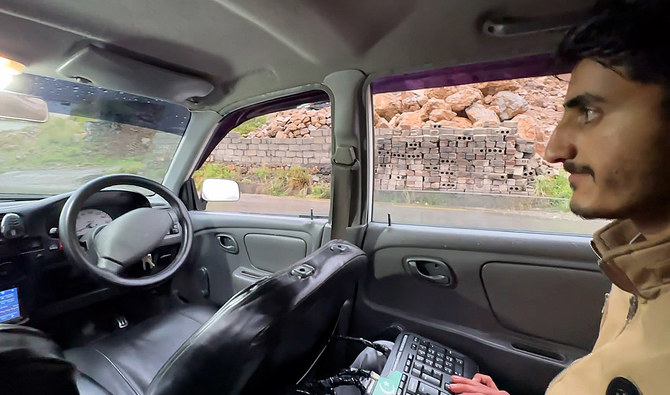

ABBOTTABAD: Under the harsh glow of a fluorescent light, 20-year-old Ehsan Zafar Abbasi is busy examining the components of an obsolete printer he has just dismantled. A pre-engineering student from the remote village of Bagh in Pakistan’s Abbottabad district, he is known for his passion for taking electronics apart, often leading to innovative but sometimes unsuccessful repairs.
Abbasi recently captured the attention of his neighborhood by configuring his family car to mimic a self-driven vehicle. With the driver’s seat empty and the headrest removed, onlookers were captivated by the sight of an automobile that seemed to be driving itself.
Speaking to Arab News earlier this week, the young student said he first thought of driving a car through a keyboard while playing video games as a child.
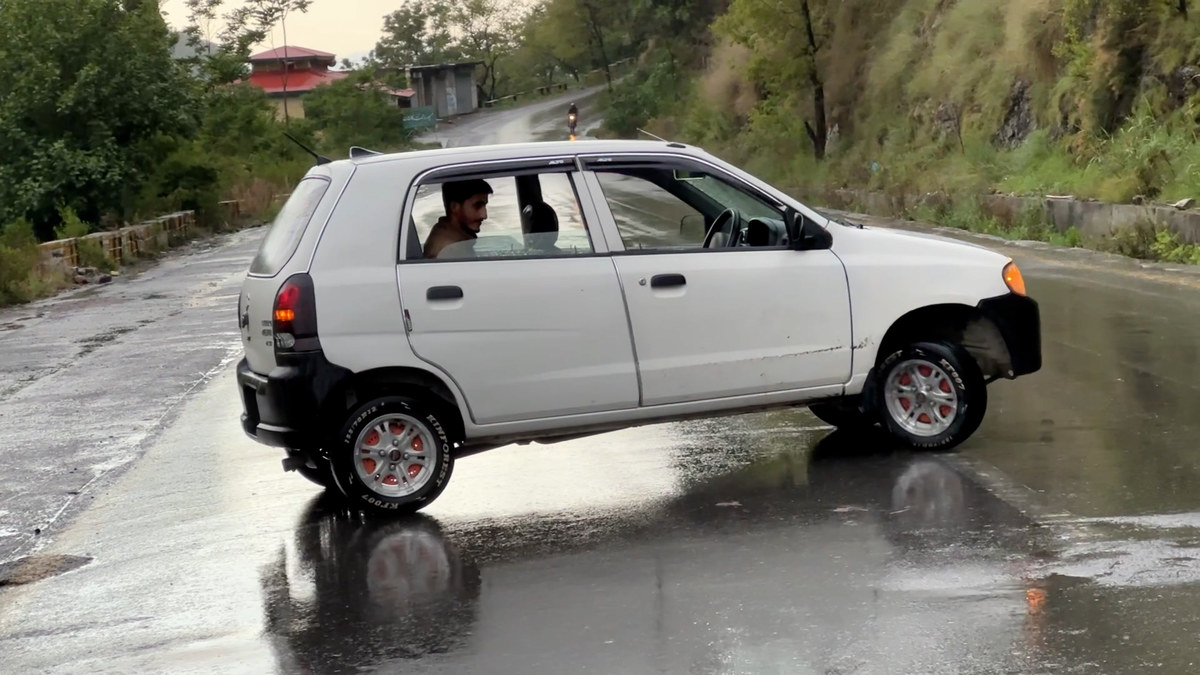
Ehsan Zafar Abbasi drives his car using a computer keyboard in Abbotabad, Pakistan on April 1, 2024. (AN Photo)
“At that time, power supply was hardly ever available,” he recalled. “So, whenever we got electricity, it was another kind of happiness. We would immediately sit in front of the computer and play those games on CDs such as GTA: Vice City or Need for Speed.”
“So, I was inspired after playing those games, realizing if a car could be driven through a keyboard in a game, it could also be driven like that in real life,” he continued.
With limited Internet accessibility in his village, Abbasi understood the workings of electronics and mechanical items by conducting his own experiments in a tiny room under the stairs in his house.
“I have built a lab where I perform my experiments,” he said. “My brothers and uncles support my ambitions. They bring me scrap electronics from the second-hand market. I have dismantled many mobile phones, tablets, printers, scanners, computers, projectors, juicer machines and other things.”
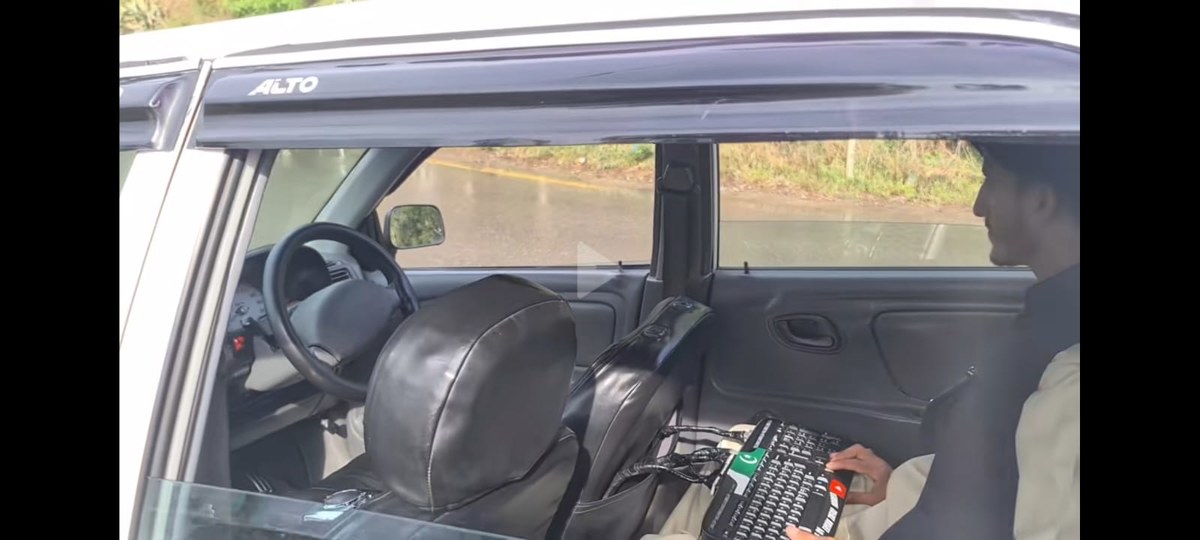
Ehsan Zafar Abbasi drives his car using a computer keyboard in Abbotabad, Pakistan on April 1, 2024. (AN Photo)
After spending over seven months perfecting his new project, Abbasi said he wanted to further refine the car by adding more features to it.
“I want to add sensors and modern technology to the car so that people with disabilities can also fulfill their wish [to drive] and become independent,” he added.
However, the keyboard-driven vehicle is not his only invention.
“A year ago, I made another device for cars in which cellphone technology was integrated,” he said. “It had a SIM. If someone decided to steal your car, you could simply make a call on the [installed] device and your car stopped working.”
The vehicle’s brakes, he explained, could be activated by using one’s cellphone. Not only that, but the installed device also relayed any conversation among the carjackers in real-time.
Asked about his future ambitions, Abbasi said he wanted to build a multinational automotive company like Tesla in Pakistan. He also shared his desire to go to a top-notch university abroad like the Massachusetts Institute of Technology in the United States.
“Obviously, I cannot afford it, nor do I possess adequate English-language skills,” he continued. “I studied in ill-equipped public schools where we did not have electricity, Internet and other modern facilities. We used to walk for two hours to go to school and two hours on our way back.”
By the time he reached home, he felt tired and usually discovered that there was no electricity.
“I could not study the way I wanted to,” he said with a deep yearning in his eyes. “I request the Pakistani government, our prime minister and the president, to support me in getting quality higher education so I can add to the prestige of my country.”


