

‘Substantial progress’ in Cairo talks on Gaza truce

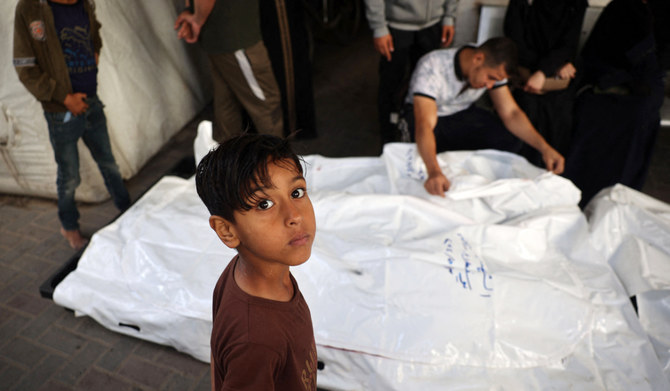
A young boy looks on as relatives of Palestinians killed in Israeli bombing, mourn near their corpses in the yard of the al-Najjar hospital in Rafah in the southern Gaza Strip on May 3, 2024, amid the ongoing conflict between Israel and the Hamas movement. (AFP)
Short Url
Updated 04 May 2024
Follow

‘Substantial progress’ in Cairo talks on Gaza truce

  • The second phase will last at least six weeks, with both sides agreeing to release a larger number of hostages and prisoners, and also committing to a longer halt to the fighting

CAIRO: Talks in Cairo involving a Hamas delegation and Egyptian mediators have made substantial progress toward achieving a ceasefire in Gaza, according to a high-ranking source.

The source, who preferred not to be named, told Cairo News Channel that Hamas representatives and an Egyptian security delegation have reached consensus on many contentious points.

Hours before the Hamas delegation’s arrival in Cairo on Saturday, Gen. Abbas Kamel, chief of Egypt’s General Intelligence Directorate, received a phone call from the movement’s leader, Ismail Haniyeh, concerning the negotiations.

Security and political expert Ahmed Mustafa told Arab News: “According to my information, Hamas has agreed to the first phase of the ceasefire deal in Gaza.

“This includes the release of a number of hostages, with the assurance that Israel will fully withdraw from Gaza after 124 days, upon completion of the three stages of the major agreement being coordinated here in Cairo.”

Mustafa also said the Hamas delegation in Cairo is expected to inform the Egyptian side of its agreement with only minor amendments.

“I believe that Hamas has agreed on some terms with the Egyptian mediators now, and previously with the Qatari mediators under American guarantees,” he said.

However, Mustafa said that Israel’s refusal to end the war in Gaza as part of any hostage deal and its determination to eliminate what remains of Hamas remain “major points of contention.”

According to Mustafa, another point of disagreement concerns allowing the entry of dual-use materials into the enclave, for example humanitarian supplies that could also be used for combat purposes, such as fuel.

He said that the first phase, which Hamas “has tentatively agreed upon, will last up to 40 days, during which up to 33 of more than 100 Israeli hostages held in Gaza since Oct. 7 will be released.”

The second phase will last at least six weeks, with both sides agreeing to release a larger number of hostages and prisoners, and also committing to a longer halt to the fighting.

Aboud Jamal, a researcher on Palestinian affairs, told Arab News: “Hamas announced on Friday evening that settlements had been reached, and a delegation from the movement would head to Cairo on Saturday to secure an agreement in a way that meets the demands of the Palestinians.”

Jamal added: “It is clear that the coming days will witness an agreement to cease fire along with the release of some Israeli hostages.

“The only remaining issue is the stance of the Israeli government, which seems to want to prolong the war to maintain (Benjamin) Netanyahu’s government following the recent protests against him in Israel.”

Jamal said the Israeli government stands to benefit by obstructing any agreement.

“So, by sending its delegation to Cairo and discussing its agreement to terms in the prospective deal through mediators, Hamas has preempted the Tel Aviv government, a move for which the movement’s leaders are to be commended.”

He added: “It appears that Egypt truly stands with the Palestinian people and is supportive of reaching an agreement that ensures a ceasefire to save what can be saved of the lives of Gaza’s residents.

“This was evident from the statement issued by Hamas before its security delegation headed to Cairo, stating that Hamas leader Ismail Haniyeh appreciates the role that Egypt is playing.”


Syria moves military reinforcements east of Aleppo after telling Kurds to withdraw

Updated 43 min 52 sec ago
Follow

Syria moves military reinforcements east of Aleppo after telling Kurds to withdraw

  • The United States, which for years has supported Kurdish fighters but also backs Syria’s new authorities, urged all parties to “avoid actions that could further escalate tensions” in a statement by the US military’s Central Command chief

ALEPPO: Syria’s army was moving reinforcements east of Aleppo city on Wednesday, a day after it told Kurdish forces to withdraw from the area following deadly clashes last week.
The deployment comes as Syria’s Islamist-led government seeks to extend its authority across the country, but progress has stalled on integrating the Kurds’ de facto autonomous administration and forces into the central government under a deal reached in March.
The United States, which for years has supported Kurdish fighters but also backs Syria’s new authorities, urged all parties to “avoid actions that could further escalate tensions” in a statement by the US military’s Central Command chief Admiral Brad Cooper.
On Tuesday, Syrian state television published an army statement with a map declaring a large area east of Aleppo city a “closed military zone” and said “all armed groups in this area must withdraw to east of the Euphrates” River.
The area, controlled by Kurdish forces, extends from near Deir Hafer, around 50 kilometers (30 miles) from Aleppo, to the Euphrates about 30 kilometers further east, as well as toward the south.
State news agency SANA published images on Wednesday showing military reinforcements en route from the coastal province of Latakia, while a military source on the ground, requesting anonymity, said reinforcements were arriving from both Latakia and the Damascus region.
Both sides reported limited skirmishes overnight.
An AFP correspondent on the outskirts of Deir Hafer reported hearing intermittent artillery shelling on Wednesday, which the military source said was due to government targeting of positions belonging to the US-backed, Kurdish-led Syrian Democratic Forces.

Declaration of war’

The SDF controls swathes of the country’s oil-rich north and northeast, much of which it captured during Syria’s civil war and the fight against the Daesh group.
On Monday, Syria accused the SDF of sending reinforcements to Deir Hafer and said it would send its own personnel there in response.
Kurdish forces on Tuesday denied any build-up of their personnel and accused the government of attacking the town, while state television said SDF sniper fire there killed one person.
Cooper urged “a durable diplomatic resolution through dialogue.”
Elham Ahmad, a senior official in the Kurdish administration, said that government forces were “preparing themselves for another attack.”
“The real intention is a full-scale attack” against Kurdish-held areas, she told an online press conference, accusing the government of having made a “declaration of war” and breaking the March agreement on integrating Kurdish forces.
Syria’s government took full control of Aleppo city over the weekend after capturing its Kurdish-majority Sheikh Maqsud and Ashrafiyeh neighborhoods and evacuating fighters there to Kurdish-controlled areas in the northeast.
Both sides traded blame over who started the violence last week that killed dozens of people and displaced tens of thousands.

PKK, Turkiye

On Tuesday in Qamishli, the main Kurdish city in the country’s northeast, thousands of people demonstrated against the Aleppo violence, with some burning pictures of Syrian President Ahmed Al-Sharaa, an AFP correspondent said, while shops were shut in a general strike.
Some protesters carried Kurdish flags and banners in support of the SDF.
“Leave, Jolani!” they shouted, referring to President Sharaa by his former nom de guerre, Abu Mohammed Al-Jolani.
“This government has not honored its commitments toward any Syrians,” said cafe owner Joudi Ali.
Other protesters burned portraits of Turkish Foreign Minister Hakan Fidan, whose country has lauded the Syrian government’s Aleppo operation “against terrorist organizations.”
Turkiye has long been hostile to the SDF, seeing it as an extension of the Kurdistan Workers’ Party (PKK) and a major threat along its southern border.
Last year, the PKK announced an end to its long-running armed struggle against the Turkish state and began destroying its weapons, but Ankara has insisted that the move include armed Kurdish groups in Syria.
On Tuesday, the PKK called the “attack on the Kurdish neighborhoods in Aleppo” an attempt to sabotage peace efforts between it and Ankara.
A day earlier, Ankara’s ruling party levelled the same accusation against Kurdish fighters.
The Britain-based Syrian Observatory for Human Rights reported 45 civilians and 60 soldiers and fighters from both sides killed in the Aleppo violence.
Aleppo civil defense official Faysal Mohammad said Tuesday that 50 bodies had been recovered from the Kurdish-majority neighborhoods after the fighting.