

Pakistan PM’s recent Saudi visit ‘most successful in decades’ — information minister

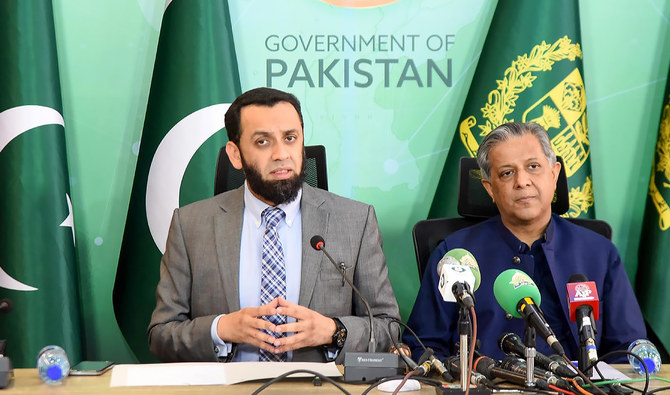
Pakistani Information Minister Attaullah Tarar addresses a press conference in Islamabad, Pakistan on May 2, 2024. (PID)
Short Url
Updated 02 May 2024
Follow

Pakistan PM’s recent Saudi visit ‘most successful in decades’ — information minister

  • Shehbaz Sharif was in Saudi Arabia from April 27-30 where he met crown prince, several top Saudi ministers
  • “High-powered” delegation of Saudi businessmen due in Pakistan in “few days” to discuss private sector investments 

ISLAMABAD: Pakistani Information Minister Attaullah Tarar said on Friday Prime Minister Shehbaz Sharif’s recent visit to Saudi Arabia was the most successful tour to the Kingdom in decades by a Pakistani leader, with the premier holding at least twelve meetings, including with the crown prince.

Sharif was in Riyadh from Apr. 27-30 to attend a special two-day meeting of the World Economic Forum on global collaboration, growth and energy. On the sidelines of the WEF conference, Sharif met and discussed bilateral investment and economic partnerships with Crown Prince Mohammed bin Salman and various top officials from the Kingdom. 

This was Sharif’s second meeting with the crown prince in a month. Before that he also met him when he last traveled to the Kindom on April 6-8.

“Such a successful tour of Saudi Arabia has not been seen in decades,” Tarar told a press briefing on Friday, speaking about Sharif’s recent trip to Riyadh for the WEF special meeting. “With Saudi ministers, the process of meetings went on for two days.”

Among those Sharif met were the Saudi ministers of finance, industries, investment, energy, climate and economy and planning, the adviser of the Saudi-Pakistan Supreme Coordination Council and the presidents of the Saudi central bank and Islamic Development Bank.

“PM had twelve meetings in two days which has not happened in history,” Tarar said. “And in the meetings every minister came and told us that it was the order of Crown Prince Mohammed bin Salman that they had to do efforts for Pakistan and cooperate with Pakistan and we have come to tell you we will do whatever we can for investments in Pakistan.”

Tarar said a “high-powered” delegation of Saudi business people and heads of major Saudi companies would be in Islamabad in the “next few days.” 

“Delegation is coming to islamabad and we have planned a big program for investment in the private sector,” the information minister added. 

Pakistan and Saudi Arabia enjoy strong trade, defense and cultural ties. The Kingdom is home to over 2.7 million Pakistani expatriates and serves as the top source of remittances to the cash-strapped South Asian country.

Both Pakistan and Saudi Arabia have been closely working to increase bilateral trade and investment deals in recent weeks, and the Kingdom recently reaffirmed its commitment to expedite an investment package worth $5 billion.

Cash-strapped Pakistan desperately needs to shore up its foreign reserves and signal to the International Monetary Fund (IMF) that it can continue to meet requirements for foreign financing which has been a key demand in previous bailout packages. 

Saudi Arabia has often come to Pakistan’s aid in the past, regularly providing it oil on deferred payments and offering direct financial support to help stabilize its economy and shore up forex reserves.


Pakistan rice exports slump 40% as India’s return hits pricing power

Updated 5 sec ago
Follow

Pakistan rice exports slump 40% as India’s return hits pricing power

  • Statistics show non-Basmati shipments have fallen over 50 percent in July-January period
  • Government offers 9 percent tax drawback on premium Basmati exports to support sector

ISLAMABAD: Pakistan’s rice exports fell 40.5 percent to $1.31 billion in the first seven months of the fiscal year, official data showed on Tuesday, as India’s return to the global market squeezed Islamabad’s market share and pricing power.

According to the Pakistan Bureau of Statistics (PBS), non-Basmati exports dropped 50.8 percent to $827.8 million, with volumes falling to 2.0 million tons from 3.15 million tons a year ago. Basmati exports declined 6.62 percent to $477.7 million, with volumes easing to 436,484 tons from 487,278 tons.

The Ministry of National Food Security told a parliamentary committee in two separate meetings in December and January that India’s re-entry into the global rice market was a key factor behind the decline, saying increased Indian supplies had made Pakistani rice less competitive.

Officials told lawmakers that India benefits from free trade agreements and provides substantial support to its rice sector, putting additional pressure on Pakistani exporters.

In response, the Ministry of Commerce last month issued a notification under the “Drawback of Local Taxes and Levies for Rice Order, 2026,” allowing a rebate of 9 percent of the free-on-board (FOB) value for Basmati exports priced above $750 per metric ton.

The government said the measure, announced on January 23, aims to ease liquidity pressures on exporters and improve competitiveness.

While PBS data for July-January shows a 40.5 percent decline, figures from the Federal Board of Revenue (FBR) for July-December show an even steeper 47 percent drop to $973 million from $1.82 billion in the same period last year, reflecting a deficit of over $800 million.

Industry representatives say they are now focusing on market diversification to counter the slowdown.

“Currently Basmati is mainly exported to Middle East and EU. Non-Basmati is exported to Philippines, Indonesia, Malaysia and African countries,” Malik Faisal Jahangir, chairman of the Pakistan Rice Exporters Association, told Arab News last week.

“For the new markets for our non-basmati rice exports, we are looking to increase our volumes to China, Philippines, Indonesia and Bangladesh,” he added.