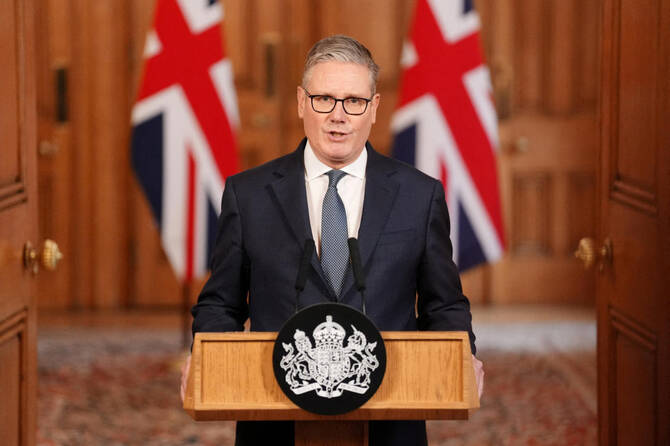
LONDON: Donald Trump said he was “very disappointed” with British Prime Minister Keir Starmer for not allowing the US to use the Diego Garcia air base to carry out strikes on Iran, the Daily Telegraph quoted the US president as saying in an interview.
Britain had reportedly initially denied the US permission to conduct air strikes from its bases, but on Sunday evening Starmer said he was accepting a request for their use in any “defensive” strikes the US wanted to make against Iranian targets.
In an interview published on Monday Trump told the British newspaper that it took “too long” for Starmer to change his mind.
“That’s probably never happened between our countries before,” he told the Telegraph, adding: “It sounds like he was worried about the legality.”
Trump said Starmer should have approved from the get-go the American use of Diego Garcia — a strategically important US-UK air base in the Indian Ocean — saying Iran was responsible for killing “a lot of people from your country.”
Britain was not involved in the joint US-Israel air strikes on Iran that killed the country’s Supreme Leader Ali Khamenei on Saturday.
Since attacks on Iran started on Saturday, Iran has been targeting Gulf countries with missiles, and on Sunday an Iranian-made drone hit Britain’s RAF Akrotiri base in Cyprus, causing limited damage and no casualties.
Trump said it was “useful” that the US would now be able to launch operations from Diego Garcia, as he also criticized a deal Starmer has made over the sovereignty of the Chagos Islands, where Diego Garcia is based.

Trump ‘very disappointed’ with UK’s Starmer for blocking use of air bases, Telegraph says
https://arab.news/gwas9
Trump ‘very disappointed’ with UK’s Starmer for blocking use of air bases, Telegraph says
- UK PM then said bases could be used in “defensive” operations
- Trump says it took “too long” for Starmer to change his mind
26 Doctors without Borders workers remain unaccounted for in South Sudan a month after attacks
- A hospital in the town of Lankien was bombed by government forces, MSF said
- “We have lost contact with them amid ongoing insecurity”
NAIROBI: More than two dozen Doctors Without Borders workers remain unaccounted for a month after attacks in South Sudan, the medical charity said.
Two facilities belonging to the group, known by French acronym MSF, were attacked on Feb. 3 in Jonglei State, northeast of the capital, Juba, where violence has displaced an estimated 280,000 people since December.
A hospital in the town of Lankien was bombed by government forces, MSF said, while another medical facility in the town of Pieri was raided by “unknown assailants.” Both were located in opposition-held areas.
Staff working at the two facilities fled alongside much of the local population into deeply rural areas where armed clashes and aerial bombardments were ongoing.
MSF said in a statement on Monday that “26 of 291 of our colleagues working in Lankien and Pieri remain unaccounted for.
“We have lost contact with them amid ongoing insecurity,” it said.
The lack of communication with its staff could be linked to the limited network connectivity in much of the state. Staff members who had been contacted described “destruction, violence and extreme hardships.”
Fighting escalated sharply in December, when opposition forces captured a string of government outposts in north central Jonglei. In January, the government responded with a counteroffensive that recaptured most of the area it had lost.
Displaced people in Akobo, an opposition-held town near the Ethiopian border, described horrific violence by government fighters. Many described not being able to find food or water as they walked for days to reach safety.
The attacks on MSF facilities in Lankien and Pieri are part of an uptick in violence on humanitarian staff, supplies and infrastructure, aid groups say. MSF facilities have been attacked 10 times in the last 12 months.
“This violence has taken an unbearable toll not only on health care services, but on the very people who kept them running,” said Yashovardhan, MSF head of mission in South Sudan, who only uses one name.
“Medical workers must never be targets,” he said. “We are deeply concerned about what has happened to our colleagues and the communities we serve.”


