

GCC countries can play pivotal role in Africa’s economic development, African stakeholders say

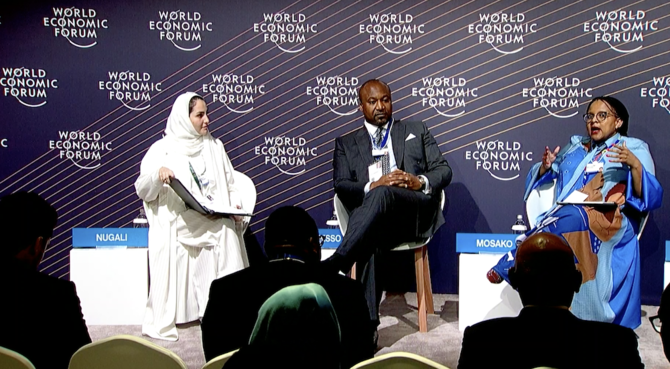
Member nations of the Gulf Cooperation Council can play a pivotal role in developing African economies, a special meeting of the World Economic Forum in Riyadh was told on Sunday. (Screenshot/WEF)
Short Url
Updated 28 April 2024
Follow

GCC countries can play pivotal role in Africa’s economic development, African stakeholders say

  • Economic relations between Africa and the GCC are set to grow significantly in the coming years

RIYADH: Member nations of the Gulf Cooperation Council can play a pivotal role in developing African economies, a special meeting of the World Economic Forum in Riyadh was told on Sunday.

Economic relations between Africa and the GCC are set to grow significantly in the coming years, economists have said, driven by mutual interests in economic diversification, investment and sustainable development.

Denis Christel Sassou Nguesso, the Republic of Congo’s international cooperation minister, said countries in central and western Africa had traditionally looked to Western powers, such as the US, France and the UK, for assistance with their development but were increasingly looking to forge links with GCC countries.

“It’s a good opportunity and position to start to work on this cooperation with (countries such as) Saudi Arabia, UAE, Qatar, Oman and Bahrain. They can help (African) countries to develop their economies and infrastructure projects,” he said.

“We’re not looking for an equal economy (with GCC states), but we’d like to build some bridges toward partnerships between our countries, to promote the public-private partnership.”

Boitumelo Mosako, CEO at the Development Bank of Southern Africa, told the panel that the GCC and African Union were founded on the same date, which coincides with Africa Day.

The GCC and the Organization of African Unity, which was replaced by the African Union, were both founded on May 25.

This was a symbol of the strong partnerships that had evolved between Africa and GCC countries, especially in direct trade, Mosako said.

“When it comes to infrastructure, that is where I see the greatest opportunity. As we all know, (Africa) is a continent with an infrastructure backlog, but we are one with aspirations of implementing an African free-trade agreement.”

But in order for this to be achieved, infrastructure projects had to be built quickly, which would not only benefit African economies but also global partners as Africa’s exports to those countries would be able to increase exponentially, Mosako said.

Highlighting opportunities in energy investment from GCC countries, she added: “We have seen this in South Africa, where GCC companies have partnered local entities as part of a renewable energy program, so it’s not something far-fetched, it’s actually happening. It’s an opportunity to close the energy gap for the continent.”

Ousmane Dione, vice president for the Middle East and North Africa at the World Bank, said that at its shortest distance, there were only 26 km between Africa and the GCC, but there was a much bigger metaphorical gap in investment from the GCC states into Africa, which he called a “land of opportunity.”

He said that by 2035, there would be 430 million young Africans coming into the labor market competing for just 100 million jobs if current policies remained in place.

This could either be a “demographic liability or a demographic dividend” depending on how other countries viewed it, he said.

“I see the GCC countries really being a part of what will be the future of that relationship, in terms of a partnership.”


IMF approves reviews, unlocks $240m in funding for Jordan

Updated 11 sec ago
Follow

IMF approves reviews, unlocks $240m in funding for Jordan

  • The decision allows Jordan to draw about $130 million under the EFF and about $110 million under the RSF

AMMAN: The International Monetary Fund’s executive board has completed the fourth review of Jordan’s Extended Fund Facility and the first review under the Resilience and Sustainability Facility, unlocking immediate access to about $240 million to support the Kingdom’s economic program.

The decision allows Jordan to draw about $130 million under the EFF and about $110 million under the RSF, bringing total disbursements under the IMF arrangement to about $733 million.

In a statement issued on Saturday, the IMF said Jordan’s economy “remains resilient,” supported by sound macroeconomic policies and strong international backing.

Growth accelerated to 2.7 percent in the first half of 2025 and is expected to reach about 3 percent in the coming years, driven by major investment projects, deeper regional integration and continued structural reforms.

Inflation remains anchored at about 2 percent, while the current account deficit is projected to narrow to below 5 percent of GDP over the medium term. The IMF also noted that Jordan’s banking sector is stable and international reserves remain strong.

Fiscal performance continues to align with program targets, underpinned by robust revenue collection and disciplined current spending. The authorities remain committed to reducing public debt to 80 percent of GDP by 2028 through gradual fiscal consolidation, while protecting social and development spending and reducing losses at public utilities.

The IMF said progress under the RSF is ongoing, with reforms addressing vulnerabilities in the water and electricity sectors and strengthening health emergency preparedness. All reform measures scheduled for the current review have been completed.

Commenting after the board discussion, IMF Deputy Managing Director Kenji Okamura said Jordan’s continued macroeconomic stability amid persistent external headwinds reflects the authorities’ commitment to sound policies, supported by strong international assistance.

He said growth continues to recover, inflation remains low and reserve buffers are strong, stressing the importance of maintaining prudent fiscal and monetary policies amid regional tensions and global uncertainty.

Okamura added that accelerated structural reforms are essential to foster job-rich growth, improve the business environment, enhance labour market flexibility, tackle youth unemployment and low female labour force participation, and attract private investment.

He also underlined the importance of sustained donor support to help Jordan manage external challenges and the economic cost of hosting large numbers of refugees, while noting that progress under the RSF would help address long-term vulnerabilities and strengthen balance-of-payments stability.