Eight years since its launch, Saudi Vision 2030 is already well ahead of schedule

Vision 2030 is built upon three pillars: Building a vibrant society, a thriving economy, and an ambitious nation, rolled out in phases. (AFP)
Short Url
Updated 25 April 2024
Follow

Eight years since its launch, Saudi Vision 2030 is already well ahead of schedule

  • Launching Vision 2030 in 2016, Crown Prince Mohammed bin Salman vowed to improve the Kingdom’s business environment
  • Today, the economy is creating employment opportunities for citizens and long-term prosperity for the nation

RIYADH: Saudi Arabia’s transformation has involved many authors: The government, Saudi citizens, the private sector, and international partners. Their combined efforts have meant that by 2023 — the Vision 2030 midpoint — the plan was already ahead of schedule.

Eight years since its launch, the social reform and economic diversification blueprint’s promise is quickly being realized, with 87 percent of its 1,064 initiatives deemed completed or on track.

At its core, Vision 2030 is built upon three pillars: Building “a vibrant society,” “a thriving economy,” and “an ambitious nation,” rolled out with a phased approach, allowing the Kingdom to adapt, evolve, and become more agile.

As Saudi Arabia approaches the end of phase two — and the start of the 2025 implementation phase — the economic strategy, which was not without its doubters early on, is no longer a mere idea but a genuine transformation.
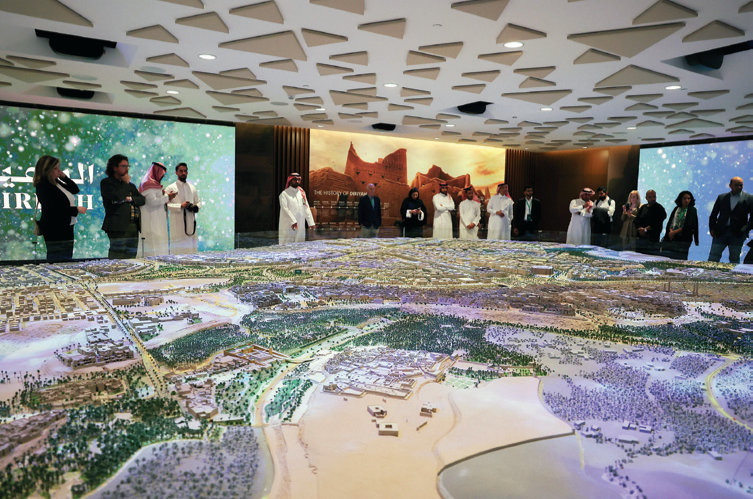


Eight years since the Kingdom's social reform and economic diversification blueprint was launched, 87 percent of the 1,064 initiatives are deemed completed or on track. (Getty Imaes/AFP)

By the end of 2023, some 197 of Vision 2030’s 243 key performance indicators had been fully achieved. Of those, 176 exceeded their targets.

A similar trend is evident across various socio-economic domains, prompting the nation to reconsider and set higher ambitions and targets for 2030. 

A technicolor economy

Launching the economic diversification plan in 2016, Crown Prince Mohammed bin Salman vowed to improve the Kingdom’s business environment, allowing the economy to flourish and drive employment opportunities for citizens and long-term prosperity for the nation.

From increasing foreign direct investments, growing the number of small and medium-sized enterprises and opening up new streams in fields like tourism and entertainment, the nation documented a record contribution from non-oil earnings.

Opinion

This section contains relevant reference points, placed in (Opinion field)

By the end of 2023, revenues surpassed $121.8 billion and contributed 50 percent to the real gross domestic product.

The Kingdom’s non-oil GDP amounted to over $503.6 billion, soaring past the baseline of over $404.9 billion and edging close to the target goal of $515.6 billion.

This comes as Saudi Arabia has implemented a series of economic and regulatory undertakings to stimulate private sector growth and attract foreign investment. These reforms include easing restrictions on foreign ownership in various sectors, streamlining business regulations and privatizing state-owned enterprises.

These ongoing shifts and Riyadh’s strategic location at the crossroads of three continents made it a valuable investment destination for global businesses. In 2023, more than 180 companies obtained permits to open regional offices in the Saudi capital.
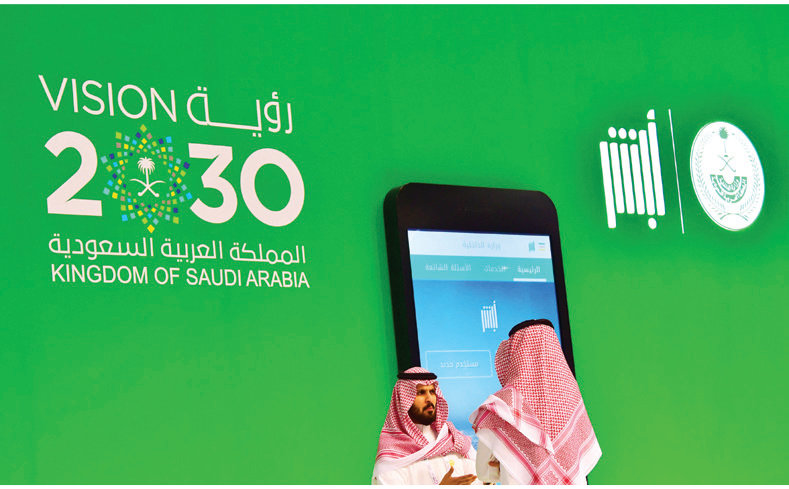


Saudi Arabia's economic diversification plan has allowed the economy to flourish and drive employment opportunities for citizens. (Supplied) 

Concurrently, the private sector’s contribution to the total GDP amounted to 45 percent, marking a notable increase from the baseline of 40.3 percent and moving closer to the Vision’s target of 65 percent.

Echoing this notion, foreign direct investment showed notable growth, contributing 2.4 percent to the country’s GDP. 

The Kingdom’s sovereign wealth entity, the Public Investment Fund, had assets under management of over $749 billion in 2023, surpassing the annual target of approximately $720 billion. 

These successes prompted the Kingdom to rank first in the Middle East and North Africa region for venture capital investment in 2023, capturing 52 percent of the total capital deployed in the area with a value of $1.4 billion.

Furthermore, the economic participation and opportunities sub-index has increased to 0.637 from the baseline of 0.33, surpassing the annual target of 0.592.

An equitable workforce

Saudi Arabia achieved its lowest unemployment rate of 7.7 percent in 2023, compared to 12.3 percent in 2016, surpassing the 2023 target of 8 percent and nearing the Vision 2030 mark of 7 percent.

Yet, the nation’s most notable employment achievement remains characterized by a previously unsung section of its labor force, with female participation now standing at an all-time high of 35.5 percent, surpassing the 2030 goal.

Saudi Arabia has seen a growing number of women taking on leadership roles in various sectors, including government, business, academia, and media.

This success was further attributed to a government that has actively worked to expand job opportunities for women across a wide range of sectors, including healthcare, education, and finance as well as technology and hospitality.

Furthermore, Vision 2030 encourages female entrepreneurship and the growth of small businesses owned and operated by women. Initiatives such as loan programs, business incubators, and networking events provide support and resources for aspiring female entrepreneurs to start and grow their businesses.

This led the nation to announce that it will be amending its previously highlighted Vision 2030 target for female participation.

SME boom

Small and medium enterprises, which are positioned to become a vital part of economic development in the Kingdom and an enabler to achieving Saudi Arabia’s Vision 2030, have recorded over 200 percent growth since the launch of the national plan.

This growth encapsulated SR10 billion ($2.67 billion) in financial aid for SMEs and 6.7 million employees in the sector by the end of 2023. 

In 2022, the Small and Medium Enterprises Bank was established by the Council of Ministers as one of several development funds and financial institutions affiliated with the National Development Fund. 

The SME Bank aims to increase financing provided to the sector and enhance institutions’ contributions to providing innovative funding solutions that help achieve stability for this sector.

Therefore, the Vision’s initiatives have further supported several programs, centers, and services provided by the Small and Medium Enterprises General Authority, also known as Monsha’at.

Among them is the “Tomoh” program, a community for fast-growing SMEs, aiming to stimulate their growth through services and programs. Tomoh contributed to listing 18 enterprises in the Saudi Stock Exchange parallel market “Nomu.”


GCC firms set for steady growth in 2026 on demand, lower rates, Moody’s says 

Updated 05 December 2025
Follow

GCC firms set for steady growth in 2026 on demand, lower rates, Moody’s says 

RIYADH: Companies in the Gulf Cooperation Council are poised to extend their growth momentum into 2026 as strong demand, easing interest rates and supportive government policies bolster operating conditions, according to a new report. 

In its latest report, Moody’s Ratings said ongoing investments in infrastructure and the rising number of technology-based projects are also key factors that will support the growth of non-financial companies operating in the region. 

The findings reinforce the progress of economic diversification efforts undertaken by GCC member states, including Saudi Arabia, aimed at strengthening non-oil sectors and reducing reliance on crude revenues. 

“GCC companies are expected to benefit from strong demand, declining interest rates, supportive economic policies, and ongoing investments in infrastructure and technology,” said Moody’s.

Sectoral breakdown

Telecom companies in the GCC are set to benefit from non-oil growth and regional governments’ ambitions for digitalization and modern technologies. 

Citing an example, stc, one of the region’s biggest telecom operators, reported a net profit of SR11.58 billion ($3.08 billion) in the first nine months of this year, reflecting a 3.1 percent rise compared to the same period in 2024. 

Moody’s added that real estate developers in the region are expected to see a stable operating environment in the near term, underpinned by strong demand fundamentals, such as population growth and smaller household sizes. 

“However, we expect a moderate price correction to begin in 2026, driven by an increase in housing supply,” said the credit rating agency.  

Companies operating in the utilities sector are expected to maintain strong market positions and benefit from stable and transparent regulatory frameworks.  

However, for some firms, the large capital investment requirements needed to support power and infrastructure upgrades, particularly in renewables, are weakening credit metrics and liquidity. 

The report further noted that GCC national oil companies are supported by low-cost production, robust balance sheets, and long-term strategies that help them withstand periods of low oil prices. 

In November, energy giant Saudi Aramco reported a third-quarter 2025 adjusted net income of $28 billion, up slightly from $27.7 billion a year earlier, as strong operating momentum and progress on key projects underpinned performance. 

Cash flow from operating activities rose to $36.1 billion from $35.2 billion in the same period last year, while free cash flow increased to $23.6 billion from $22 billion. 

Turning to the wider sub-Saharan African region, Moody’s said the growth of non-financial corporates is underpinned by ongoing macroeconomic recovery and structural reforms, despite persistent challenges and the direct and indirect effects of US tariffs. 

This supports the operating environment for telecommunications, as well as real estate and construction-related industries. 

Growth in EMEA region 

The outlook for credit conditions for non-financial companies in Europe, the Middle East and Africa for 2026 is stable.  

“We expect growth to pick up modestly, and financial conditions have eased. While uncertainty about trade policy persists, EMEA companies have so far only felt limited effects from US tariffs,” said Moody’s.

Among the major factors expected to influence credit conditions in 2026 — particularly for non-financial companies — are political polarization and digital disruption, including advancements in artificial intelligence. 

In terms of digital disruption, Europe has strong technical capabilities but faces a more fragmented venture capital market than the US and weaker scaling potential for AI firms. 

The report said the sectors that will benefit most from AI include technology suppliers and data-driven industries such as healthcare and automotive, which will gain from enhanced analytics, predictive modeling, and decision support. 

Key beneficiaries across the technology value chain include manufacturers of electrical components and systems used in data centers, such as Schneider Electric SE, Siemens Aktiengesellschaft, and ABB Ltd. 

Moody’s further said that deteriorating security conditions in Europe — driven by the ongoing war in Ukraine and reduced US engagement in NATO — will lead to higher government defense spending, which will positively affect defense and related manufacturing industries. 

US tariffs on branded drug imports will slightly pressure cash flows and add complexity for European branded pharmaceutical companies, but strong margins will limit credit risk.  

Some companies have been negotiating tariff exemptions in exchange for US investments and price concessions for Medicaid patients and direct-to-consumer sales, both of which have minimal earnings impact. 

Regarding GDP growth, Moody’s said the eurozone economy is expected to expand by 1.3 percent in 2026, compared to 1.1 percent in 2025. 

“In Europe, political uncertainty is likely to continue to weigh on consumer sentiment and saving rates are still high because households remain cautious. Still, we expect retail sales and household spending to gradually recover as inflation eases and unemployment rates stay low,” said the report.  

It added: “Monetary policy has eased as inflation has come under control, with the ECB cutting rates to 2 percent, lowering refinancing costs for euro-denominated debt. Credit market conditions have improved and companies have recently benefited from good access to capital markets.”  

Saudi Arabia’s rapid growth 

Saudi Arabia is among the EMEA economies expected to see rapid growth in the near term, with real GDP projected to expand by 4 percent in 2025 and further accelerate to 4.5 percent in 2026. 

In November, Moody’s said in a separate report that Saudi Arabia’s economy is set to maintain solid growth in the coming years, driven by strong non-oil performance and the unwinding of OPEC+ production cuts. 

The credit assessor, which rates Saudi Arabia at Aa3, said the grade reflects a large, wealthy economy supported by sizeable hydrocarbon reserves and a strong government balance sheet. 

The outlook builds on earlier analysis published in October, when Moody’s highlighted steady progress in the Kingdom’s diversification agenda under Vision 2030. 

The agency said at the time that Saudi Arabia is on track to sustain annual non-oil growth of 4.5 to 5.5 percent over the next five to 10 years, as major projects advance and private consumption remains firm. 

Last month, another report by the Institute of Chartered Accountants in England and Wales echoed similar views, stating that Saudi Arabia’s economy is projected to expand by 4.5 percent in 2025, 4.3 percent in 2026, and 4.5 percent in 2027.