

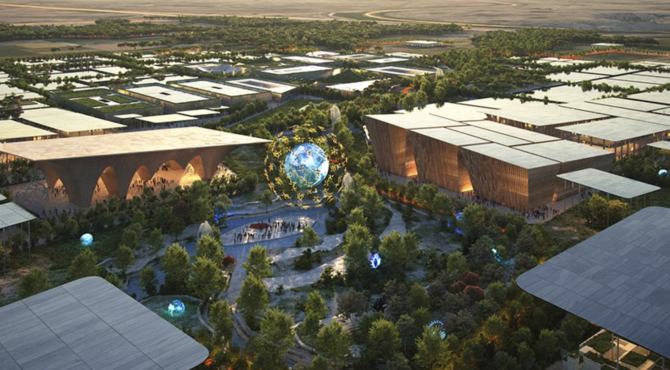

JEDDAH/RIYADH: Saudi Arabia is bidding to host World Expo 2030 in Riyadh to highlight both its vast potential to the world and the tangible progress it has accomplished with its wide-ranging Vision 2030 economic and social reforms.
“During the eight years since the announcement of Saudi Vision 2030, the Kingdom has witnessed changes and developments that surpass what has been accomplished in the past 80 years of its history, and Riyadh is a part of this success story,” Princess Reema bint Bandar, the Saudi ambassador to the US, said recently.
She was speaking in Paris in June during the 172nd General Assembly of the Bureau International des Expositions, or BIE, the intergovernmental organization that selects host nations for World Expo.
If the BIE chooses Riyadh to host the event in 2030, the Saudi capital will feature pavilions from 246 countries and welcome about 40 million visitors, who will see for themselves the realization of Vision 2030.
Riyadh is competing with Busan, in South Korea, and Rome to host this prestigious event.
“Our vision is a strong, thriving, and stable Saudi Arabia that provides opportunity for all,” Saudi Crown Prince Mohammed bin Salman said in the Vision 2030 leadership message.
He added: “Our vision is a tolerant country with Islam as its constitution and moderation as its method. We will welcome qualified individuals from all over the world. and will respect those who have come to join our journey and our success.”
Vision 2030 seeks to utilize every valuable asset Saudi Arabia has in order to diversify its economy and invest in its people by creating a more sustainable and equitable future, new employment opportunities, and harnessing the potential of young Saudis.
These goals influence every aspect of the Kingdom’s development, from environmental sustainability to economic diversification.
In addition, Vision 2030 also includes dozens of megaprojects and giga-projects spread across the Kingdom, as well as hundreds of initiatives, programs and reforms. These aim to drive the growth of domestic industries and attract investment.
The reform program’s rapid progress demonstrates Riyadh’s commitment to development, achieving prosperity, and ensuring inclusivity for all citizens.
As a testament to Saudi Arabia’s growth and path to prosperity, the International Monetary Fund recently named the Kingdom the fastest-growing economy among the G20 countries, with an overall growth rate of 8.7 percent.
Vision 2030 was launched in 2016 by the crown prince, who devised it as a broad framework for developing his country by establishing a diversified and sustainable economy and a new and vibrant society.
The Kingdom created the Vision Realization Programs to make this agenda a reality. VRP covers the development of programs pertaining to quality of life, housing, fiscal sustainability, health, human capital, and the experience of Muslims performing Hajj.
Saudi Arabia continues to demonstrate its commitment to transforming society by implementing these programs.
Hosting an international event of Expo 2030’s magnitude requires significant infrastructure. Saudi Arabia’s eagerness to win the bid has played a pivotal role in accelerating the implementation of Vision 2030’s goals.
The Kingdom has already allocated a budget of $7.8 billion to investments for Riyadh in anticipation of the expo. More broadly, Vision 2030 aims to reach $3.3 trillion in national-level investments by the end of this decade.
Riyadh Expo 2030 also presents a golden opportunity to attract foreign investment, contributing to the economic diversification goal of Vision 2030.
These reforms have been progressively introduced since the initial announcement of the Vision in 2016, beginning with modest changes that have since evolved into substantial and far-reaching transformative reforms.
A significant turning point occurred on Oct. 24, 2017, when the crown prince delivered a groundbreaking speech at the Future Investment Forum, where he unveiled NEOM, a colossal $500-billion megacity project, and underlined the Kingdom’s commitment to “modern Islam.”
Less than a year later, on Apr. 18, 2018, the Kingdom lifted its longstanding ban on movie theaters, marking a crucial first step toward restructuring its cultural landscape. Mere months later, on June 24, 2018, Riyadh went one step further and lifted the decades-old prohibition on women driving.
The latter move proved a milestone in its journey toward societal progress and proof of the Kingdom’s willingness to enact hitherto unimaginable changes.
While some may view these reforms as long overdue, they are monumental for Saudi Arabia, and set the stage for the momentous change Vision 2030 envisages, fundamentally transforming the Kingdom’s society and economy.
For decades, Saudi Arabia welcomed precious few tourists besides pilgrims. Its economy was also far from diversified or dynamic, relying almost solely on the revenue generated from oil exports. All this has begun to change rapidly in just a few short years.
Today, the Kingdom hopes to draw millions of visitors from around the world to expand its growing tourism sector, which has seen record growth since the start of this decade, while fulfilling Vision 2030’s objective of creating more employment opportunities for Saudi citizens.
Central to Vision 2030, this initiative has provided the world with a unique opportunity to explore a land that was once shrouded in mystery.
Aside from catering to tourists seeking leisure in its many luxury resorts, Saudi Arabia has also shone a spotlight on its cultural and historical heritage sites, which were previously difficult for foreign tourists or even archaeologists to access.
On Feb. 10, 2019, the Kingdom took a momentous step by unveiling the ancient oasis of AlUla, inviting tourists to experience its rich history and cultural heritage firsthand.
Riyadh Expo 2030 would act as a platform for Saudi Arabia to share its history, traditions, and cultural diversity with the world, promoting cross-cultural understanding and supporting Vision 2030’s cultural preservation goals.
The Kingdom promises the expo will become the “first environmentally friendly exhibition that achieves zero” carbon emissions, Riyadh Expo 2030 team member Nouf Bint Majid Al-Muneef said in a speech delivered to BIE.
The goal to host a zero-carbon emission expo also aligns with Vision 2030’s commitment to clean energy and sustainability. Furthermore, Saudi Arabia aims to derive 50 percent of its energy from renewable sources by 2030.
BIE member states will choose the host country for World Expo 2030 at their 173rd General Assembly scheduled for November this year.
If Saudi Arabia wins, it will seize the opportunity to showcase its technological advancements, and the sweeping cultural and societal changes that Vision 2030 has accomplished in less than a decade.


