

Bangladesh, Qatar sign 10 cooperation deals during emir’s first Dhaka trip

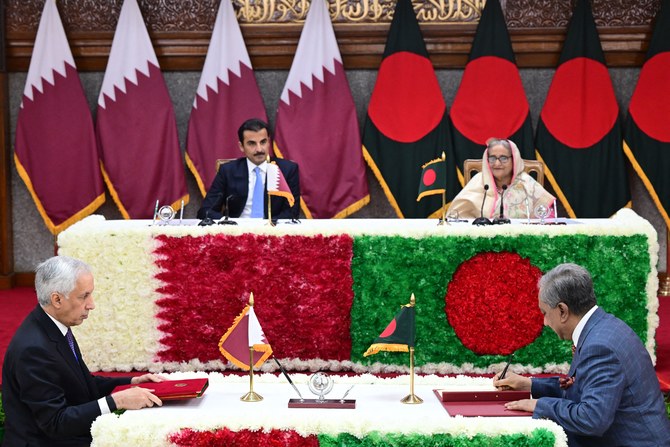
Emir of Qatar Sheikh Tamim bin Hamad al-Thani, left, and Bangladesh’s Prime Minister Sheikh Hasina attend the bilateral agreement signing ceremony in Dhaka. (AFP)
Short Url
Updated 23 April 2024
Follow

Bangladesh, Qatar sign 10 cooperation deals during emir’s first Dhaka trip

  • Agreements cover investment, maritime transport and establishment of joint business council
  • Bangladeshi president invited Qatar’s emir to invest in the country’s special economic zones

DHAKA: Bangladesh and Qatar signed 10 cooperation agreements on Tuesday as the Gulf state’s Emir Sheikh Tamim bin Hamad Al-Thani made his first official visit to Dhaka.

Prime Minister Sheikh Hasina and Sheikh Tamim witnessed the signing ceremony, which covered deals on investment, maritime transport, taxation, legal affairs and the establishment of a Bangladesh-Qatar joint business council.

The two countries also signed several memoranda of understanding, including on diplomatic training, education, labor, youth and sports, as well as port management cooperation.

Sheikh Tamim then held a meeting with President Mohammed Shahabuddin as part of his visit to Bangladesh, which is the second stop in the emir’s Asia tour that began in the Philippines on Sunday.

During their talks, Shahabuddin invited Qatar to invest in Bangladesh’s special economic zones.

“Bangladesh will welcome investments in various sectors including in state-led food supply chains from production to consumption such as agro-production and processing, food packaging, smart agriculture and fertilizer production,” Shahabuddin’s press secretary Joynal Abedin told reporters after the meeting.

“Qatar investors can get massive incentives and support in sectors like petrochemicals, energy, machineries, information technology, electronics, ceramics, agri-business, and food processing in Bangladesh.”

Shahabuddin also urged Sheikh Tamim to recruit more skilled workers from Bangladesh during their talks, Abedin said.  

Qatar is currently the largest supplier of liquefied natural gas to Bangladesh. Earlier this year, the emirate signed a 15-year agreement with the US-based Excelerate Energy to supply 1 million metric tons per year of LNG to Bangladesh starting from January 2026.

The Gulf state is also home to about 400,000 Bangladeshis who live and work there, as it is one of the preferred destinations for migrant workers from the South Asian country.


UN’s top court opens Myanmar Rohingya genocide case

Updated 14 min 8 sec ago
Follow

UN’s top court opens Myanmar Rohingya genocide case

  • The Gambia filed a case against Myanmar at the UN’s top court in 2019
  • Verdict expected to impact Israel’s genocide case over war on Gaza

DHAKA: The International Court of Justice on Monday opened a landmark case accusing Myanmar of genocide against its mostly Muslim Rohingya minority.

The Gambia filed a case against Myanmar at the UN’s top court in 2019, two years after a military offensive forced hundreds of thousands of Rohingya from their homes into neighboring Bangladesh.

The hearings will last three weeks and conclude on Jan. 29.

“The ICJ must secure justice for the persecuted Rohingya. This process should not take much longer, as we all know that justice delayed is justice denied,” said Asma Begum, who has been living in the Kutupalong refugee camp in Bangladesh’s Cox’s Bazar district since 2017.

A mostly Muslim ethnic minority, the Rohingya have lived for centuries in Myanmar’s western Rakhine state but were stripped of their citizenship in the 1980s and have faced systemic persecution ever since.

In 2017 alone, some 750,000 of them fled military atrocities and crossed to Bangladesh, in what the UN has called a textbook case of ethnic cleansing by Myanmar.

Today, about 1.3 million Rohingya shelter in 33 camps in Cox’s Bazar, turning the coastal district into the world’s largest refugee settlement.

“We experienced horrific acts such as arson, killings and rape in 2017, and fled to Bangladesh,” Begum told Arab News.

“I believe the ICJ verdict will pave the way for our repatriation to our homeland. The world should not forget us.”

A UN fact-finding mission has concluded that the Myanmar 2017 offensive included “genocidal acts” — an accusation rejected by Myanmar, which said it was a “clearance operation” against militants.

Now, there is hope for justice and a new future for those who have been displaced for years.

“We also have the right to live with dignity. I want to return to my homeland and live the rest of my life in my ancestral land. My children will reconnect with their roots and be able to build their own future,” said Syed Ahmed, who fled Myanmar in 2017 and has since been raising his four children in the Kutupalong camp.

“Despite the delay, I am optimistic that the perpetrators will be held accountable through the ICJ verdict. It will set a strong precedent for the world.”

The Myanmar trial is the first genocide case in more than a decade to be taken up by the ICJ. The outcome will also impact the genocide case that Israel is facing over its war on Gaza.

“The momentum of this case at the ICJ will send a strong message to all those (places) around the world where crimes against humanity have been committed,” Nur Khan, a Bangladeshi lawyer and human rights activist, told Arab News.

“The ICJ will play a significant role in ensuring justice regarding accusations of genocide in other parts of the world, such as the genocide and crimes against humanity committed by Israel against the people of Gaza.”