

Hezbollah drones target northern Acre in response to Israeli strikes on Lebanese group

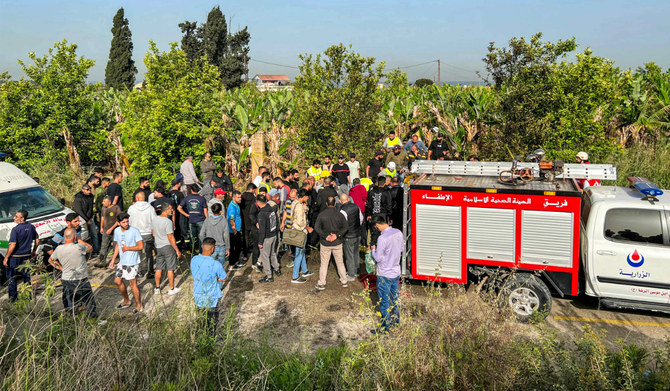
People gather at the site of an Israeli strike on a vehicle in the Adloun plain area, between Lebanon's southern cities of Sidon and Tyre, on April 23, 2024. (AFP)
Short Url
Updated 23 April 2024
Follow

Hezbollah drones target northern Acre in response to Israeli strikes on Lebanese group

  • Israeli media reported that “those present on the beach were evacuated after a Hezbollah drone was intercepted in the skies over Nahariyya and Acre”
  • Israeli army had said it killed “two significant terrorists in Hezbollah’s aerial unit”

BEIRUT: Hezbollah forces in south Lebanon on Tuesday launched a combined aerial attack with diversionary and assault drones on Israeli military targets.

The focus of the Lebanese group’s attack was the headquarters of the Golani Brigade at the Shraga barracks, north of the city of Acre.

The attack was described as “a new qualitative strike against an Israeli site,” using drones said to be able to bypass Israeli radar and avoid Iron Dome missiles.

A security source told Arab News that the attack was “a sensitive targeting.” The area struck is more than 15 km from the border with Lebanon.

“This targeting took place in broad daylight while the Israelis were celebrating the Jewish Passover,” the source said.

Hezbollah said it launched the drones “in response to Israeli aggression against the Lebanese town of Aadloun and the assassination of a (Hezbollah) cadre there.”

Videos on social media showed explosions and smoke rising north of the coastal city of Acre, with beachgoers fleeing in all directions.

Israeli media reported that “those present on the beach were evacuated after a Hezbollah drone was intercepted in the skies over Nahariyya and Acre.”

A few hours after Hezbollah’s strike, Israeli warplanes carried out an airstrike on the town of Hanin, 7 km north of Bint Jbeil. It destroyed a two-story family house.

Initial reports said there were two casualties, including a woman, and five were wounded, some seriously, including women and children. The injured were transferred to hospitals.

Meanwhile, an Israeli military drone struck a car between the towns of Adloun and Al-Kharayeb, killing Hussein Ali Azqul, who reports suggested was an engineer working in Hezbollah’s air defense unit.

The group was left mourning a second member, Mohammed Khalil Attiya, from Qana, who died from injuries received a few days ago. The Israeli army described him as a “leader in the Radwan Force (a Hezbollah special unit).”

In ongoing cross-border clashes between Hezbollah and Israeli forces, the former said it had attacked “a gathering of Israeli enemy soldiers in the vicinity of Al-Asi,” to which Israeli fighter jets retaliated with airstrikes on the towns of Blida and Hula.

Israeli airstrikes continued relentlessly on Tuesday night, striking Yaroun and Al-Aishiya as well as other districts in south Lebanon.

The Israeli military also launched flash bombs over villages in the western and central areas, extending to the outskirts of Tyre, and on Tuesday morning fired heavy weapon rounds toward the towns of Naqoura and Jabal Al-Labouneh.


Hundreds flee to government-held areas in north Syria ahead of possible offensive

Updated 56 min 18 sec ago
Follow

Hundreds flee to government-held areas in north Syria ahead of possible offensive

  • Many of the civilians who fled used side roads to reach government-held areas
  • Men, women and children arrived in cars and pickup trucks that were packed with bags of clothes

DEIR HAFER, Syria: Scores of people carrying their belongings arrived in government-held areas in northern Syria on Friday ahead a possible attack by Syrian troops on territory held by Kurdish-led fighters east of the city of Aleppo.
Many of the civilians who fled used side roads to reach government-held areas because the main highway was blocked with barriers at a checkpoint that previously was controlled by the Kurdish-led and US-backed Syrian Democratic Forces, Associated Press journalists observed.
The Syrian army said late Wednesday that civilians would be able to evacuate through the “humanitarian corridor” from 9 a.m. to 5 p.m. Thursday. The announcement appeared to signal plans for an offensive against the SDF in the area east of Aleppo.
There were limited exchanges of fire between the two sides.
Men, women and children arrived in cars and pickup trucks that were packed with bags of clothes, mattresses and other belongings. They were met by local officials who directed them to shelters.
In other areas, people crossed canals on small boats and crossed a heavily damaged pedestrian bridge to reach the side held by government forces.
The SDF closed the main highway but about 4,000 people were still able to reach government-held areas on other roads, Syrian state TV reported.
A US military convoy arrived in Deir Hafer in the early afternoon but it was not immediately clear whether those personnel will remain. The US has good relations with both sides and has urged calm.
Inside Deir Hafer, many shops were closed and people stayed home.
“When I saw people leaving I came here,” said Umm Talal, who arrived in the government-held area with her husband and children. She added that the road appeared safe and her husband plans to return to their home.
Abu Mohammed said he came from the town of Maskana after hearing the government had opened a safe corridor, “only to be surprised when we arrived at Deir Hafer and found it closed.”
SDF fighters were preventing people from crossing through Syria’s main east-west highway and forcing them to take a side road, he said.
The tensions in the Deir Hafer area come after several days of intense clashes last week in Aleppo, previously Syria’s largest city and commercial center, that ended with the evacuation of Kurdish fighters from three neighborhoods north of the city that were then taken over by government forces.
The fighting broke out as negotiations stalled between Damascus and the SDF over an agreement reached in March to integrate their forces and for the central government to take control of institutions including border crossings and oil fields in the northeast.
The US special envoy to Syria, Tom Barrack, posted on X Friday that Washington remains in close contact with all parties in Syria, “working around the clock to lower the temperature, prevent escalation, and return to integration talks between the Syrian government and the SDF.”
The SDF for years has been the main US partner in Syria in fighting against the Daesh group, but Turkiye considers the SDF a terrorist organization because of its association with Kurdish separatist insurgents in Turkiye.