Pakistani finance minister meets top UAE businessmen, banking officials in investment push 

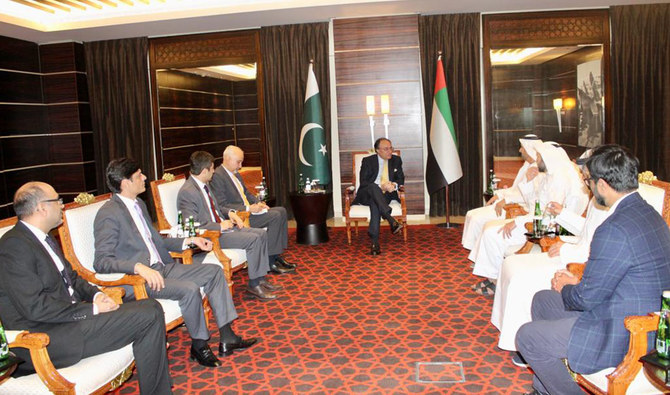
Pakistan Finance Minister Muhammad Aurangzeb (center) in a meeting with foreign investors in Dubai on April 22, 2024. (Photo courtesy: Ministry of finance)
Short Url
Updated 22 April 2024
Follow

Pakistani finance minister meets top UAE businessmen, banking officials in investment push 

  • Muhammad Aurangzeb separately meets chairmen of Ayana Holding company and Nad Al Shiba Holding company
  • Discusses financial and economic cooperation with senior officials of Mashreq Bank and First Abu Dhabi Bank in Dubai

KARACHI: Finance Minister Muhammad Aurangzeb met foreign investors in Dubai on Monday to explore ways to enhance investment activity between Pakistan and the UAE in IT, energy, transport and real estate development sectors, the Pakistani finance ministry said in a statement.

The UAE is Pakistan’s third-largest trading partner after China and the United States. Policymakers in Pakistan consider the Gulf state an optimal export destination due to its geographical proximity, which minimizes transportation and freight costs while facilitating commercial transactions.

UAE is also home to some 1.5 million Pakistani expatriates and the second-largest source of remittances to the South Asian country, after Saudi Arabia.

The finance ministry said Aurangzeb met Abdulla Bin Lahej, chairman of the UAE-based Ayana Holding company and Mohammed Hilal Bin Tarraf Al Mansoori, chairman of the Nad Al Shiba Holding company, in Dubai.

“He explored ways to enhance investment activity between the UAE and Pakistan by supporting existing economic partnerships and exploring further diversification to include areas of Information technology, renewable energy, transport and logistics, infrastructure and real estate development,” the statement said.

The ministry said Aurangzeb highlighted Pakistan’s “competitive advantages” that make it an ideal destination for investors seeking high returns and sustainable growth. 

“The Finance Minister also highlighted the role of SIFC [Special Investment Facilitation Council] in assisting investors at every stage of their journey, comprehensive support services including market research, regulatory guidance, investment facilitation, and post-investment support, ensuring a smooth experience,” the statement read.

The SIFC is a civil-military government body formed in June 2023 to attract international investment, mainly from Gulf countries, in Pakistan’s key economic sectors of agriculture, mining, IT and others.

Separately, Aurangzeb met with senior officials of Mashreq Bank and First Abu Dhabi Bank in Dubai to discuss strengthening of financial and economic cooperation.

“The minister emphasized upon the bankers to reconsider their appetite for arranging financing for the country [Pakistan] given significant improvements in economic fundamentals,” the finance ministry said.

The Pakistani finance minister was in Washington from Apr. 14 till 21 to participate in spring meetings organized by the International Monetary Fund (IMF) and World Bank. His tour was an important one for the South Asian country as Pakistan’s ongoing nine-month, $3 billion loan program with the global lender expires this month. Pakistan has already said it is in talks with the international lender for a larger IMF program.

During the visit, Aurangzeb met officials of multilateral institutions and his counterparts from Saudi Arabia and China to highlight the government’s economic reforms and Pakistan’s investment potential.


Peshawar church attack haunts Christians at Christmas

Updated 13 sec ago
Follow

Peshawar church attack haunts Christians at Christmas

  • The 2013 suicide attack at All Saints Church killed 113 worshippers, leaving lasting scars on survivors
  • Prime Minister Shehbaz Sharif vowed to protect religious minorities on Christmas, act against any injustice

PESHAWAR: After passing multiple checkpoints under the watchful eyes of snipers stationed overhead, hundreds of Christians gathered for a Christmas mass in northwest Pakistan 12 years after suicide bombers killed dozens of worshippers.

The impact of metal shards remain etched on a wall next to a memorial bearing the names of those killed at All Saints Church in Peshawar, in the violence-wracked province of Khyber Pakhtunkhwa.

“Even today, when I recall that day 12 years ago, my soul trembles,” Natasha Zulfiqar, a 30-year-old housewife who was wounded in the attack along with her parents, told AFP on Thursday.

Her right wrist still bears the scar.

A militant group claimed responsibility for the attack on September 22, 2013, when 113 people were killed, according to a church toll.

“There was blood everywhere. The church lawn was covered with bodies,” Zulfiqar said.

Christians make up less than two percent of Pakistan’s 240 million people and have long faced discrimination in the conservative Muslim country, often sidelined into low-paying jobs and sometimes the target of blasphemy charges.

Along with other religious minorities, the community has often been targeted by militants over the years.

Today, a wall clock inside All Saints giving the time of the blast as 11:43 am is preserved in its damaged state, its glass shattered.

“The blast was so powerful that its marks are still visible on this wall — and those marks are not only on the wall, but they are also etched into our hearts as well,” said Emmanuel Ghori, a caretaker at the church.

Addressing a Christmas ceremony in the capital Islamabad, Prime Minister Shehbaz Sharif vowed to protect religious minorities.

“I want to make it clear that if any injustice is done to any member of a minority, the law will respond with full force,” he said.

For Azzeka Victor Sadiq, whose father was killed and mother wounded in the blasts, “The intensity of the grief can never truly fade.”

“Whenever I come to the church, the entire incident replays itself before my eyes,” the 38-year-old teacher told AFP.