


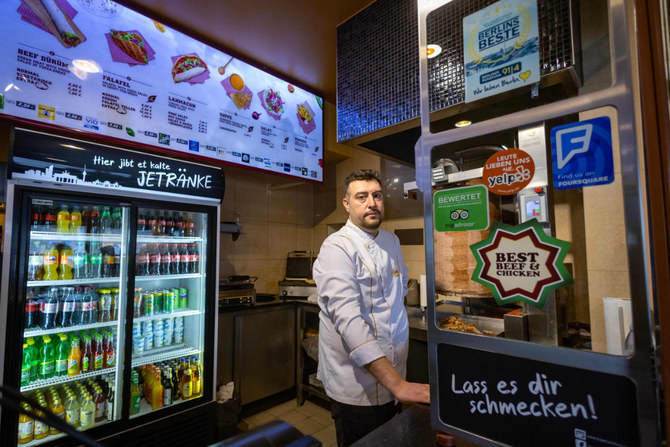

BERLIN: German President Frank-Walter Steinmeier begins a delicate visit to Turkiye on Monday, taking a Berlin kebab chef with him as a show of close personal ties between the two nations despite differences with his Turkish counterpart.
Steinmeier, who is visiting Turkiye for the first time since becoming president, has had a difficult relationship with Turkish leader Recep Tayyip Erdogan.
The German head of state has been quick to call out Erdogan’s approach toward Israel and has previously raised concerns about the erosion of democratic norms in Turkiye.
The fact that he is not starting the trip in the capital Ankara “is a signal,” said a source in the German presidency who asked not to be named.
Instead, Steinmeier’s first stop will be Istanbul, where he will meet civil society activists, as well as the city’s mayor, opposition figure Ekrem Imamoglu.
Voters’ decision to return Imamoglu as mayor in recent local elections dealt a blow to Erdogan and his ruling party.
On Tuesday, Steinmeier will meet survivors of the devastating 2023 earthquake in Gaziantep near the Syrian border.
Talks with Erdogan in Ankara will wait until Wednesday.
Instead of flattering the president, Steinmeier is hoping to put the emphasis on the links between people in the two countries.

German President Frank-Walter Steinmeier attends a Bundeswehr training in Munster, Germany, on April 18, 2024. (REUTERS)
In particular, the German president hopes to highlight the contribution made by generations of Turkish migrants, who since the 1960s have come to work in Germany.
Among those to establish themselves in Germany was the grandfather of Arif Keles, a Berlin kebab shop owner invited on the trip by Steinmeier.
The grilled meat artisan will serve doner kebab to guests at a dinner in Istanbul on Monday night.
“The spit is traveling with us in the presidential plane,” Keles told AFP ahead of the journey.
The dish of thinly sliced meat cooked on a vertical rotisserie was introduced to Germany by Turkish migrants.
Packed with chopped vegetables and doused with mayonnaise, the doner kebab has gained iconic status.
The snack has become “a kind of German national food,” one of Steinmeier’s advisers said in a briefing.
Local sales of the kebab total an estimated seven billion euros ($7.5 billion) — an immigrant success story the German presidency wants to celebrate.
Doner dealer Keles is the third generation to manage the family business in southwest Berlin.
His grandfather moved to Germany and worked for years in a factory before opening his own restaurant in 1986.
“Now the president is taking me as a grandson to the home of my ancestors,” Keles said.
“I see it as a great honor that I am allowed to go on this visit.”
Steinmeier’s trip was meant to underline that “the personal stories and achievements of four generations of Turkish immigrants” are part of Germany’s history, the presidential office said.
Around three million people with Turkish heritage live in Germany, but their presence has often been the subject of a fraught debate over split loyalties.
Only last year did Germany agree to significantly ease citizenship rules to allow more dual nationals, a relief to many Turkish people who have lived in Germany for decades.
Perceived backing for Erdogan in the Turkish diaspora has also caused irritation in Germany, while officials in Berlin have had a strained relationship with Ankara.
Erdogan’s support for Hamas has troubled Berlin, which solidly backs Israel in the war against the Palestinian militant group.
Erdogan traded barbs with Steinmeier on a visit to Germany in November last year, shortly after the October 7 attack by Hamas on Israel that triggered the war.
The disagreement has added to tensions over sharp German criticism of authoritarian moves that German officials see as threatening democracy in Turkiye.
Berlin has criticized Erdogan’s clampdown on domestic dissent while recognizing that getting regional power Turkiye onside was necessary to tackle thorny issues.
Despite having served seven years as president, this is Steinmeier’s first visit to Turkiye as head of state.


