


Health-harming heat stress rising in Europe, scientists say

1 / 3
People relax in the Retiro park in Madrid, Spain, on March 20, 2024. Europe is the fastest-warming continent and its temperatures are rising at roughly twice the global average, climate monitoring organizations say. (AP Photo/File)
2 / 3
A lake of meltwater has formed on the tongue of the Rhone Glacier near Goms, Switzerland, on June 13, 2023, an effect of temperatures rising in Europe at roughly twice the global average. (AP Photo/File)
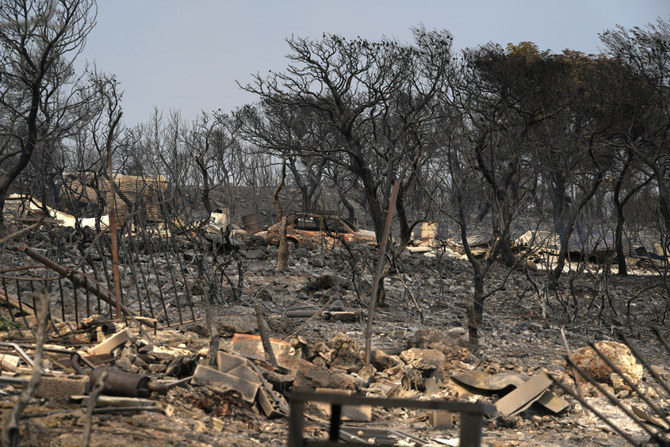
3 / 3
This photo taken on July 19, 2023, shows burnt trees and a car in Mandra, west of Athens, Greece, an effect of temperatures rising in Europe at roughly twice the global average. (AP Photo/File)
Short Url
Updated 22 April 2024
Follow

Health-harming heat stress rising in Europe, scientists say

  • Temperatures in Europe are rising at roughly twice the global average, Copernicus and WMO reported
  • Deaths related to heat have increased by around 30 percent in Europe in the last 20 years, the report said

BRUSSELS: Europe is increasingly facing bouts of heat so intense that the human body cannot cope, as climate change continues to raise temperatures, the EU’s Copernicus climate monitoring service and the World Meteorological Organization said on Monday.
In a report on Europe’s climate, Copernicus and the WMO noted last year’s extreme conditions, including a July heatwave which pushed 41 percent of southern Europe into strong, very strong or extreme heat stress — the biggest area of Europe under such conditions in any day on record.
Extreme heat poses particular health risks to outdoor workers, the elderly, and people with existing conditions like cardiovascular diseases and diabetes.
Parts of Italy recorded 7 percent more deaths than normal last July, with victims including a 44-year-old man painting road markings in the northern town of Lodi who collapsed and died.
Heat stress measures the impact that the environment has on the human body, combining factors like temperature, humidity and the body’s response, to establish a “feels like” temperature.

Parts of Spain, France, Italy and Greece experienced up to ten days of extreme heat stress in 2023, defined as a “feels like” temperature of more than 46 degrees Celsius, at which point immediate action must be taken to avoid heat stroke and other health issues.
Deaths related to heat have increased by around 30 percent in Europe in the last 20 years, the report said.
The EU’s environment agency urged governments last month to prepare health care systems for climate change and called for EU rules to protect outdoor workers from extreme heat.
Last year was the world’s hottest since records began. Europe is the world’s fastest-warming continent.
Greenhouse gas emissions were the biggest cause of last year’s exceptional heat, the report said. Factors including the El Nino weather pattern also played a role.
The heat fueled extreme weather including flooding, since the warmer atmosphere can hold more moisture, causing heavier downpours when it is released.
Floods in Slovenia last year affected 1.5 million people. Greece suffered the EU’s biggest wildfire on record which, at 960 square km, was twice the size of Athens. Alpine glaciers lost 10 percent of their remaining volume during 2022 and 2023.
“Some of the events of 2023 took the scientific community by surprise because of their intensity, their speed of onset, extent and duration,” said Carlo Buontempo, director of the Copernicus Climate Change Service.


India, Arab League target $500bn in trade by 2030

Updated 6 sec ago
Follow

India, Arab League target $500bn in trade by 2030

  • It was the first such gathering of India–Arab FMs since the forum’s inauguration in 2016
  • India and Arab states agree to link their startup ecosystems, cooperate in the space sector

NEW DELHI: India and the Arab League have committed to doubling bilateral trade to $500 billion by 2030, as their top diplomats met in New Delhi for the India–Arab Foreign Ministers’ Meeting. 

The foreign ministers’ forum is the highest mechanism guiding India’s partnership with the Arab world. It was established in March 2002, with an agreement to institutionalize dialogue between India and the League of Arab States, a regional bloc of 22 Arab countries from the Middle East and North Africa.

The New Delhi meeting on Saturday was the first gathering in a decade, following the inaugural forum in Bahrain in 2016.

India’s Foreign Minister S. Jaishankar said in his opening remarks that the forum was taking place amid a transformation in the global order.

“Nowhere is this more apparent than in West Asia or the Middle East, where the landscape itself has undergone a dramatic change in the last year,” he said. “This obviously impacts all of us, and India as a proximate region. To a considerable degree, its implications are relevant for India’s relationship with Arab nations as well.”

Jaishankar and his UAE counterpart co-chaired the talks, which aimed at producing a cooperation agenda for 2026-28.

“It currently covers energy, environment, agriculture, tourism, human resource development, culture and education, amongst others,” Jaishankar said.

“India looks forward to more contemporary dimensions of cooperation being included, such as digital, space, start-ups, innovation, etc.”

According to the “executive program” released by India’s Ministry of External Affairs, the roadmap agreed by India and the League outlined their planned collaboration, which included the target “to double trade between India and LAS to US$500 billion by 2030, from the current trade of US$240 billion.”

Under the roadmap, they also agreed to link their startup ecosystems by facilitating market access, joint projects, and investment opportunities — especially health tech, fintech, agritech, and green technologies — and strengthen cooperation in space with the establishment of an India–Arab Space Cooperation Working Group, of which the first meeting is scheduled for next year.

Over the past few years, there has been a growing momentum in Indo-Arab relations focused on economic, business, trade and investment ties between the regions that have some of the world’s youngest demographics, resulting in a “commonality of circumstances, visions and goals,” according to Muddassir Quamar, associate professor at the School of International Studies, Jawaharlal Nehru University.

“The focus of the summit meeting was on capitalizing on the economic opportunities … including in the field of energy security, sustainability, renewables, food and water security, environmental security, trade, investments, entrepreneurship, start-ups, technological innovations, educational cooperation, cultural cooperation, youth engagement, etc.,” Quamar told Arab News.

“A number of critical decisions have been taken for furthering future cooperation in this regard. In terms of opportunities, there is immense potential.”