

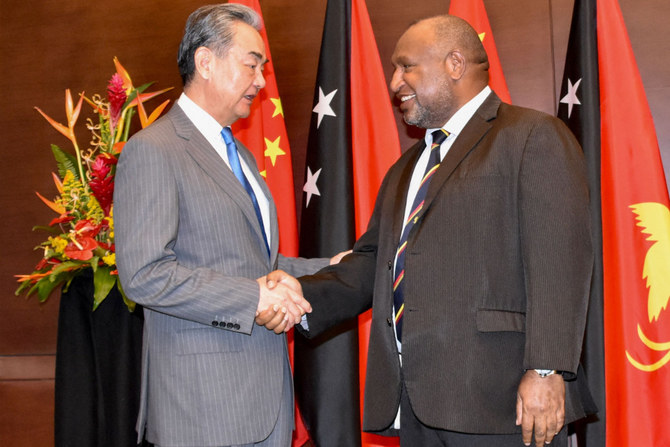

SYDNEY, Australia: China’s foreign minister on Saturday accused Western powers in the AUKUS security pact of provoking division and risking nuclear proliferation in the South Pacific.
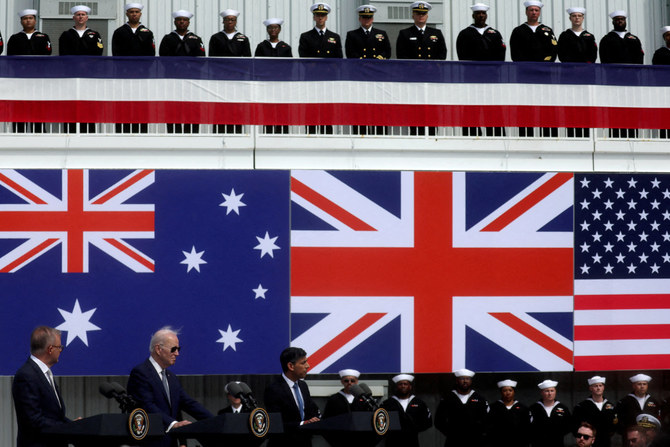
On a weekend visit to strengthen Beijing’s ties with Papua New Guinea, Foreign Minister Wang Yi lashed out at AUKUS, which provides for the United States and Britain to equip Australia with nuclear-powered but conventionally armed submarines.
The three-way AUKUS agreement “runs counter” to a South Pacific treaty banning nuclear weapons in the region, he told a news conference in Port Moresby.
AUKUS also “raises serious nuclear proliferation risks,” the Chinese foreign minister told reporters after meeting with his Papua New Guinea counterpart Justin Tkatchenko.
In recent years, Beijing has tried to chip away at US and Australian influence across the South Pacific, including in Papua New Guinea.
The Pacific Islands, while small in population, are replete with natural resources and sit at a geostrategic crossroads that could prove strategically vital in any military dispute over Taiwan.
Australia is by far Papua New Guinea’s largest donor, but Chinese firms have made solid inroads into markets in the impoverished but resource-rich nation.

The Chinese foreign minister seized on a recent announcement by the AUKUS nations that they are considering cooperating with Japan on military technology.
Under the AUKUS agreement, the partners plan to develop advanced warfighting capabilities such as artificial intelligence, undersea drones and hypersonic missiles.
“The recent attempts to draw more countries to join in such an initiative of stoking confrontation between blocs and provoking division are totally inconsistent with the urgent needs of the island countries,” the foreign minister said.
Wang took a thinly veiled swipe at Australian and US relations with Solomon Islands, which held elections on Wednesday.
Solomon Islands
The Solomons’ incumbent prime minister, Manasseh Sogavare, has embraced China while his main challengers view Beijing’s growing influence with a mix of skepticism and alarm.
A new government has yet to be agreed among elected MPs.

Electoral officers prepare to count votes from the general election at the Multi-Purpose Center in Honiara, capital city of the Solomon Islands, on April 19, 2024. (AFP)
“We believe that the people of Solomon Islands have the wisdom and ability to determine the future of their country. Island nations belong to their people,” Wang said.
“They are not the backyard of any big country,” Wang said — an allusion to historic perceptions that Australia considered the South Pacific to be its backyard.
State-backed Chinese news outlets have pushed reports that the United States might orchestrate riots to block Sogavare from returning to power.
US Ambassador to the Solomons Ann Marie Yastischock has said such rumors are “blatantly misleading.”
Papua New Guinea’s foreign minister welcomed the Chinese minister, saying they had “reached some understanding” in their talks.
“PNG values China as an important bilateral partner,” he said.
Wang is scheduled to have breakfast with Papua New Guinea Prime Minister James Marape on Sunday, wrapping up a three-nation tour of Indonesia, Cambodia and Papua New Guinea that began April 18.


