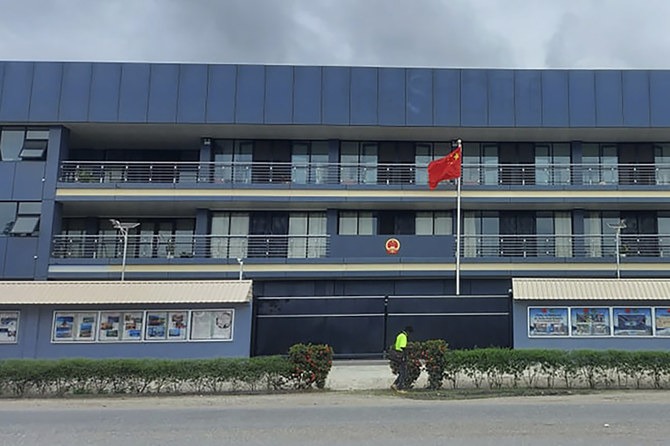
WELLINGTON, New Zealand: A security alliance between China and the Solomon Islands has sent shudders throughout the South Pacific, with many worried it could set off a large-scale military buildup or that Western animosity to the deal could play into China’s hands.
What remains most unclear is the extent of China’s ambitions.
A Chinese military presence in the Solomons would put it not only on the doorstep of Australia and New Zealand but also in close proximity to Guam, with its massive US military bases.
China so far operates just one acknowledged foreign military base, in the impoverished but strategically important Horn of Africa nation of Djibouti. Many believe that China’s People’s Liberation Army is busy establishing an overseas military network, even if they don’t use the term “base.”
The Solomon Islands government says a draft of its agreement with China was initialed last week and will be “cleaned up” and signed soon.
The draft, which was leaked online, says that Chinese warships could stop in the Solomons for “logistical replenishment” and that China could send police, military personnel and other armed forces to the Solomons “to assist in maintaining social order.”
The draft agreement specifies China must approve what information is disclosed about joint security arrangements, including at media briefings.
The Solomon Islands, home to about 700,000 people, switched diplomatic recognition from Taiwan to Beijing in 2019 — a move rejected by the most populous province and a contributing factor to riots last November.
US Secretary of State Antony Blinken responded in February by saying that Washington would reopen its embassy in the capital, Honiara, which has been closed since 1993, to increase its influence in the Solomons before China becomes “strongly embedded.”
Both China and the Solomons have strongly denied the new pact will lead to the establishment of a Chinese military base. The Solomon Islands government said the pact is necessary because of its limited ability to deal with violent uprisings like the one in November.
“The country has been ruined by recurring internal violence for years,” the government said this week.
But Australia, New Zealand and the US have all expressed alarm about the deal, with New Zealand Prime Minister Jacinda Ardern describing it as “gravely concerning.”
David Panuelo, the president of nearby Micronesia, which has close ties to the US, wrote an impassioned letter to Solomon Islands Prime Minister Manasseh Sogavare asking him to rethink the agreement.
He noted that both Micronesia and the Solomon Islands were battlegrounds during World War II, caught up in the clash of great powers.
“I am confident that neither of us wishes to see a conflict of that scope or scale ever again, and most particularly in our own backyards,” Panuelo wrote.
But the Solomon Islands police minister mocked Panuelo’s concerns on social media, saying he should be more worried about his own atoll being swallowed by the ocean due to climate change.
Sogavare has likewise dismissed foreign criticism of the security agreement as insulting, while labeling those who leaked the draft as “lunatics.”
China’s Foreign Ministry spokesperson said the agreement aims to maintain the safety of people’s lives and property, and “does not have any military overtones,” saying media speculation on the potential development of a base was groundless.
Euan Graham, a senior fellow at the International Institute for Strategic Studies based in Singapore, said China has been pursuing such a port facility for some five years as it aims to expand its naval presence in the South Pacific as part of Beijing’s long-game of seeking to become the dominant regional power.
“If they want to break out into the Pacific, at some point they will need the logistics capability to support that presence,” Graham said. “We’re not talking about war plans here; this is really about extending their presence and influence.”
Unlike the base built in Djibouti, where China has commercial interests in the region to protect, Graham said any operation in the Solomon Islands would likely be less substantial.
“It’s quite a subtle and interesting geopolitical game that’s emerged in the South Pacific,” he added. “And I think the Chinese have been very successful, if you like, in outflanking the United States and Australia in an influence competition, not a military competition.”
China’s base in Djibouti was opened in 2017. China doesn’t call it a base, but rather a support facility for its naval operations fending off piracy in the Gulf of Aden and for its African peacekeeping operations. It boasts a 400-meter (1,300-foot) runway and a pier big enough to dock either of China’s two operating aircraft carriers.
The base, with 2,000 personnel, allows China to position supplies, troops and equipment in a strategically crucial region, while also keeping an eye on US forces that are stationed nearby.
Chief among other potential base candidates is Cambodia, whose authoritarian leader Hun Sen has long been a trusted Chinese ally and which reportedly signed a secret 2019 agreement permitting the establishment of a Chinese base.
China is dredging the harbor at Ream Naval Base to allow ships larger than any Cambodia possesses to dock, and is building new infrastructure to replace a US-built naval tactical headquarters. A Chinese base in Cambodia would establish a chokepoint in the Gulf of Thailand close to the crucial Malacca Strait.
China has also funded projects at Gwadar in Pakistan, another close ally, and in Sri Lanka, where Chinese infrastructure lending has forced the government to hand over control of the southern port of Hambantota.
Especially intriguing has been an alleged Chinese push to establish a base in the West African nation of Equatorial Guinea. That would give China a presence on the Atlantic opposite the east coast of the continental United States as well as in an important African oil-producing region.
“China has seized opportunities to expand its influence at a time when the US and other countries have not been as engaged economically in the Pacific islands,” said Elizabeth Wishnick, an expert on Chinese foreign policy at Montclair State University in New Jersey.
About 80 years ago in the Solomon Islands, the US military began its famous “island hopping” campaign of World War II to take back Pacific islands from Imperial Japanese forces one-by-one. It successfully won back the main island of Guadalcanal in February 1943 after some six months of fierce fighting.
Today, the Solomon Islands would give China the potential ability to interfere with US naval operations in the region that could be crucial in the event of a conflict over Taiwan or in the South and East China seas.
Lt. Gen. Greg Bilton, Australia’s chief of joint operations, said that if Chinese naval ships were able to operate from the Solomon Islands it would “change the calculus.”
“They’re in much closer proximity to the Australian mainland, obviously, and that would change the way that we would undertake day-to-day operations, particularly in the air and at sea,” he told reporters.
But Jonathan Pryke, the director of the Pacific Islands Program at the Lowy Institute, an Australian think tank, said he thinks that leaders have overreacted to the agreement, perhaps in Australia’s case because there is an election looming.
“It’s clearly getting everyone very animated in the West and very alarmed,” Pryke said. “But I don’t think it markedly changes things on the ground.”
He said the pact could be seen as the first step toward China establishing a base, but there would need to be many more steps taken before that could happen.
“I think the alarmism has strengthened China’s hand by pushing the Solomon Islands into a corner,” Pryke said. “And they’ve reacted the way I imagine many countries would react from getting this outside pressure — by pushing back, and digging their heels in.”


![]()
![]()

China’s security deal with Solomons raises alarm in Pacific

Short Url
https://arab.news/cxraj
China’s security deal with Solomons raises alarm in Pacific
- A Chinese military presence in the Solomons would put it on the doorstep of Australia and New Zealand
- It will also be in close proximity to Guam, with its massive US military bases


Latest updates


© 2026 SAUDI RESEARCH & PUBLISHING COMPANY, All Rights Reserved And subject to Terms of Use Agreement.