

Pakistan to train 1 million youth annually to export skilled human resource to Gulf countries

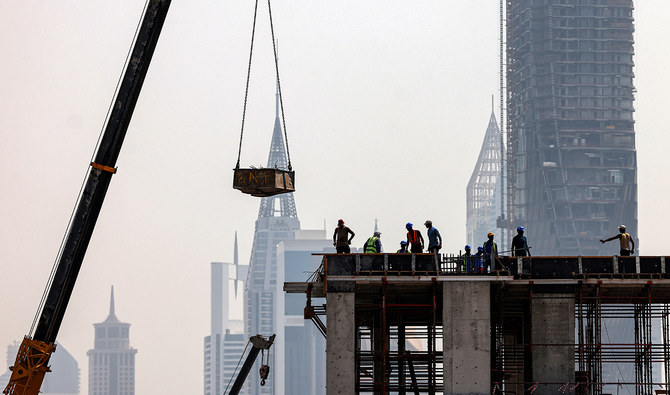
Workers carry on construction at the site of a residential tower being built along the central Sheikh Zayed Road in Dubai on July 18, 2023 during a heat wave. (AFP/File)
Short Url
Updated 20 April 2024
Follow

Pakistan to train 1 million youth annually to export skilled human resource to Gulf countries

  • Islamabad is planning to roll out a new education policy next month, with a focus on vocational training and out-of-school children
  • Educationists, however, say the real challenge for the government is to ensure implementation of the policy, focus on teacher training

ISLAMABAD: Pakistan’s government is working on a new education policy to impart technical skills to one million youth annually to export trained human resource to Saudi Arabia and other Gulf countries, an official said on Friday.

The cash-strapped South Asian nation of 241 million has been working on a holistic national education policy to cover technical training for the youth by enrolling over 2.5 million out-of-school children.

The Special Investment Facilitation Council (SIFC), a federal body led by Prime Minister Shehbaz Sharif to attract investment from foreign and domestic sources, has given specific targets to the education ministry to finalize a comprehensive policy to improve the education sector.

“This new policy aims to impart vocational training to at least one million youth per annum to export skilled workforce to Saudi Arabia and other Gulf countries,” Rana Mujtaba, a spokesperson for the Pakistani ministry of education and professional training, told Arab News.

“It will be rolled out in May.”

There are around 9 million overseas Pakistanis living and working in different countries, including 2.8 million in Saudi Arabia, who remit around $30 billion back home annually to support the country’s fragile economy.

“Majority of our overseas workforce is unskilled labor. Therefore, the government is now focusing on enhancing vocational capacity of the youth,” Mujtaba said.

In the National Education Policy 2017-2025, Pakistan aimed to raise its literacy rate from the existing 60 percent to 90 percent by 2025, narrow down the gender gaps, reduce rural and urban imbalance, improve quality of education, promote technical and vocational education with skill development programs, and ensure good governance. But all this has yet to be achieved.

Mujtaba said Pakistan’s vocational training institutes already had a “strong affiliation” with Saudi Arabia, where all training certificates were accepted.

“The SIFC that is chaired by the PM has given a general direction to the ministry to work on a new education policy to improve the sector’s performance,” he said.

The spokesperson dispelled the notion that the education ministry was working on the new education policy without taking provincial governments on-board, since education has primarily been a provincial subject in the South Asian country.

“The federal government is in fact supporting the provinces in improving the education sector. All provincial ministers and education secretaries are on-board as the federal ministry has sought inputs from all of them,” he said.

“This will be a holistic policy that will also address the issue of out-of-school children, improving the higher education’s standards, domestic and foreign scholarships for the students.”

Educationists and public policy experts said the government had already devised numerous policies and produced documents to improve the education sector, but it would lack in implementation of these plans.

“The silver lining in the new policy is that the government is for the first time focusing on out-of-school children, but there needs to be an effective mechanism in place with clear timelines to address this issue,” Taimur Bandey, an educationist, told Arab News.

“The government needs to allocate its resources for teachers training and upgrade libraries and laboratories in the institutions to improve the education standards.” 


Pakistani, Bangladeshi officials discuss trade, investment and aviation as ties thaw

Updated 28 December 2025
Follow

Pakistani, Bangladeshi officials discuss trade, investment and aviation as ties thaw

  • Pakistan and Bangladesh were once one nation, but they split in 1971 as a result of a bloody civil war
  • Ties between Pakistan, Bangladesh have warmed up since last year and both nations have resumed sea trade

ISLAMABAD: Pakistan's High Commissioner to Bangladesh Imran Haider on Sunday met Chief Adviser Muhammad Yunus in Dhaka, the latter's office said on, with the two figures discussing trade, investment and aviation.

Pakistan and Bangladesh were once one nation, but they split in 1971 as a result of a bloody civil war, which saw the part previously referred to as East Pakistan seceding to form the independent nation of Bangladesh.

Ties between Pakistan and Bangladesh have warmed up since former prime minister Sheikh Hasina’s ouster as a result of a student-led uprising in August 2024. Relations remain frosty between Dhaka and New Delhi over India’s decision to grant asylum to Hasina.

Pakistan has attempted to forge closer ties with Bangladesh in recent months and both South Asian nations last year began sea trade, followed by efforts to expand government-to-government commerce.

"During the meeting, both sides discussed ways to expand cooperation in trade, investment, and aviation as well as scaling up cultural, educational and medical exchanges to further strengthen bilateral relations between the two South Asian nations," Yunus's office said in a statement on X.

In 2023-24 Pakistan exported goods worth $661 million to Bangladesh, while its imports were only $57 million, according to the Trade Development Authority of Pakistan. In Aug. this year, the Pakistani and Bangladeshi commerce ministries signed a memorandum of understanding to establish a Joint Working Group on Trade, aiming to raise their bilateral trade volume to $1 billion in the financial year that began in July.

The Pakistani high commissioner noted that bilateral trade has recorded a 20 percent growth compared to last year, with business communities from both countries actively exploring new investment opportunities, according to the statement.

He highlighted a significant increase in cultural exchanges, adding that Bangladeshi students have shown strong interest in higher education opportunities in Pakistan, particularly in medical sciences, nanotechnology, and artificial intelligence. Haider also said that Dhaka-Karachi direct flights are expected to start in January.

"Chief Adviser Professor Muhammad Yunus welcomed the growing interactions between the two countries and emphasized the importance of increased visits as well as cultural, educational and people-to-people exchanges among SAARC (South Asian Association for Regional Cooperation) member states," the statement read.

"Professor Yunus also underscored the need to further boost Bangladesh–Pakistan trade and expressed hope that during Mr. Haider’s tenure, both countries would explore new avenues for investment and joint venture businesses."