

India’s Lok Sabha election 2024: What you need to know

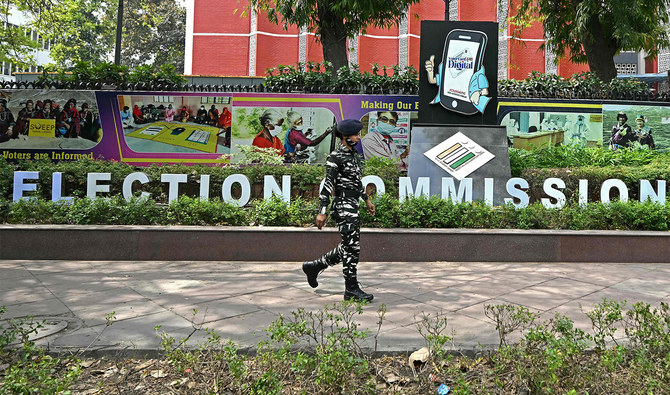
People walk past a model of Electronic Voting Machine (EVM) displayed outside the office of the Election Commission of India, ahead of country's upcoming general elections, in New Delhi on April 15, 2024. (AFP)
Short Url
Updated 16 April 2024
Follow

India’s Lok Sabha election 2024: What you need to know

  • India is holding the world’s biggest election starting this month, with nearly one billion people eligible to vote
  • Votes to be counted on June 4 after polling done on April 19, April 26, May 7, May 13, May 20, May 25, June 1

India is holding the world’s biggest election starting this month, with nearly 1 billion people eligible to vote and Prime Minister Narendra Modi in the pole position.

WHAT IS IT?

Elections to the 543 contested seats in the lower house of parliament, called the Lok Sabha, for a term of five years. To rule, a party or a coalition needs a simple majority of 272 seats. Prime Minister Narendra Modi’s Bharatiya Janata Party (BJP) won 303 seats the last time, followed by 52 for the main opposition Indian National Congress (INC).

In addition to the contested seats, India’s president can nominate up to two Anglo-Indians to the Lok Sabha.

The Bharatiya Janata Party, BJP, won 303 seats in 2019 general election. The second largest party, the Indian National Congress, INC, won 52 seats. The Dravida Munnetra Kazhagam, DMK, emerged as the third largest party.
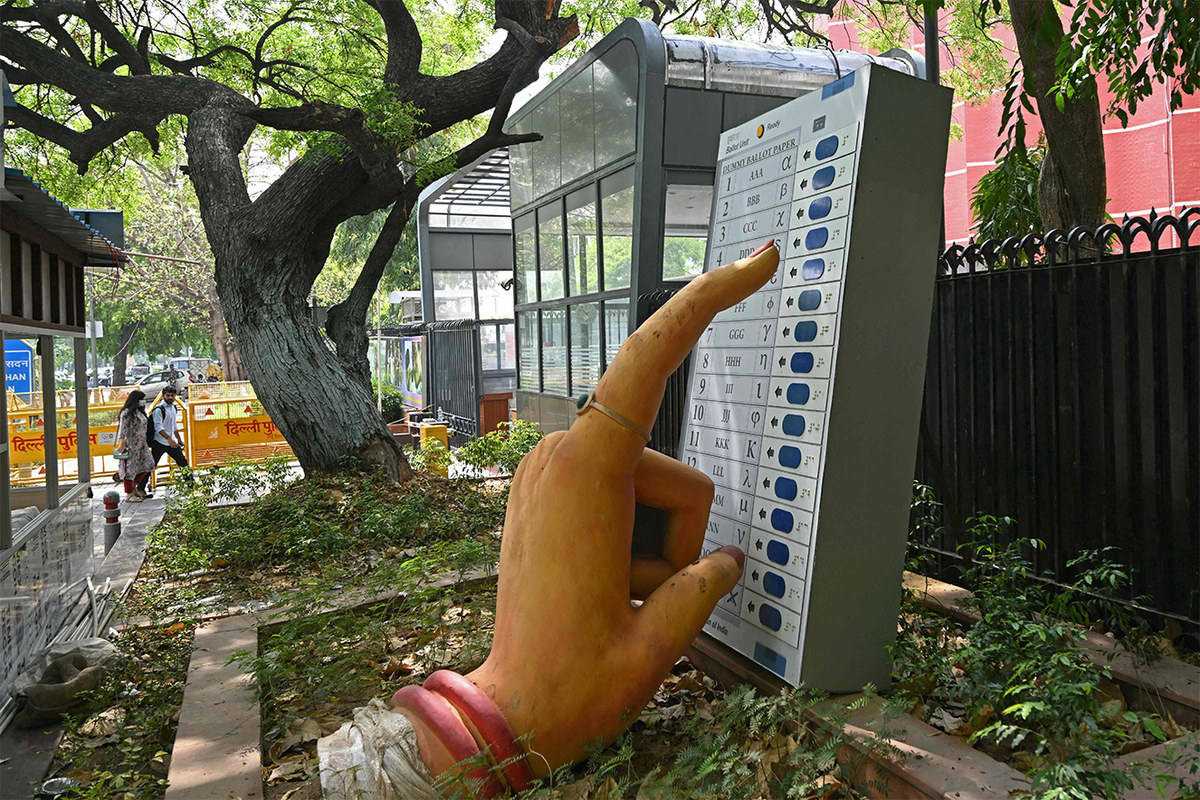


People walk past a model of Electronic Voting Machine (EVM) displayed outside the office of the Election Commission of India, ahead of the country's upcoming general elections, in New Delhi on April 15, 2024. (AFP)

WHERE AND WHEN IS IT TAKING PLACE?

The elections will be conducted in seven phases partly to ensure sufficient security at polling booths across the vast country. Voters can make their choice by pressing a button on an electronic voting machine, first used in India in 1982 and more widely since the early 2000s.

Votes will be counted on June 4 after polling is done on April 19, April 26, May 7, May 13, May 20, May 25 and June 1.

The elections in the world’s largest democracy for 543 seats will be held in 7 phases.

HOW DOES IT WORK?

The world’s most populous nation follows the first-past-the-post system, where voters cast a vote for a single candidate in a constituency and the candidate with the most votes wins the seat. The voting age is 18 years and contestants need to be at least 25 years old.

A total of 968 million voters are registered, out of which 497 million are men and 471 million are women. A higher percentage of women voters than men are likely to vote for the second time in a row.

WHO ARE THE MAIN CANDIDATES?

Modi headlines the race, followed by his de facto deputy Amit Shah and the main opposition face, Rahul Gandhi of the Congress party. Gandhi’s mother Sonia, the matriarch of the Nehru-Gandhi dynasty, is not contesting this time.

WHY IS IT IMPORTANT?

Modi is chasing a record-equalling third straight term like India’s first prime minister, Jawaharlal Nehru. Modi says another overwhelming victory for the National Democratic Alliance, led by the BJP, is crucial to meet his goal of lifting India to a developed economy by 2047 from middle-income levels. The world’s fifth-largest economy has grown fast in the past few years and Modi has “guaranteed” to take it to the third position if he wins the election.

The BJP draws its support mainly from Hindus, who form 80 percent of the country’s 1.42 billion people and for whom Modi earlier this year delivered on a key party promise of building a grand Hindu temple on a disputed site.

The opposition “INDIA” alliance, largely a center-left grouping of more than two dozen disparate parties, says a victory for it is essential to save the country’s democratic and secular setup, lift its marginalized communities, raise prices for farmers and create jobs for its young. Opinion polls, which have a mixed record in India, predict another thrashing of the Congress alliance at the hands of the BJP.


Carney says Canada has no plans to pursue free trade agreement with China as Trump threatens tariffs

Updated 5 sec ago
Follow

Carney says Canada has no plans to pursue free trade agreement with China as Trump threatens tariffs

TORONTO: Canadian Prime Minister Mark Carney said Sunday his country has no intention of pursuing a free trade deal with China. He was responding to US President Donald Trump’s threat to impose a 100 percent tariff on goods imported from Canada if America’s northern neighbor went ahead with a trade deal with Beijing.
Carney said his recent agreement with China merely cuts tariffs on a few sectors that were recently hit with tariffs.
Trump claims otherwise, posting that “China is successfully and completely taking over the once Great Country of Canada. So sad to see it happen. I only hope they leave Ice Hockey alone! President DJT”
The prime minister said under the free trade agreement with the US and Mexico there are commitments not to pursue free trade agreements with nonmarket economies without prior notification.
“We have no intention of doing that with China or any other nonmarket economy,” Carney said. “What we have done with China is to rectify some issues that developed in the last couple of years.”
In 2024, Canada mirrored the United States by putting a 100 percent tariff on electric vehicles from Beijing and a 25 percent tariff on steel and aluminum. China had responded by imposing 100 percent import taxes on Canadian canola oil and meal and 25 percent on pork and seafood.
Breaking with the United States this month during a visit to China, Carney cut its 100 percent tariff on Chinese electric cars in return for lower tariffs on those Canadian products.
Carney has said there would be an initial annual cap of 49,000 vehicles on Chinese EV exports coming into Canada at a tariff rate of 6.1 percent, growing to about 70,000 over five years. He noted there was no cap before 2024. He also has said the initial cap on Chinese EV imports was about 3 percent of the 1.8 million vehicles sold in Canada annually and that, in exchange, China is expected to begin investing in the Canadian auto industry within three years.
Trump posted a video Sunday in which the chief executive of the Canadian Vehicle Manufacturers’ Association warns there will be no Canadian auto industry without US access, while noting the Canadian market alone is too small to justify large scale manufacturing from China.
“A MUST WATCH. Canada is systematically destroying itself. The China deal is a disaster for them. Will go down as one of the worst deals, of any kind, in history. All their businesses are moving to the USA. I want to see Canada SURVIVE AND THRIVE! President DJT,” Trump posted on social media.
Trump’s post on Saturday said that if Carney “thinks he is going to make Canada a ‘Drop Off Port’ for China to send goods and products into the United States, he is sorely mistaken.”
“We can’t let Canada become an opening that the Chinese pour their cheap goods into the U.S,” US Treasury Secretary Scott Bessent said on ABC’s “This Week.”
“We have a , but based off — based on that, which is going to be renegotiated this summer, and I’m not sure what Prime Minister Carney is doing here, other than trying to virtue-signal to his globalist friends at Davos.”
Trump’s threat came amid an escalating war of words with Carney as the Republican president’s push to acquire Greenland strained the NATO alliance.
Carney has emerged as a leader of a movement for countries to find ways to link up and counter the US under Trump. Speaking in Davos before Trump, Carney said, “Middle powers must act together because if you are not at the table, you are on the menu” and he warned about coercion by great powers — without mentioning Trump’s name. The prime minister received widespread praise and attention for his remarks, upstaging Trump at the World Economic Forum.
Trump’s push to acquire Greenland has come after he has repeatedly needled Canada over its sovereignty and suggested it also be absorbed into the United States as a 51st state. He posted an altered image on social media this week showing a map of the United States that included Canada, Venezuela, Greenland and Cuba as part of its territory.