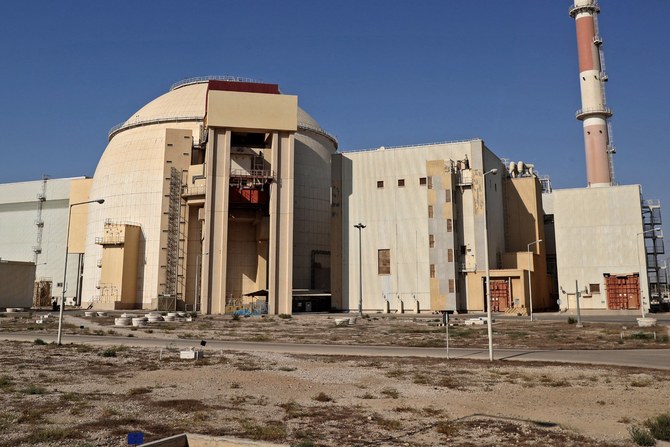
United Nations: Iran temporarily closed its nuclear facilities over “security considerations” in the wake of its massive missile and drone attack on Israel over the weekend, the head of the UN’s atomic watchdog said Monday.
Speaking to journalists on the sidelines of a UN Security Council meeting, International Atomic Energy Agency (IAEA) chief Rafael Grossi was asked whether he was concerned about the possibility of an Israeli strike on an Iranian nuclear facility in retaliation for the attack.
“We are always concerned about this possibility. What I can tell you is that our inspectors in Iran were informed by the Iranian government that yesterday (Sunday), all the nuclear facilities that we are inspecting every day would remain closed on security considerations,” he said.
The facilities were to reopen on Monday, Grossi said, but inspectors would not return until the following day.
“I decided to not let the inspectors return until we see that the situation is completely calm,” he added, while calling for “extreme restraint.”
Iran launched more than 300 drones and missiles at Israel overnight from Saturday into Sunday in retaliation for an air strike on a consular building in Damascus that killed seven of its Revolutionary Guards, two of them generals.
Israel and its allies shot down the vast majority of the weapons, and the attack caused only minor damage, but concerns about a potential Israeli reprisal have nevertheless stoked fears of all-out regional war.
Israel has carried out operations against nuclear sites in the region before.
In 1981, it bombed the Osirak nuclear reactor in Saddam Hussein’s Iraq, despite opposition from Washington. And in 2018, it admitted to having launched a top-secret air raid against a reactor in Syria 11 years prior.
Israel is also accused by Tehran of having assassinated two Iranian nuclear physicists in 2010, and of having kidnapped another the previous year.
Also in 2010, a sophisticated cyberattack using the Stuxnet virus, attributed by Tehran to Israel and the United States, led to a series of breakdowns in Iranian centrifuges used for uranium enrichment.
Israel accuses Iran of wanting to acquire an atomic bomb, something Tehran denies.

Iran closed nuclear facilities in wake of Israel attack: IAEA chief
https://arab.news/6vstu
Iran closed nuclear facilities in wake of Israel attack: IAEA chief
- Israel has carried out operations against nuclear sites in the region before
- Israel accuses Iran of wanting to acquire an atomic bomb, something Tehran denies
Aid workers find little life in El-Fasher after RSF takeover
- First UN visit to the devastated Sudanese city finds traumatized civilians in ‘unsafe conditions’
PORT SUDAN: Traumatized civilians left in Sudan’s El-Fasher after its capture by paramilitary forces are living without water or sanitation in a city haunted by famine, UN aid coordinator Denise Brown said on Monday.
El-Fasher fell to the paramilitary Rapid Support Forces in October after more than 500 days of siege, and last Friday, a small UN humanitarian team was able to make its first short visit in almost two years.
Mass atrocities, including massacres, torture, and sexual violence, reportedly accompanied the capture of the city. Satellite pictures reviewed by AFP show what appear to be mass graves.
FASTFACT
From a humanitarian point of view, UN aid coordinator Denise Brown said, El-Fasher remains Sudan’s ‘epicenter of human suffering’ and the city — which once held more than a million people — is still facing a famine.
Brown described the city as a “crime scene,” but said human rights experts would carry out investigations while her office focuses on restoring aid to the survivors.
“We weren’t able to see any of the detainees, and we believe there are detainees,” she said.
From a humanitarian point of view, she said, El-Fasher remains Sudan’s “epicenter of human suffering” and the city — which once held more than a million people — is still facing a famine.
“El-Fasher is a ghost of its former self,” Brown said in an interview.
“We don’t have enough information yet to conclude how many people remain there, but we know large parts of the city are destroyed. The people who remain, their homes have been destroyed.”
“These people are living in very precarious situations,” warned Brown, a Canadian diplomat and the UN’s humanitarian coordinator in Sudan.
“Some of them are in abandoned buildings. Some of them ... in very rudimentary conditions, plastic sheeting, no sanitation, no water. So these are very undignified, unsafe conditions for people.”
Since April 2023, Sudan has been gripped by a conflict between the regular army and its former allies, the RSF, which has triggered a humanitarian catastrophe.
Brown said the team “negotiated hard with the RSF” to obtain access and managed to look around, visit a hard-pressed hospital, and some abandoned UN premises — but only for a few hours.
Their movements were also limited by fears of unexploded ordnance and mines left behind from nearly two years of fighting.
“There was one small market operating, mostly with produce that comes from surrounding areas, so tomatoes, onions, potatoes,” she said.
“Very small quantities, very small bags, which tells you that people can’t afford to buy more.”
“There is a declared famine in El-Fasher. We’ve been blocked from going in. There’s nothing positive about what’s happened in El-Fasher.
“It was a mission to test whether we could get our people safely in and out, to have a look at what remains of the town, who remains there, what their situation is,” she said.
The war in Sudan has killed tens of thousands of people, driven 11 million from their homes, and caused what the UN has declared “the world’s worst humanitarian disaster.”