

’No longer a shadow war’: Iran says attack on Israel marks strategic shift

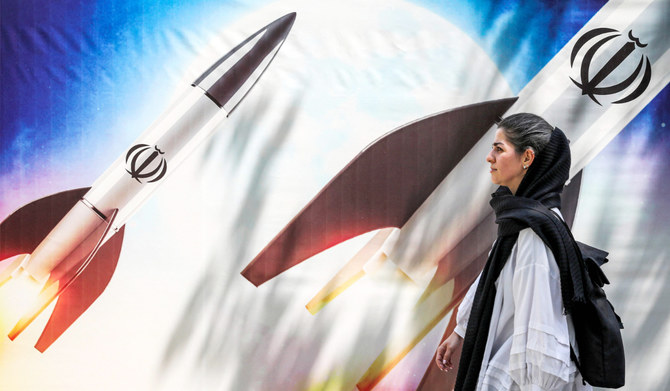
A woman walks past a banner depicting launching missiles bearing the emblem of the Islamic Republic of Iran in central Tehran on April 15, 2024. (AFP)
Short Url
Updated 16 April 2024
Follow

’No longer a shadow war’: Iran says attack on Israel marks strategic shift

  • Israel’s military said it intercepted 99 percent of the aerial threats with the help of the United States and other allies, and that the overnight attack caused only minor damage
  • Israel has killed at least 33,797 Palestinians in Gaza, mostly women and children, according to the health ministry in the Hamas-run territory

TEHRAN: Iran’s missile and drone barrage against Israel was the first act of a tough new strategy, Tehran says, warning arch foe Israel that any future attack will spark “a direct and punishing response.”
This spells a dramatic shift from past years in which the Islamic republic and Israel have fought a shadow war of proxy fights and covert operations across the Middle East and sometimes further afield.
Iran from late Saturday launched hundreds of drones and missiles, including from its own territory, directly at Israel, to retaliate for a deadly April 1 strike on Iran’s consulate in Damascus.
Israel’s military said it intercepted 99 percent of the aerial threats with the help of the United States and other allies, and that the overnight attack caused only minor damage.
Iran said it had dealt “heavy blows” to Israel and hailed the operation as “successful.”
“Iran’s victorious... operation means that the era of strategic patience is over,” the Iranian president’s political deputy, Mohammad Jamshidi wrote on X.
“Now the equation has changed. Targeting Iranian personnel and assets by the regime will be met with a direct and punishing response.”
President Ebrahim Raisi said the operation had “opened a new page” and “taught the Zionist enemy (Israel) a lesson.”
Iran said it acted in self-defense after the Damascus strike levelled the consular annexe of its embassy and killed seven members of the Islamic Revolutionary Guard Corps (IRGC), including two generals.
Western governments denounced Iran’s retaliation as “destabilising the region.”
Iran, however, insisted the attack was “limited” and urged Western nations to “appreciate (its) restraint” toward Israel, especially since the outbreak of the Gaza war on October 7.
Regional tensions have soared amid the Israel-Hamas war which has drawn in Iran-backed armed groups in Lebanon, Syria, Iraq and Yemen.
Several IRGC members, including senior commanders, have been killed in recent months in strikes in Syria which Iran has also blamed on Israel.

Since the 1979 Islamic revolution, Iran has frequently called for Israel’s destruction and made support for the Palestinian cause a centerpiece of its foreign policy.
But it had refrained from directly striking Israel until Saturday, an attack on a scale which appeared to catch many in the international community by surprise.
For decades, Iran relied on a network of allied groups to exert its influence in the region and to deter Israel and the United States, according to experts.
A 2020 report by the Washington Institute said that Tehran had adopted a policy of “strategic patience,” which had “served it well since the inception of the Islamic republic in 1979.”
Former moderate president Hassan Rouhani was a staunch defender of the strategy, especially following Washington’s 2018 withdrawal from a landmark nuclear deal, advocating for Tehran not to take immediate countermeasures and taking a longer view.
Even after the 2020 US killing of Qasem Soleimani, an IRGC commander revered in Iran, Tehran gave prior warning to Washington, US sources said, before it launched missiles against two American bases in Iraq, and no soldiers were killed in the attack.
After Saturday’s attack on Israel, Guards chief Hossein Salami also said Iran was “creating a new equation.”
“Should the Zionist regime attack our interests, our assets, our personnel and citizens at any point, we will counterattack it from the Islamic Republic of Iran,” he was quoted as saying by local media.
The attack was also hailed as a “historic” success by Iranian media, with the government-run newspaper Iran saying the offensive “has created a new power equation in the region.”
The ultra-conservative daily Javan said the attack was “an experience Iran needed, to know how to act in future battles” and that it would make Israel “think long before (committing) any crime” against Tehran.
The reformist Ham Mihan newspaper said the attack “ended the status quo and broke the rules of the conflict that pitted the two sides against each other for 20 years and pushed the situation into another phase.”
“This is no longer a shadow war,” it said.

The children in Israel’s prisons
Ongoing hostage-for-prisoners exchange opens the world’s eyes to arrests, interrogations, and even abuse of Palestinian children by Israeli authorities

Enter


keywords

Aoun slams ‘systematic policy of aggression’ as Israeli strikes kill 2, wound journalists in south Lebanon escalation

Updated 4 sec ago
Follow

Aoun slams ‘systematic policy of aggression’ as Israeli strikes kill 2, wound journalists in south Lebanon escalation

  • Lebanese Army: Attacks terrorize civilians and hinder weapons control plan
  • Israeli army spokesperson said military eliminated Abu Ali Salameh, who served as a Hezbollah liaison officer in the area
  • Israeli drones targeted sites with heavy airstrikes, wounding journalists in Qanarit and destroying their equipment, cameras and vehicles

BEIRUT: Two people were killed and several journalists wounded in a series of Israeli attacks on Wednesday targeting southern areas, most of which lie north of the Litani River.

The Lebanese Army Command described the escalation as “impeding the army’s efforts and hindering the completion of its plan to confine weapons to Lebanese territory.” It said that the strikes terrorized civilians, caused deaths and injuries, displaced dozens of families and undermined regional stability.

The day’s security situation was dominated by hours of Israeli escalation, including airstrikes and evacuation warnings targeting villages and populated areas ahead of further bombardment.

The Israeli army said that warplanes carried out precision strikes on civilian vehicles in Bazouriyeh, killing a Hezbollah member. A separate drone strike hit a civilian vehicle on the Zahrani-Mseileh road, killing one person, with Israel claiming the target was another Hezbollah operative.

Israeli army spokesman Avichai Adraee said that the military “eliminated Abu Ali Salameh, who served as a Hezbollah liaison officer” in the village of Yanouh, in southern Lebanon. He accused Salameh of managing Hezbollah activities to “enable the group to operate within civilian areas and on private property, and to establish terrorist infrastructure in the heart of populated civilian areas, through the deliberate and cynical exploitation of the residents to serve Hezbollah’s objectives.”

Adraee claimed that on Dec. 13, Israel alerted Lebanon’s enforcement mechanism about a Hezbollah weapons depot in Yanouh. Salameh allegedly relayed the notification to other Hezbollah members, who then blocked Lebanese army access by staging a gathering while removing weapons from the site.

He said that Salameh also coordinated with the Lebanese army to falsely document the property as weapons-free, even as “suspicious boxes” were removed via a back entrance. Adraee called these actions a violation of Israel-Lebanon understandings, adding that “the Israeli army will continue to take measures to eliminate all threats.”

Israeli artillery also shelled the Harmoun area in the Bint Jbeil district, south of the Litani River, prompting Israeli army warnings — complete with maps — for residents of Qanarit, Kfour in Nabatieh and Jarjouh to evacuate immediately.

Israeli drones then hammered the sites with heavy airstrikes, wounding journalists in Qanarit and destroying their equipment, cameras and vehicles.

The Press Photographers Syndicate said: “Israeli claims of maintaining safe distances offer no protection, just as the warnings issued by the enemy to civilians offer no protection. It seems that cameras are not a red line.”

The statement urged photojournalists “to exercise caution and avoid turning their professional commitment into a reckless gamble.” 

Civilians in the targeted areas reported receiving phone calls from Israel ordering them to clear squares, residential neighborhoods and a mosque.

The Lebanese Army Command confirmed that “Israeli attacks and violations targeted civilian buildings and homes in several areas, most recently in villages in the south, in a blatant violation of Lebanon’s sovereignty and security, the cessation of hostilities agreement, and UN Security Council Resolution 1701.”

Lebanese President Joseph Aoun issued a statement on Wednesday evening condemning the strikes and accused Tel Aviv of “pursuing a systematic policy of aggression” that targeted civilians and violated international humanitarian law, and constituted “a dangerous escalation.”

“This repeated aggressive behavior proves Israel’s refusal to abide by its commitments under the cessation of hostilities agreement and reflects a deliberate disregard for the efforts exerted by the Lebanese state to control the situation on the ground, maintain stability, and prevent the escalation of the confrontation,” he said.

He called on the international community — particularly the agreement’s sponsors — “to assume their legal and political responsibilities and take clear and effective measures to stop these violations and put an end to the policy of impunity.”

The escalation also came as Aoun reaffirmed his commitment to “monopolizing weapons in the hands of the state throughout all Lebanese territory.”

At a meeting of the Higher Supervisory Committee for Lebanon’s border protection program — attended by the US and Canadian ambassadors — Army Commander Gen. Rudolph Haykal stressed the army’s “absolute commitment” to securing borders but called for “qualitative military support” to tackle challenges on the northern and eastern fronts.

The army said that the ambassadors praised “its professionalism and success,” stressing the need to bolster the military institution to enhance its ability to maintain security nationwide. Lebanese military units are currently securing the northern and eastern borders with Syria to combat smuggling, weapons transfers and illegal infiltration.