

Iraqi leader calls for restraint in Middle East during Washington visit

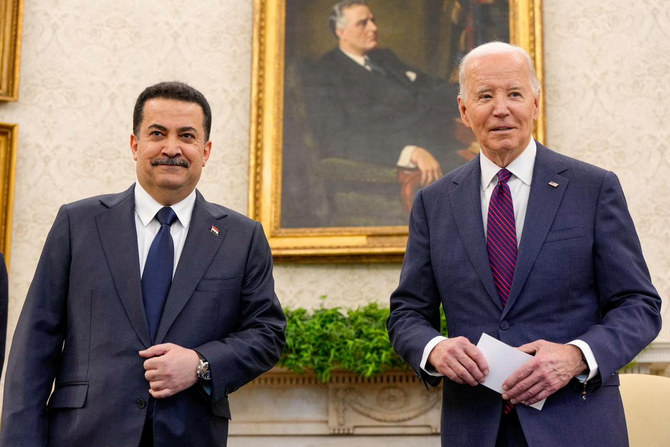
US President Joe Biden meets with Iraqi Prime Minister Mohammed Shia Al-Sudani at the White House in Washington, US, April 15, 2024. (Reuters)
Short Url
Updated 16 April 2024
Follow

Iraqi leader calls for restraint in Middle East during Washington visit

  • “We encourage all the efforts of stopping the expansion of the area of conflict, especially the latest development,” Sudani said
  • The meetings come as US ally Israel weighs its response to Iran’s missile and drone attack

WASHINGTON: Iraqi Prime Minister Mohammed Shia Al-Sudani called for restraint in the Middle East on Monday during talks in Washington as tensions soar between Iran and Israel after Tehran’s weekend strikes.
“We encourage all the efforts of stopping the expansion of the area of conflict, especially the latest development,” Sudani said at the White House at the start of a meeting with President Joe Biden.
The meetings come as US ally Israel weighs its response to Iran’s missile and drone attack, with the United States and Europe urging restraint.
Iraq is a rare ally of both Washington and Tehran. Iraqi airspace was a main route for Iran’s unprecedented drone and ballistic missile attack on Israel, and Iraqi officials say Iran informed them, as well as other countries in the region, ahead of the attack.
Sudani is leading a delegation that is meeting officials across Washington on Monday, including Biden and Defense Secretary Lloyd Austin.
“In the spirit of partnership our views may be divergent about what’s happening in the region,” Sudani said through a translator as he sat next to Biden in the Oval Office.
“But we agree certainly about the international law, the international humanitarian law and the responsibility to protect and the law of war, and we reject any repression against the civilians, especially women and children, and we encourage the commitment about respecting international norms and diplomatic missions.”
Biden said Washington was committed to Israel’s security and to bringing an end to fighting in Gaza.
“We’re committed to a ceasefire that will bring the hostages home and preventing conflict from spreading beyond what it already has,” Biden said.
“The partnership between the United States and Iraq is critical,” he added, noting efforts against Daesh and the two nations’ critical strategic agreement.
Deputy Prime Minister Muhammad Ali Tamim, who co-chaired a meeting of the US-Iraq Higher Coordinating Committee with US Secretary of State Antony Blinken, said Iraq was concerned about its region being “dragged into a wider war that will threaten international security and safety.”
“And therefore we call on all parties for self restraint and respect the rules of diplomatic works and also international laws,” he said.
US and other Western officials have welcomed economic reform plans put forward by Sudani, but concerns remain over the influence of Iran-backed groups. Shiite Muslim armed groups have engaged in tit-for-tat attacks on US forces linked to Israel’s war in Gaza.
The US invaded Iraq in 2003 to topple Saddam Hussein and withdrew in 2011, only for troops to return in 2014 to help fight Daesh after the militant group overran large parts of the country.
Washington and Baghdad are in talks over ending the US-led military coalition in the country, although the Higher Coordinating Committee is tasked with discussing other aspects of the relationship, including economic ties.
Blinken, who reiterated that Washington does not want to see the regional conflict swell, said the meetings would focus on issues including energy security, democracy, the rule of law, climate and water, and noted US private sector interest, especially in Iraq’s energy sector.
“Through these efforts we look forward to helping advance the prime minister’s affirmative agenda, and seeing Iraq succeed,” Blinken said.

The children in Israel’s prisons
Ongoing hostage-for-prisoners exchange opens the world’s eyes to arrests, interrogations, and even abuse of Palestinian children by Israeli authorities

Enter


keywords

UN rights chief Shocked by ‘unbearable’ Darfur atrocities

Updated 18 January 2026
Follow

UN rights chief Shocked by ‘unbearable’ Darfur atrocities

  • Mediation efforts have failed to produce a ceasefire, even after international outrage intensified last year with reports of mass killings, rape, and abductions during the RSF’s takeover of El-Fasher in Darfur

PORT SUDAN: Nearly three years of war have put the Sudanese people through “hell,” the UN’s rights chief said on Sunday, blasting the vast sums spent on advanced weaponry at the expense of humanitarian aid and the recruitment of child soldiers.
Since April 2023, Sudan has been gripped by a conflict between the army and the paramilitary Rapid Support Forces that has left tens of thousands of people dead and around 11 million displaced.
Speaking in Port Sudan during his first wartime visit, UN Human Rights commissioner Volker Turk said the population had endured “horror and hell,” calling it “despicable” that funds that “should be used to alleviate the suffering of the population” are instead spent on advanced weapons, particularly drones.
More than 21 million people are facing acute food insecurity, and two-thirds of Sudan’s population is in urgent need of humanitarian aid, according to the UN.
In addition to the world’s largest hunger and displacement crisis, Sudan is also facing “the increasing militarization of society by all parties to the conflict, including through the arming of civilians and recruitment and use of children,” Turk added.
He said he had heard testimony of “unbearable” atrocities from survivors of attacks in Darfur, and warned of similar crimes unfolding in the Kordofan region — the current epicenter of the fighting.
Testimony of these atrocities must be heard by “the commanders of this conflict and those who are arming, funding and profiting from this war,” he said.
Mediation efforts have failed to produce a ceasefire, even after international outrage intensified last year with reports of mass killings, rape, and abductions during the RSF’s takeover of El-Fasher in Darfur.
“We must ensure that the perpetrators of these horrific violations face justice regardless of the affiliation,” Turk said on Sunday, adding that repeated attacks on civilian infrastructure could constitute “war crimes.”
He called on both sides to “cease intolerable attacks against civilian objects that are indispensable to the civilian population, including markets, health facilities, schools and shelters.”
Turk again warned on Sunday that crimes similar to those seen in El-Fasher could recur in volatile Kordofan, where the RSF has advanced, besieging and attacking several key cities.
Hundreds of thousands face starvation across the region, where more than 65,000 people have been displaced since October, according to the latest UN figures.