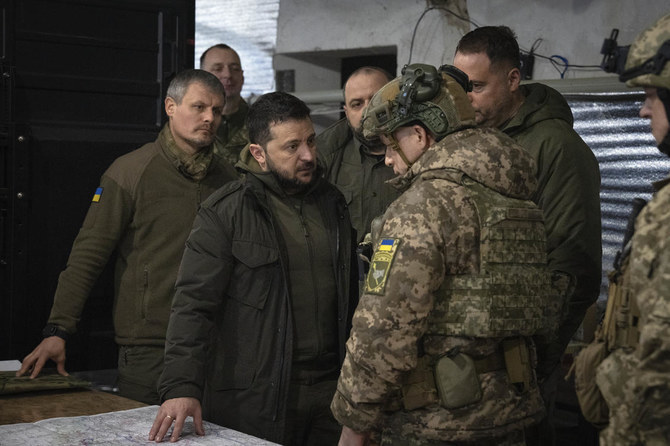

KYIV: Ukraine’s army chief said on Saturday the situation on the eastern front had worsened in recent days as Russia has intensified its armored assaults and battles rage for control of a village west of the devastated city of Bakhmut.
The statement by Col. General Oleksandr Syrskyi more than two years since Russia’s invasion reflected the grim mood in Kyiv as vital US military aid that Kyiv expected to receive months ago remains stuck in Congress.
Syrskyi said he traveled to the area to stabilize the front as Russian assault groups using tanks and armored personnel carriers took advantage of dry, warm weather that has made it easier to maneuver.
“The situation on the eastern front in recent days has grown considerably more tense. This is linked primarily to the significant activization of offensive action by the enemy after the presidential elections in Russia,” he wrote on the Telegram app.
Since President Vladimir Putin won a new term in a stage-managed mid-March election, Russia has stepped up its attacks on Ukraine and unleashed three massive aerial strikes on its energy system, pounding power plants and substations.
The slowdown in military assistance from the West has left Ukraine more exposed to aerial attacks and heavily outgunned on the battlefield. Kyiv has made increasingly desperate appeals for supplies of air defense missiles in recent weeks.
Moscow’s forces, Syrskyi said, were taking significant losses during their attacks in the east, but were also making tactical gains.
Social media channels reported the fall of Ukraine’s eastern village of Bohdanivka to the west of the occupied city of Bakhmut, prompting Kyiv’s defense ministry to deny them.
But it acknowledged fierce fighting in the area and said Russian assault groups had reached the village’s northern outskirts overnight. “Bohdanivka is now under the control of the defense forces,” it said.
The settlement lies a few kilometers northeast of the town of Chasiv Yar, a Kyiv-controlled stronghold that Russia has been trying to reach after seizing the town of Avdiivka in February to the south.
SEIZE THE STRATEGIC INITIATIVE
Russia’s defense ministry said on Saturday its forces had captured Pervomaiske, a village to the south also located in Ukraine’s Donetsk region where Moscow has focused its offensive operations for months.
Moscow said its troops had improved their tactical position on the front line there after capturing the village 8 kilometers (4.97 miles) southwest of occupied Avdiivka. Kyiv did not immediately comment on the status of Pervomaiske.
Syrskyi said Russian armored assault groups were attacking on the fronts of Lyman as well as Bakhmut and using dozens of tanks and armored personnel carriers to try to break through lines on the Pokrovsk front.
President Volodymyr Zelensky, who has warned Russia may be preparing a big offensive push in late May or in June, inspected domestically-produced weapons at an event outside Kyiv where he presented state awards to Ukrainian arms producers.
At the event, Ukraine’s military drone forces chief said supplies of drones to the front lines this year were already three times higher than the volume supplied over the course of the whole of last year, the Interfax-Ukraine news agency reported.
He also said Ukraine had strike drones capable of flying 1,200 km.
In his statement, Syrskyi said only a technological edge over Russia in sophisticated weapons would allow Kyiv “to seize the strategic initiative” from a better equipped and larger foe.
He called for better training for soldiers and in particular infantry, a clear reference to Ukraine’s manpower challenges.
Ukraine’s parliament passed a bill on Thursday to overhaul how the armed forces draft civilians into the ranks. Zelensky also signed legislation last week lowering the draft age from 27 to 25.