Argentina court blames ‘terrorist state’ Iran for 1990s attacks

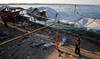
Rescuers search for people from the rubble of the building housing the Argentinian Israelite Mutual Association (AMIA in Spanish) that was demolished in a powerful bomb explosion in Buenos Aires on July 18, 1994. (Ali Burafi / AFP)
Short Url
Updated 12 April 2024
Follow

Argentina court blames ‘terrorist state’ Iran for 1990s attacks

  • Court found that Iran ordered the bomb attacks on Israel’s embassy in Buenos Aires in 1992 and on the AMIA Jewish center in 1994
  • The embassy blast killed 29 and the AMIA Jewish Center bombing left 85 dead and 300 injured
  • Prosecutors charged top Iranian officials with ordering the attacks. Tehran has denied any involvement

BUENOS AIRES: Over three decades after deadly attacks in Buenos Aires targeted Israel’s embassy and a Jewish center, an Argentine court placed the blame Thursday on Iran and declared it a “terrorist state,” according to local media.

The ruling, cited by press reports, said Iran had ordered the attack in 1992 on Israel’s embassy and the 1994 attack on the Argentine Israelite Mutual Association (AMIA) Jewish center.
The court also implicated the Iran-backed Shiite movement Hezbollah and called the attack against the AMIA — the deadliest in Argentina’s history — a “crime against humanity,” according to court documents cited by media reports.
“Hezbollah carried out an operation that responded to a political, ideological and revolutionary design under the mandate of a government, of a State,” Carlos Mahiques, one of the three judges who issued the decision, told Radio Con Vos, referencing Iran.
In 1992, a bomb attack on the Israeli embassy left 29 dead. Two years later, a truck loaded with explosives drove into the AMIA Jewish center and detonated, leaving 85 dead and 300 injured.
The 1994 assault has never been claimed or solved, but Argentina and Israel have long suspected Lebanon’s Shiite Hezbollah group carried it out at Iran’s request.
Prosecutors charged top Iranian officials with ordering the attack. Tehran has denied any involvement.
Argentina has the largest Jewish community in Latin America, with some 300,000 members.
It also is home to immigrant communities from the Middle East — from Syria and Lebanon in particular.
The judges ruled Thursday that the AMIA attack was a crime against humanity, and put blame on then-president Ali Akbar Hashemi Bahramaie Rafsanjani as well as other Iranian officials and Hezbollah members.
The decision was welcomed by the president of the Delegation of Israelite Associations of Argentina (DAIA), Jorge Knoblovits.
He told Radio Mitre the ruling “is very important, because it enables the victims to go to the International Criminal Court.”
Former Argentine president Carlos Menem, who died in 2021 and was the president at the time of both attacks, was tried for covering up the AMIA bombing, but ultimately acquitted.
His former intelligence chief Hugo Anzorreguy was sentenced to four-and-a-half years in jail for his role in obstructing the probe.
He was among some dozen defendants who faced a slew of corruption and obstruction of justice charges in the case, including the former judge who led the investigation into the attack, Juan Jose Galeano, who in 2019 was jailed for six years for concealment and violation of evidence.


Fourth Palestine Action activist ends hunger strike in UK prison

Protesters take part in a demonstration in support of "Defend Our Juries" and their campaign against the ban on Palestine Action
Updated 5 sec ago
Follow

Fourth Palestine Action activist ends hunger strike in UK prison

  • Amy Gardiner-Gibson began eating again after 49 days of protest
  • Govt rejects claims it ignored prison safety protocols

LONDON: A fourth Palestine Action activist imprisoned in the UK has ended her hunger strike.

Amy Gardiner-Gibson, who also uses the name Amu Gib, began eating again after 49 days of fasting, the campaign group Prisoners for Palestine said.

Qesser Zuhrah, another activist, ended her hunger strike last week after 48 days but said she might resume it next year, Sky News reported.

Four Palestine Action activists have now ended their hunger strikes while in prison, while four others are continuing to fast.

All of them are in prison on remand, awaiting trial for a series of high-profile alleged break-ins and criminal damage.

Palestine Action was proscribed as a terrorist organization and banned earlier this year.

On Tuesday, Swedish climate activist Greta Thunberg was arrested in central London at a rally in support of the hunger strikers.

The protesters are demanding that weapons factories in Britain with ties to Israel be shut down, as well as the removal of Palestine Action’s proscription.

They are also calling for immediate bail to be given to imprisoned pro-Palestine activists and an end to the alleged mistreatment of prisoners in custody.

Seven imprisoned members of Palestine Action have been transferred to hospital over the course of the hunger strike campaign. Doctors have highlighted concerns about the long-term impact of fasting on the activists.

Lawyers representing the group on Monday initiated legal action against the government over its alleged failure to follow prison safety regulations.

The government, however, has rejected this accusation, Sky News reported.

A Ministry of Justice spokesperson said: “Ministers do not intervene in individual cases. Where individuals are on remand, doing so would risk prejudicing ongoing legal proceedings and undermine the independence of the justice system.

“Concerns about welfare and process can be raised through established legal and administrative channels, including prison governors and ultimately the prison and probation ombudsman.

“Healthcare decisions are taken independently by qualified NHS professionals and appropriate care and oversight frameworks remain in place.”

The activists still on hunger strike include Heba Muraisi and Teuta Hoxha. Hoxha has been on remand for 13 months and her family told Sky News they feared she would die in prison.

Another of the activists, Kamran Ahmad, is believed to have been on hunger strike for 45 days and hospitalized three times.

Lewie Chiaramello, who has Type 1 diabetes, is on day 31 of his strike and taking part by fasting every other day.