

Japanese astronaut to be first non-American to set foot on moon

US President Joe Biden and Japan's Prime Minister Fumio Kishida attend an official state dinner at the White House in Washington on April 10, 2024. (REUTERS)
Short Url
Updated 11 April 2024
Follow

Japanese astronaut to be first non-American to set foot on moon

  • President Biden announced the offer to Japan as the US seeks to strengthen ties with its key Asian ally
  • NASA’s Artemis program seeks to return humans to the Moon for the first time in over 50 years
  • PM Kishida hailed the announcement and said that Japan would in return supply a rover for the program

WASHINGTON: A lucky Japanese astronaut will become the first non-American to set foot on the Moon during one of NASA’s upcoming Artemis missions, US President Joe Biden announced Wednesday.

The offer to Japan — an opportunity many nations have long dreamed of — came as part of Prime Minister Fumio Kishida’s state visit, and as Washington seeks to strengthen ties with its key Asian ally.
“Two Japanese astronauts will join future American missions, and one will become the first non-American ever to land on the Moon,” Biden said in a press conference with Kishida.
Kishida hailed the announcement as a “huge achievement” and announced that Japan would in return supply a rover for the program.
NASA’s Artemis program seeks to return humans to the Moon for the first time in over 50 years, and to build a sustained lunar presence ahead of potential missions to Mars.



CEO of Venturi Astrolabe Jaret Matthews speaks in front of a mock-up of the the LTV (Lunar Terrain Vehicle) is shown on a screen during a news conference at the Johnson Space Center in Houston, Texas, on April 3, 2024, to announce the new vehicle which will help Artemis astronauts explore the moon on future missions. (AFP)

Between 1969 and 1972, the US Apollo program saw 12 Americans — all white men — walk on the Moon.
NASA previously announced that the Artemis program would see the first woman and the first person of color land on the Moon.
“America will no longer walk on the Moon alone,” NASA chief Bill Nelson said in a video published on social media.
“Diplomacy is good for discovery. And discovery is good for diplomacy,” he added.
The first mission to take astronauts to the lunar surface, Artemis 3, is planned for 2026. China meanwhile has said it seeks to put humans on the Moon by 2030.

Tokyo and Washington have worked together in the space sector for years, notably collaborating on operations at the International Space Station (ISS).
And this year, Japan became the fifth country to succeed in landing a spacecraft on the Moon, with its SLIM craft touching down in January.
In a joint media release, the United States and Japan clarified that a Japanese national would land on the Moon “assuming important benchmarks are achieved,” without clarifying further.
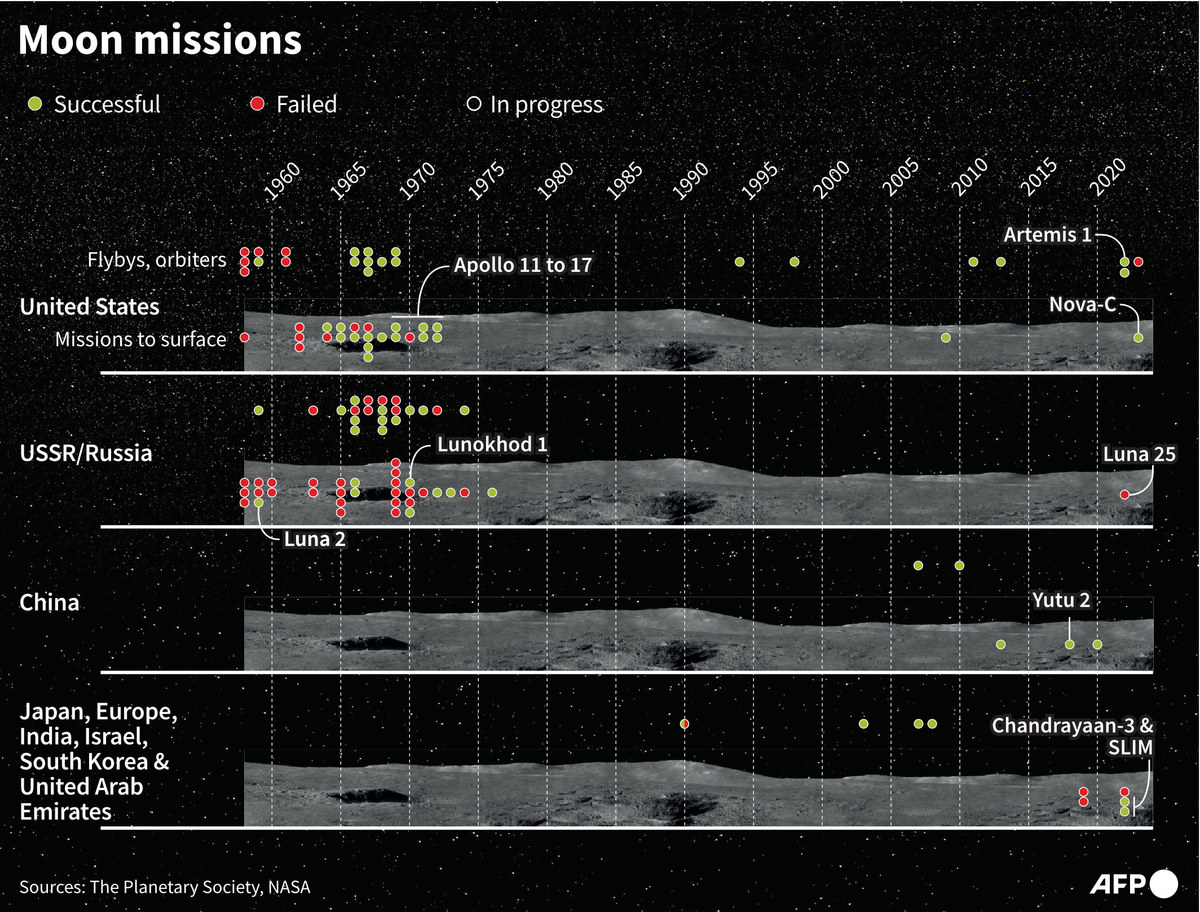


History of Moon missions, by country and by type of mission. (AFP)

The lunar rover provided by Japan in return will be pressurized, meaning astronauts can travel farther and work for longer periods on the lunar surface, according to the statement.
It added that the pressurized rover will accommodate two astronauts in the “mobile habitat and laboratory” for up to 30 days as they explore the area near the lunar South Pole.
NASA currently plans to use the rover on the future Artemis 7 mission, followed by subsequent missions over a 10-year lifespan.

The European Space Agency (ESA) has three seats reserved for future Artemis missions in exchange for technological contributions to the program.
However, it is still unclear whether European astronauts will have the chance to step foot on the Moon or just fly around it.
Daniel Neuenschwander, director of human and robotic exploration at the ESA, said these details of the agreement with NASA were still “subject to further discussions.”
Neuenschwander added in a phone interview with AFP on Wednesday that he could “perfectly understand” the cooperation between the United States and Japan, acknowledging “geostrategic” motives for the agreement.
The Artemis space program was inaugurated in 2022 with Artemis 1, which successfully flew an uncrewed vessel around the Moon.
Artemis 2 is planned for 2025 and will send four astronauts around the Moon without landing. The crew will consist of three Americans and a Canadian, who are currently in training.
The first crewed landing on the Moon will be Artemis 3, currently scheduled for 2026. NASA has not yet announced who will take part in the mission.


How decades of deforestation led to catastrophic Sumatra floods

Updated 9 sec ago
Follow

How decades of deforestation led to catastrophic Sumatra floods

  • At least 1.4m hectares of forest in flood-affected provinces were lost to deforestation since 2016
  • Indonesian officials vow to review permits, investigate companies suspected of worsening the disasters

JAKARTA: About a week after floods and landslides devastated three provinces in Indonesia’s Sumatra island, Rubama witnessed firsthand how the deluge left not only debris and rubble but also log after log of timber.

They were the first thing that she saw when she arrived in the Beutong Ateuh Banggalang district of Aceh, where at least two villages were wiped out by floodwaters.

“We saw these neatly cut logs moving down the river. Some were uprooted from the ground, but there are logs cut into specific sizes. This shows that the disaster in Aceh, in Sumatra, it’s all linked to illegal forestry practices,” Rubama, empowerment manager at Aceh-based environmental organization HAKA, told Arab News.

Monsoon rains exacerbated by a rare tropical storm caused flash floods and triggered landslides across Aceh, North Sumatra, and West Sumatra in late November, killing 969 people and injuring more than 5,000 as of Wednesday, as search efforts continue for 252 others who remain missing.

In the worst-hit areas, residents were cut off from power and communication for days, as floodwater destroyed bridges and torrents of mud from landslides blocked roads, hampering rescue efforts and aid delivery to isolated villages.

When access to the affected regions gradually improved and the scale of the disaster became clearer, clips of washed-up trunks and piles of timber crashing into residential areas circulated widely online, showing how the catastrophic nature of the storm was compounded by deforestation.

“This is real, we’re seeing the evidence today of what happens when a disaster strikes, how deforestation plays a major role in the aftermath,” Rubama said.

For decades, vast sections of Sumatra’s natural forest have been razed and converted for mining, palm oil plantations and pulpwood farms.

Around 1.4 million hectares of forest in Aceh, North Sumatra and West Sumatra were lost to deforestation between 2016 and 2025 alone, according to Indonesian environmental group WALHI, citing operations by 631 permit-holding companies.

Deforestation in Sumatra stripped away natural defenses that once absorbed rainfall and stabilized soil, making the island more vulnerable to extreme weather, said Riandra Purba, executive director of WALHI’s chapter in North Sumatra.

Purba said the Sumatra floods should serve as a “serious warning” for the government to issue permits more carefully.

“Balancing natural resource management requires a sustainable approach. We must not sacrifice natural benefits for the financial benefit of a select few,” he told Arab News.

“(The government) must evaluate all the environmental policies in the region … (and) implement strict monitoring, including law enforcement that will create a deterrent effect to those who violate existing laws.”

In Batang Toru, one of the worst-hit areas in North Sumatra where seven companies operate, hundreds of hectares had been cleared for gold mining and energy projects, leaving slopes exposed and riverbeds choked with sediment.

When torrential rains hit last month, rivers in the area were swollen with runoff and timber, while villages were buried or swept away.

As public outrage grew in the wake of the Sumatra floods, Indonesian officials, including Environment Minister Hanif Faisol Nurofiq, have moved to review existing permits and investigate companies suspected of worsening the disaster. 

“Our focus is to ensure whether company activities are influencing land stability and (increasing) risks of landslides or floods,” Nurofiq told Indonesian magazine Tempo on Saturday.

Sumatra’s natural forest cover stood at about 11.6 million hectares as of 2023, or about 24 percent of the island’s total area, falling short of the 30 to 33 percent forest coverage needed to maintain ecological balance.

The deadly floods and landslides in Sumatra also highlighted the urgency of disaster mitigation in Indonesia, especially amid the global climate crisis, said Kiki Taufik, forest campaigner at Greenpeace Indonesia. 

Over two weeks since floods and landslides inundated communities in Sumatra, a few villages remain isolated and over 800,000 people are still displaced. 

“This tropical cyclone, Senyar, in theory, experts said that it has a very low probability of forming near the equator, but what we have seen is that it happened, and this is caused by rapid global warming … which is triggering hydrometeorological disasters,” Taufik told Arab News.

“The government needs to give more attention, and even more budget allocation, to mitigate disaster risks … Prevention is much more important than (disaster) management, so this must be a priority for the government.”