

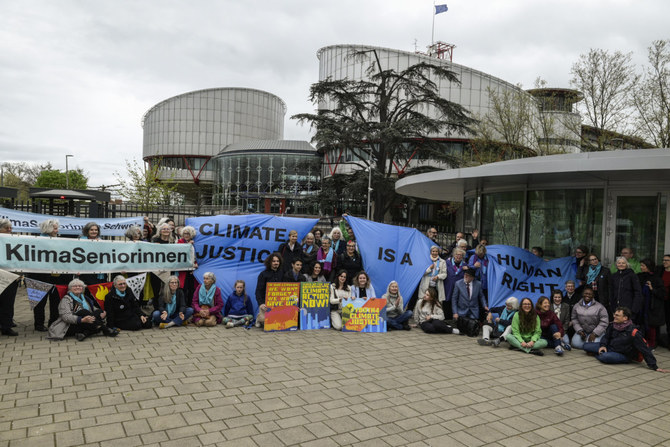

STRASBOURG, France: Europe’s highest human rights court ruled Tuesday that countries must better protect their people from the consequences of climate change, siding with a group of older Swiss women against their government in a landmark ruling that could have implications across the continent.
The European Court of Human Rights rejected two other, similar cases on procedural grounds — a high-profile one brought by Portuguese young people and another by a French mayor that sought to force governments to reduce greenhouse gas emissions.
But the Swiss case, nonetheless, sets a legal precedent in the Council of Europe’s 46 member states against which future lawsuits will be judged.
“This is a turning point,” said Corina Heri, an expert in climate change litigation at the University of Zurich.
Although activists have had success with lawsuits in domestic proceedings, this was the first time an international court ruled on climate change — and the first decision confirming that countries have an obligation to protect people from its effects, according to Heri.
She said it would open the door to more legal challenges in the countries that are members of the Council of Europe, which includes the 27 EU nations as well as many others from Britain to Turkiye.
The Swiss ruling softened the blow for those who lost Tuesday.
“The most important thing is that the court has said in the Swiss women’s case that governments must cut their emissions more to protect human rights,” said 19-year-od Sofia Oliveira, one of the Portuguese plaintiffs. “Their win is a win for us, too, and a win for everyone!”
The court — which is unrelated to the European Union — ruled that Switzerland “had failed to comply with its duties” to combat climate change and meet emissions targets.
That, the court said, was a violation of the women’s rights, noting that the European Convention on Human Rights guarantees people “effective protection by the state authorities from the serious adverse effects of climate change on their lives, health, well-being and quality of life.”
A group called Senior Women for Climate Protection, whose average age is 74, had argued that they were particularly affected because older women are most vulnerable to the extreme heat that is becoming more frequent.
“The court recognized our fundamental right to a healthy climate and to have our country do what it failed to do until now: that is to say taking ambitious measures to protect our health and protect the future of all,” said Anne Mahrer, a member of the group.
Switzerland said it would study the decision to see what steps would be needed. “We have to, in good faith, implement and execute the judgment,” Alain Chablais, who represented the country at last year’s hearings, told The Associated Press.
Judge Siofra O’Leary, the court’s president, stressed that it would be up to governments to decide how to approach climate change obligations — and experts noted that was a limit of the ruling.
“The European Court of Human Rights stopped short of ordering the Swiss government to take any specific action, underscoring that relief from the Swiss government ‘necessarily depends on democratic decision-making’ to enact the laws necessary to impose such a remedy,” said Richard Lazarus, a professor at Harvard Law School who specializes in environmental and natural resources law.
Activists have argued that many governments have not grasped the gravity of the climate change — and are increasingly looking to the courts to force them to do more to ensure global warming is held to 1.5 degrees Celsius (2.7 degrees Fahrenheit) above pre-industrial levels, in line with the goals of the Paris climate agreement.
A judge in Montana ruled last year that state agencies were violating the constitutional right to a clean environment by allowing fossil fuel development — a first-of-its- kind trial in the US that added to a small number of similar legal decisions around the world.
As part of trying to meet climate goals, the European Union, which doesn’t include Switzerland, currently has a target to be climate-neutral by 2050. Despite those efforts, the Earth shattered global annual heat records in 2023 and flirted with the world’s agreed-upon warming threshold, Copernicus, a European climate agency, said in January.
Celebrity climate activist Greta Thunberg was in the courtroom as the decision was announced. “These rulings are a call to action. They underscore the importance of taking our national governments to court,” the 21-year-old Swede told the AP.
“The first ruling by an international human rights court on the inadequacy of states’ climate action leaves no doubt,” said Joie Chowdhury, senior attorney with the Center for International Environmental Law, “the climate crisis is a human rights crisis.”


