

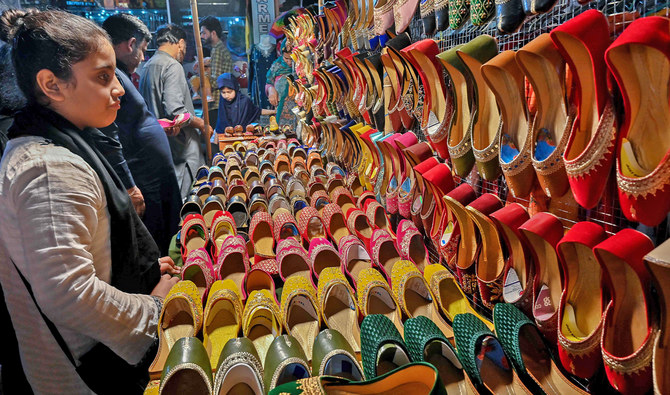

RAWALPINDI: With Eid Al-Fitr just around the corner, special night bazaars have popped up in Pakistan’s twin cities of Rawalpindi and Islamabad, attracting crowds of customers despite rising inflation in the South Asian country.
Pakistanis looking for new clothes, shoes, jewelry and Eid gifts throng markets and shopping centers in the last week of the holy fasting month of Ramadan, which culminates into three-day Eid Al-Fitr religious festival.
Special Eid bazaars in Islamabad and Rawalpindi, which come fully alive after the iftar dinner, have been enticing scores of men, women and children by offering artificial jewelry, ready-to-wear garments, shoes, cosmetics and bangles.
While these markets have been keeping the Eid shopping spirit alive, double-digit inflation in Pakistan has dampened the customer enthusiasm this year, with shoppers complaining of high prices of essential Eid items.
“We observe fast the whole day. We feel a bit free and relaxed this time,” Saima Abbas, a housewife, told Arab News, while buying artificial jewelry from an Eid bazaar stall near Rawalpindi’s Commercial Market.
“A day after, there is Eid. The kids are very much excited and happy that they will be enjoying after a day, thinking they will be free, celebrating, going to friends’ homes and cheering.”
In anticipation of Eid festivities, children have also been accompanying parents to these markets in the middle of the night to buy clothes and shoes of their choice for one of the two major Muslim festivals.
“I wanted to buy a Kaptaan Chapal [a traditional sandal named after former prime minister Imran Khan who started putting them on a few years back] and a couple of rings [for my sisters],” Aadheen Nabi Malik, a grade-4 student, told Arab News, who was visiting the market with his mother.
“Sadly, I couldn’t find the rings and it is a very big problem.”
He complained of a “suffocating rush” at the market, saying it became difficult for him to pass through the crowds to reach the desired stalls.
“I have purchased a sandal only and bought a couple things for younger sisters,” he said. “They were crying over the rush as it is suffocating.”
Malik’s mother, Seemi Malik, who is an interior designer in Islamabad, said they were planning to visit Lahore to see their relatives and friends on Eid.
“As you know, one hardly finds time for outing, but on these festivals there is [always] a family get together,” she told Arab News. “[We] will cook meals [in Lahore], [wear] bangles and henna as per our Islamic festivals.”
Amid the festivity and shopping frenzy, customers also complained of exorbitant prices of Eid essentials, urging well-off individuals to demonstrate compassion and buy Eid gifts to the underprivileged.
Qaisar Ikhlaq, a customer in Rawalpindi who was shopping for his family, said there were many people in his neighborhood who could not afford new clothes and shoes this Eid due to the rising inflation.
“All who are coming here [for shopping] should buy something from their own budget for their neighbors,” he suggested. “It is important because people cannot afford these days.”
Suleman Saleem Khan, a Pakistani businessman who runs a restaurant in Turkiye, complained about the quality of sale items in these Eid night bazaars and a huge price difference compared to Istanbul.
“There is a hell of a difference in comparison to [Turkiye], a massive inflation here, everything is out of reach of the family, but the one who comes from abroad can afford it,” he said, adding that only those who earned in foreign currency could afford Eid shopping in Pakistan.
“It [shopping] went above my budget, but I didn’t feel it [much] because I brought dollars and Euros from abroad, but comparatively it is massive inflation here, so only Allah can help this country.”
Traders at these markets said they equally felt the bite of inflation, higher taxes and exorbitant utility bills as their sales had dropped, compared to the previous Eid season.
“The challenges [to run business] are taxes and exorbitant electricity bills, we have staff expenses, salaries and this has been disturbing us,” Ghulam Abbas, a boutique owner, told Arab News.
Abbas said it was becoming difficult for him to attract new customers in the wake of the inflation. “We are running the business with the support of our loyal customers,” he added.


