

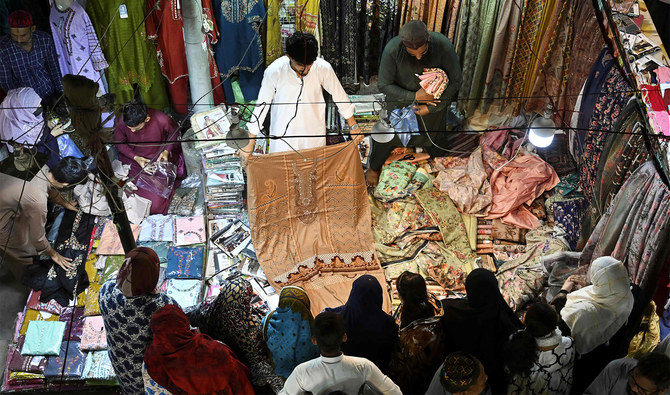

KARACHI: With the Eid Al-Fitr holiday around the corner, biting inflation and rising utility bills have forced many residents in Pakistan’s commercial hub of Karachi to forgo holiday shopping, with traders’ representatives predicting an up to 20 percent dip in sales compared to last year.
Buying new clothes, shoes and accessories is an integral part of Eid Al-Fitr festivities for most Pakistanis each year, or at least those who can afford it. Men wear long-sleeved kameez shalwar suits while women opt for vibrantly colored and embroidered kurtas and ankle-length skirts known as lehengas and ghararas.
But this month, with Pakistan’s fragile $350 billion economy in crisis, inflation hovering above 20.68 percent year-on-year has put a damper on Eid shopping sprees.
“Last year there was a lower figure [for Eid sales] which was estimated to be around Rs20 billion [$72.1 million] based on sales in Karachi,” Atiq Mir, chairman of the All Karachi Tahir Ittehad, an umbrella of major business centers in the southern port city, told Arab News.
“I think this year the figure will be even lower than last year.”
Mir said people from the middle- and lower-middle classes were struggling to afford clothes for their children this Eid.
“That is because I think the economy of the country is falling, jobs are disappearing and there are no prospects for new jobs,” Mir lamented. “It is a disillusioned public’s Eid that may eat away the happiness of many.”
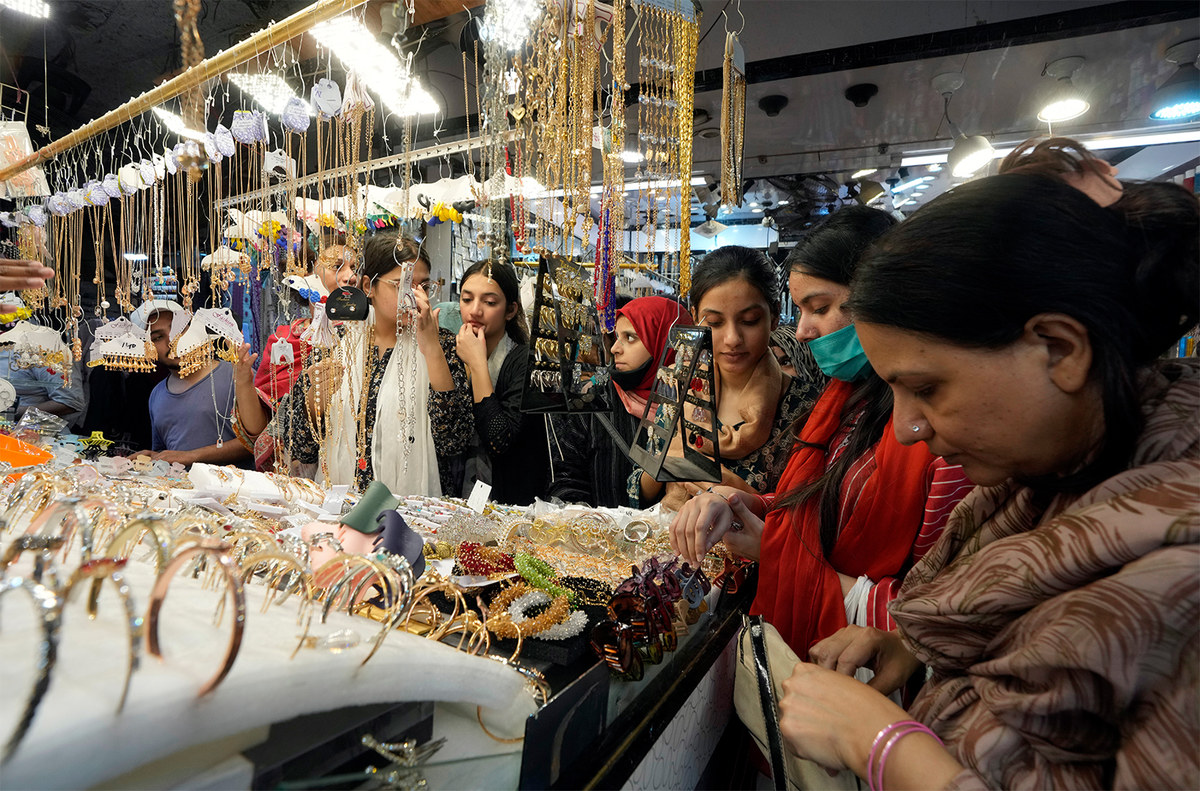
Women browse traditional artificial jewelry while they visit a market to shop for the upcoming Eid al-Fitr celebrations, in Karachi, Pakistan, on April 7, 2024. (AP)
Rana Tariq Mehboob, chairman of the Chainstore Association of Pakistan (CAP), a representative body of over 200 brands in Pakistan operating more than 20,000 outlets nationwide, estimated that high inflation had dented Eid shopping by about 20 percent.
“We estimate that sales have shrunk by about 10-20 percent,” Mehboob said, “because fuel, electricity, and grocery costs have increased.”
Forty percent of Pakistanis now live below the poverty line, up from 39.9 percent in the last fiscal year, a World Bank report released last week said, adding that nearly 10 million people were hovering near the poverty line and risked falling below it.
Pakistan has been caught in a high inflationary spiral since April 2022, with the highest ever inflation rate recorded at 38 percent in May 2023. The government credits soaring inflation to painful decisions it had to take to meet conditions for an IMF bailout program, including hiking energy tariffs and fuel prices.
Gas and electricity rates were hiked by 318.7 percent and 73 percent respectively in a year, according to official data.
“TO SHOP OR EAT”
Pakistani traders at the city’s busy Saddar shopping area said though Karachi’s markets were crowded closer to the Eid holiday, there were fewer “genuine buyers” and more window shoppers.
“It is obvious that people are receiving higher utility bills which are more than their grocery bills,” Mansur ul Arfeen, a trader, told Arab News. “If they pay those bills first, how will they afford other things?”
“Where they used to buy three suits before, now they are buying only one because their purchasing power is very low,” cloth merchant Suresh Kumar said. “They are mostly going to low category markets because this is relatively expensive stuff here [in Saddar].”
Noreen Sabah, a housewife, complained her budget for Eid clothes was not enough to match prices:
“We came with a budget of Rs1,500-Rs2,000 [$5.4 to $7.21] per children’s dress but we realized the prices were completely out of budget.”
Customer Danish Raza also said high expenses had forced him to only shop for his children this year, rather than for himself, his wife or others in his family.
“Inflation has increased so much,” he said, “that you are left with the option to either shop or eat.”


