Pakistan, Saudi Arabia reaffirm commitment to expedite $5 billion investment package

1 / 2
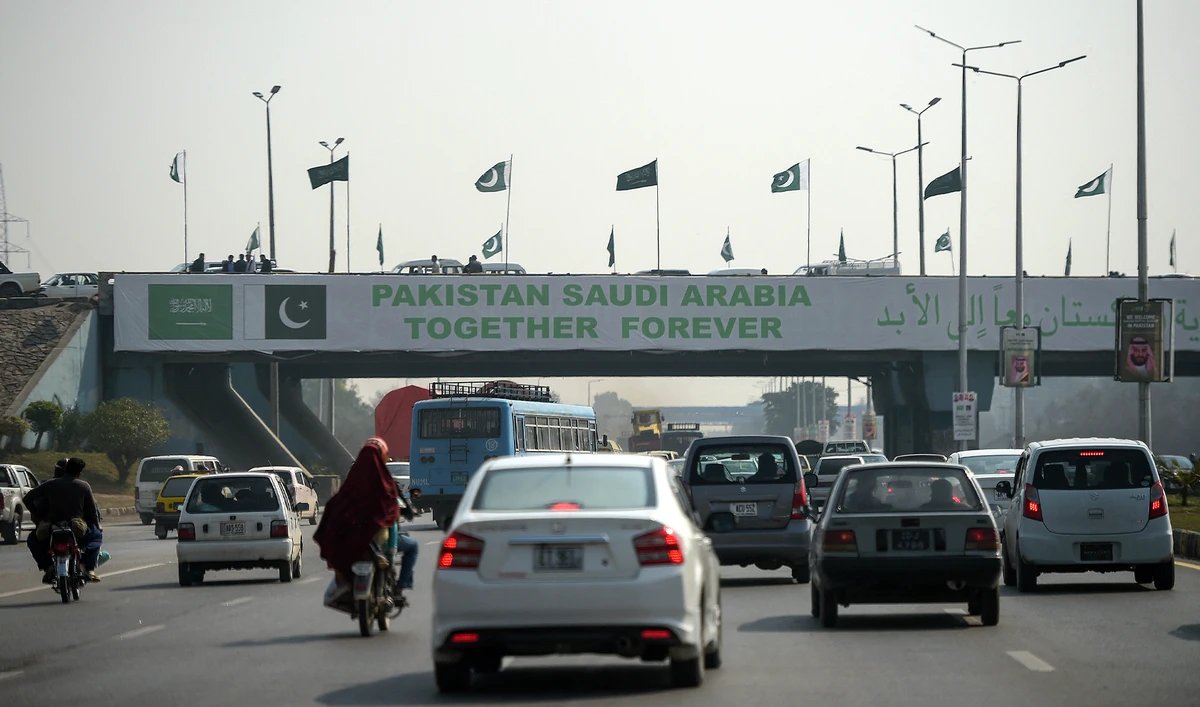
Pakistani commuters drive their vehicles under a banner welcoming Saudi Arabian Crown Prince Mohammed bin Salman displayed on a bridge, ahead of his arrival, in Islamabad on February 15, 2019. (AFP/File)
2 / 2
Saudi Crown Prince Mohammed bin Salman (center) meets Pakistan's Prime Minister Shehbaz Sharif (left) in his palace on the eve of 29th Ramadan, during the holy month of Ramadan, in the holy city of Makkah, Saudi Arabia, on April 7, 2024. (Saudi Press Agency)
Short Url
Updated 09 April 2024
Follow

Pakistan, Saudi Arabia reaffirm commitment to expedite $5 billion investment package

  • The development occurs at a meeting between PM Shehbaz Sharif, Crown Prince Mohammed bin Salman
  • Both sides stress the importance of a dialogue between Pakistan and India to ‘resolve outstanding issues’

ISLAMABAD: Pakistan and Saudi Arabia have reaffirmed their commitment to expedite an investment package worth $5 billion discussed previously, the Pakistan foreign office said on Monday, a day after Prime Minister Shehbaz Sharif met with Saudi Crown Prince Mohammed bin Salman.

The prime minister met the Saudi crown prince at the Al-Safa Palace in Makkah Al-Mukarramah on Sunday, according to a joint statement issued by the Pakistani foreign ministry.

During the meeting, the crown prince extended his congratulations to PM Sharif on assuming office, while the Pakistan PM, in turn, conveyed gratitude for the Kingdom’s steadfast support and hospitality.

“The discussions centered on fortifying the fraternal relations between the two brotherly nations and exploring avenues for enhanced collaboration across various sectors,” the joint statement read.

“Emphasis was placed on the Kingdom’s supportive role in Pakistan’s economy and the mutual desire to strengthen trade and investment ties. Both parties affirmed their commitment to expediting the first wave of investment package worth $ 5 billion which was discussed previously.”

Cash-strapped Pakistan desperately needs to shore up its current account deficit and signal to the International Monetary Fund (IMF) that it can continue to meet requirements for foreign financing that has been a key demand in previous bailout packages.

The prime minister invited the crown prince to undertake an official visit to Pakistan at the earliest convenience which was accepted by the Crown Prince Mohammed bin Salman, according to the statement.

Both leaders exchanged views on regional and global developments of mutual interest, including the worrying situation in Gaza.

“They urged for international efforts to halt Israeli military operations in Gaza, mitigate humanitarian impact and underscored the imperative for the international community to pressure Israel to cease hostilities, adhere to international law, and facilitate unhindered humanitarian aid access to Gaza,” it read.

“They discussed the need for advancing the peace process in accordance with relevant resolutions of the Security Council and the General Assembly as well as the Arab Peace Initiative aimed at finding a just and comprehensive solution, for the establishment of an independent Palestinian state with East Jerusalem as its capital.”

The two sides also stressed the importance of dialogue between Pakistan and India to “resolve the outstanding issues between the two countries, especially the Jammu and Kashmir dispute to ensure peace and stability in the region,” according to the joint statement.

The disputed Himalayan region of Kashmir is claimed in full, though ruled in part by both India and Pakistan since independence from Britain in 1947, with the neighbors having fought two of their three wars over it.

Sharif arrived in Saudi Arabia on a three-day official visit on Saturday, his first foreign trip as Pakistan’s chief executive since his election to the post last month. He was accompanied by his niece and Punjab chief minister, Maryam Nawaz Sharif, as well as the ministers of finance, foreign affairs, economic affairs, defense and information. The Pakistani premier and his delegation were also invited to an iftar by the Saudi crown prince.

Pakistan and Saudi Arabia enjoy strong trade, defense and cultural ties. The Kingdom is home to over 2.7 million Pakistani expatriates and serves as the top destination for remittances to the cash-strapped South Asian country.

Saudi Arabia has often come to cash-strapped Pakistan’s aid by regularly providing the South Asian country oil on deferred payment facilities and offering direct financial support to help stabilize its economy, shore up its foreign exchange reserves.
Pakistan PM orders accelerated privatization of power sector to tackle losses

Updated 15 December 2025
Follow

Pakistan PM orders accelerated privatization of power sector to tackle losses

  • Tenders to be issued for privatization of three major electricity distribution firms, PMO says
  • Sharif says Pakistan to develop battery energy storage through public-private partnerships

ISLAMABAD: Pakistan’s prime minister on Monday directed the government to speed up privatization of state-owned power companies and improve electricity infrastructure nationwide, as authorities try to address deep-rooted losses and inefficiencies in the energy sector that have weighed on the economy and public finances.

Pakistan’s electricity system has long struggled with financial distress caused by a combination of factors including theft of power, inefficient collection of bills, high costs of generating electricity and a large burden of unpaid obligations known as “circular debt.” In the first quarter of the current financial year, government-owned distribution companies recorded losses of about Rs171 billion ($611 million) due to poor bill recovery and operational inefficiencies, official documents show. Circular debt in the broader power sector stood at around Rs1.66 trillion ($5.9 billion) in mid-2025, a sharp decline from past peaks but still a major fiscal drain. 

Efforts to contain these losses have been a focus of Pakistan’s economic reform program with the International Monetary Fund, which has urged structural changes in the energy sector as part of financing conditions. Previous government initiatives have included signing a $4.5 billion financing facility with local banks to ease power sector debt and reducing retail electricity tariffs to support economic recovery. 

“Electricity sector privatization and market-based competition is the sustainable solution to the country’s energy problems,” Prime Minister Shehbaz Sharif said at a meeting reviewing the roadmap for power sector reforms, according to a statement from the prime minister’s office.

The meeting reviewed progress on privatization and infrastructure projects. Officials said tenders for modernizing one of Pakistan’s oldest operational hubs, Rohri Railway Station, will be issued soon and that the Ghazi Barotha to Faisalabad transmission line, designed to improve long-distance transmission of electricity, is in the initial approval stages. While not all power-sector decisions were detailed publicly, the government emphasized expanding private sector participation and completing priority projects to strengthen the electricity grid.

In another key development, the prime minister endorsed plans to begin work on a battery energy storage system with participation from private investors to help manage fluctuations in supply and demand, particularly as renewable energy sources such as solar and wind take a growing role in generation. Officials said the concept clearance for the storage system has been approved and feasibility studies are underway.

Government briefing documents also outlined steps toward shifting some electricity plants from imported coal to locally mined Thar coal, where a railway line expansion is underway to support transport of fuel, potentially lowering costs and import dependence in the long term.

State authorities also pledged to address safety by converting unmanned railway crossings to staffed ones and to strengthen food safety inspections at stations, underscoring broader infrastructure and service improvements connected to energy and transport priorities.