In bid to promote interfaith harmony, Hindu youths organize iftar for Muslims in Karachi

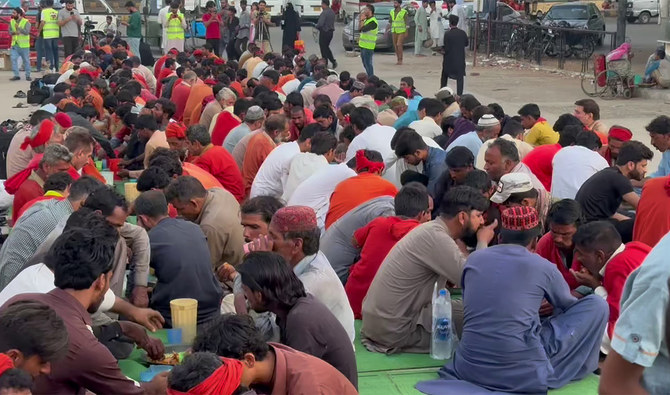
Hindu Maheshwari community organizes iftar meals in Karachi, Pakistan on April 7, 2024. (AN photo)
Short Url
Updated 08 April 2024
Follow

In bid to promote interfaith harmony, Hindu youths organize iftar for Muslims in Karachi

  • Hindu youths from Maheshwar community have been hosting iftar events for primarily low-wage Muslim laborers since Ramadan 21
  • Organizer says iftar drive is a “healing wave” against hatred and aims to promote peace and unity among Muslims and Hindus

KARACHI: A group of Hindu youths in Pakistan’s southern port city of Karachi hosted Muslims, primarily low-wage laborers, for iftar on Sunday, saying the initiative is aimed at promoting peace and interfaith harmony. 

Muslims break their fast during the holy month of Ramadan with an evening meal known as iftar. Members of the Hindu Maheshwar community, who hail from Pakistan’s southern Tharparkar district, have been hosting Muslims for iftar daily from Ramadan 21 and aim to continue the practice till the last day of the month. The iftar is organized by the community at the Karachi Cantonment Railway Station area. 

“This is a sacred month of Ramadan in which we have organized this iftar program,” Sagar Langhani, one of the members of the Maheshwar community, told Arab News. “Its purpose is to promote peace.”

Langhani said Muslims in Pakistan celebrate Hindu religious festivals of Holi and Diwali, adding that his community would also celebrate Ramadan and Eid with Muslims. 

Bhevish Kumar, another member of the group, said in Tharparkar Hindus refrain from celebrating during the Islamic month of Muharram, in which Muslims mourn the martyrdom of Imam Hussain, the grandson of Prophet Muhammad (peace be upon him). He said in turn, Muslims in Tharparkar abstain from openly slaughtering animals during Eid Al-Adha out of respect for the Hindu religion, which considers cows sacred animals. 

“Our efforts extend beyond mere hospitality, we aim to instill hope, inclusivity, and pluralism,” Kumar told Arab News. “This iftar drive is a healing wave against the currents of hatred, promoting peace and unity.”

The Maheshwar community is known for its mobilization initiatives. One such example is the Maheshwari Premier League, a cricket tournament that has expanded over time to include educational, health care campaigns and free medical tests. 

For the interfaith iftar, Langhani said the group selected a menu featuring vegetable biryani, potato samosas, the sweet jalebi snack and dates. 

“This is the greatest example of peace and brotherhood which we have established, sending a message of positivity to the world,” Langhani said, adding that humanity should be promoted as it “always comes first.”

He further emphasized the inclusive nature of the event, stating that people from all faiths are present at the iftar. 

“We don’t ask anyone about their background, there is nothing about caste or creed,” he said. 

“This is a spread of love.”


World Bank approves $700 million for Pakistan’s economic stability

Updated 20 December 2025
Follow

World Bank approves $700 million for Pakistan’s economic stability

  • Of this, $600 million will go for federal programs and $100 million will ⁠support a provincial program in Sindh
  • The results-based design ensures that resources are only disbursed once program objectives are achieved

ISLAMABAD: The World Bank has approved $700 million in ​financing for Pakistan under a multi-year initiative aimed at supporting the country’s macroeconomic stability and service delivery, the bank said on Friday.

The funds will be released under the bank’s Public ‌Resources for Inclusive ‌Development — Multiphase ‌Programmatic ⁠Approach (PRID-MPA) that ‌could provide up to $1.35 billion in total financing, according to the lender.

Of this amount, $600 million will go for federal programs and $100 million will ⁠support a provincial program in ‌the southern Sindh province. The results-based design ensures that resources are only disbursed once program objectives are achieved.

“Pakistan’s path to inclusive, sustainable growth requires mobilizing more domestic resources and ensuring they are used efficiently and transparently to deliver results for people,” World Bank country director Bolormaa Amgaabazar said in a statement.

“Through this MPA, we are working with the Federal and Sindh governments to deliver tangible impacts— more predictable funding for schools and clinics, fairer tax systems, and stronger data for decision‑making— while safeguarding priority social and climate investments and strengthening public trust.”

The approval ‍follows a $47.9 ‍million World Bank grant ‍in August to improve primary education in Pakistan’s most populous Punjab province.

In November, an IMF-World Bank ​report, uploaded by Pakistan’s finance ministry, said Pakistan’s fragmented ⁠regulation, opaque budgeting and political capture are curbing investment and weakening revenue.

Regional tensions may surface over international financing for Pakistan. In May, Reuters reported that India would oppose World Bank funding for Pakistan, citing a senior government ‌source in New Delhi.

“Strengthening Pakistan’s fiscal foundations is essential to restoring macroeconomic stability, delivering results and strengthening institutions,” said Tobias Akhtar Haque, Lead Country Economist for the World Bank in Pakistan.

“Through the PRID‑MPA, we are launching a coherent nationwide approach to support reforms that expand fiscal space, bolster investments in human capital and climate resilience, and strengthen revenue administration, budget execution, and statistical systems. These reforms will ensure that resources reach the frontline and deliver better outcomes for people across Pakistan with greater efficiency and accountability.”

In Sindh, the program is expected to increase provincial revenues, enhance the speed and transparency of payments, and broaden the use of data to guide provincial decision making. The program will directly support the increase of public resources for inclusive development, including more equitable and responsive financing for primary health care facilities and more funding for schools.