

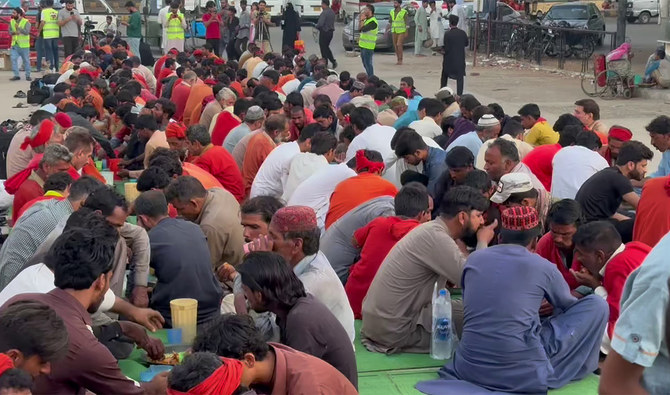
In bid to promote interfaith harmony, Hindu youths organize iftar for Muslims in Karachi

Hindu Maheshwari community organizes iftar meals in Karachi, Pakistan on April 7, 2024. (AN photo)
Short Url
Updated 08 April 2024
Follow

In bid to promote interfaith harmony, Hindu youths organize iftar for Muslims in Karachi

  • Hindu youths from Maheshwar community have been hosting iftar events for primarily low-wage Muslim laborers since Ramadan 21
  • Organizer says iftar drive is a “healing wave” against hatred and aims to promote peace and unity among Muslims and Hindus

KARACHI: A group of Hindu youths in Pakistan’s southern port city of Karachi hosted Muslims, primarily low-wage laborers, for iftar on Sunday, saying the initiative is aimed at promoting peace and interfaith harmony. 

Muslims break their fast during the holy month of Ramadan with an evening meal known as iftar. Members of the Hindu Maheshwar community, who hail from Pakistan’s southern Tharparkar district, have been hosting Muslims for iftar daily from Ramadan 21 and aim to continue the practice till the last day of the month. The iftar is organized by the community at the Karachi Cantonment Railway Station area. 

“This is a sacred month of Ramadan in which we have organized this iftar program,” Sagar Langhani, one of the members of the Maheshwar community, told Arab News. “Its purpose is to promote peace.”

Langhani said Muslims in Pakistan celebrate Hindu religious festivals of Holi and Diwali, adding that his community would also celebrate Ramadan and Eid with Muslims. 

Bhevish Kumar, another member of the group, said in Tharparkar Hindus refrain from celebrating during the Islamic month of Muharram, in which Muslims mourn the martyrdom of Imam Hussain, the grandson of Prophet Muhammad (peace be upon him). He said in turn, Muslims in Tharparkar abstain from openly slaughtering animals during Eid Al-Adha out of respect for the Hindu religion, which considers cows sacred animals. 

“Our efforts extend beyond mere hospitality, we aim to instill hope, inclusivity, and pluralism,” Kumar told Arab News. “This iftar drive is a healing wave against the currents of hatred, promoting peace and unity.”

The Maheshwar community is known for its mobilization initiatives. One such example is the Maheshwari Premier League, a cricket tournament that has expanded over time to include educational, health care campaigns and free medical tests. 

For the interfaith iftar, Langhani said the group selected a menu featuring vegetable biryani, potato samosas, the sweet jalebi snack and dates. 

“This is the greatest example of peace and brotherhood which we have established, sending a message of positivity to the world,” Langhani said, adding that humanity should be promoted as it “always comes first.”

He further emphasized the inclusive nature of the event, stating that people from all faiths are present at the iftar. 

“We don’t ask anyone about their background, there is nothing about caste or creed,” he said. 

“This is a spread of love.”


Pakistan’s defense chief accuses ‘Indian-sponsored proxies’ of fueling violence in Balochistan

Updated 4 sec ago
Follow

Pakistan’s defense chief accuses ‘Indian-sponsored proxies’ of fueling violence in Balochistan

  • Field Marshal Syed Asim Munir speaks to participants of 18th National Workshop on Balochistan
  • Warns violation of Pakistan’s territorial integrity will be met with a “firm and decisive response”

ISLAMABAD: Pakistan’s Chief of Defense Forces (CFD) Field Marshal Syed Asim Munir on Wednesday blamed militant groups allegedly sponsored by India for fueling violence and disrupting development in the province, warning the military will foil their designs. 

Munir was speaking to participants of the 18th National Workshop on Balochistan (NWB) at the General Headquarters of the military in Rawalpindi. The NWB features discussions on Pakistan’s policies on security, development and other challenges related to Balochistan by officials, leaders and citizens. 

Pakistan accuses India of sponsoring militant groups in its southwestern Balochistan province, who demand independence from Islamabad. India rejects the allegations. These ethnic Baloch militant groups accuse Pakistan’s government and military of denying locals a share in the province’s mineral wealth, charges that both deny. 

“Highlighting the security challenges, the COAS & CDF remarked that Indian-sponsored proxies continue to propagate violence and disrupt development in Balochistan,” the Inter-Services Public Relations (ISPR), the military’s media wing, said in a statement.

“He reaffirmed that such inimical designs will be thwarted through stern actions by security forces to rid the province of terrorism and unrest.”

The Pakistani army chief lauded the federal and provincial governments’ initiatives for Balochistan’s development, underscoring a people-centric approach to unlock the province’s “vast economic potential.”

Munir appreciated the civil society for its constructive role in debunking propaganda, the military’s media wing said. 

“He stressed the importance of rejecting vested political agendas to ensure that Balochistan’s future is shaped by long-term prosperity for all its residents,” the ISPR said. 

The CDF reaffirmed Pakistan’s commitment to regional peace but stressed that any violation of the country’s territorial integrity will be met with a decisive response. 

Pakistan suffered a surge in militant attacks in its northwestern and Balochistan provinces this year. As per the Pakistan Institute for Conflict and Security Studies (PICSS) think tank, combat-related deaths in 2025 rose by 73 percent to 3,387, compared with 1,950 in 2024. 

These deaths included 2,115 militants, 664 security forces personnel, 580 civilians and 28 members of pro-government peace committees (combatants), the think tank said in a press release. 

“PICSS noted that most violence remained concentrated in Pashtun-majority districts of Khyber Pakhtunkhwa, including the tribal districts (erstwhile FATA), and in Balochistan,” the think tank said in its report on Sunday. 

Islamabad also accuses Afghanistan of sheltering militants who launch attacks on Pakistan soil. Kabul rejects these allegations and says it cannot be held responsible for Pakistan’s security lapses.