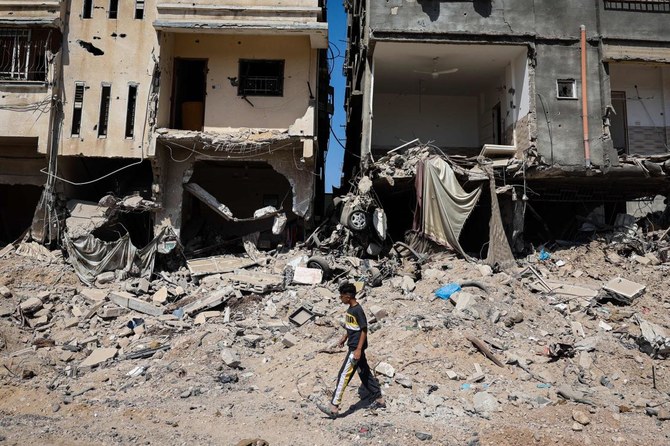
KHAN YUNIS: “It smells like death,” said Maha Thaer, a mother of four, as she returned to the devastated southern Gaza city of Khan Yunis on Sunday, after Israeli troops withdrew.
“We don’t have a city anymore — only rubble. There is absolutely nothing left. I could not stop myself crying as I walked through the streets,” the 38-year-old told AFP.
“All the streets have been bulldozed. And the smell... I watched people digging and bringing out the bodies,” said Thaer, whose home was partially destroyed.
Soon after the Israeli army said its troops were pulling out, people began to emerge into the devastated landscape — the residents of Khan Yunis returning to find what remained of their homes.
Nearly 400,000 people lived in Khan Yunis and its environs before October 7. Much of the area is now in ruins after months of bombardment and heavy fighting between Israeli troops and Palestinian militants.
A straggle of men and boys riding donkey carts, bicycles and the odd pickup truck headed north out of Rafah in the far south of the Gaza Strip, where more than 1.5 million Palestinians had taken refuge from the relentless Israeli ground invasion and bombardment.
They passed the burned-out shell of the Al-Salam hospital, with almost all of the buildings around it razed to the ground.
Thaer, from the upmarket Hamad City district in the west of Khan Yunis, said she was “very shocked and sad.”
“There were no walls or windows. Most of the towers were completely blown up,” she said.
Thaer said she would move back into her badly damaged apartment, “even though it is not suitable for living, but it is better than tents.”
Her neighbors suffered a greater misfortune. “They found their homes destroyed and they don’t know where they will go,” she said.
Other Gazans carried a mattress on their heads in the hope they would still have four walls to put it in.
One of those who left Rafah on Sunday climbed on the top of a heap of rubble in Khan Yunis which once had been a home.
With everything around him in ruins, AFP photographs showed the man standing among smashed concrete and corrugated iron roofing.
Not a single structure within sight appeared untouched by the war.
Other images showed large swathes of the city flattened.
The Israeli army told AFP that it had pulled its 98th division of ground troops out of the southern city on Sunday to “recuperate,” with one official telling the Israeli media it had killed thousands of Hamas fighters there.
“There’s no need for us to remain... We did everything we could there,” an army official told Haaretz newspaper.
The Gaza war broke out on October 7 with an attack by Hamas militants that resulted in the deaths of 1,170 people, mostly civilians, Israeli figures show.
Israel’s retaliatory offensive has killed at least 33,175 people in Gaza, mostly women and children, according to the health ministry in the Hamas-run territory.


‘It smells like death’: Gazans return to devastated Khan Yunis
https://arab.news/6pyqk
‘It smells like death’: Gazans return to devastated Khan Yunis

- “We don’t have a city anymore — only rubble," Palestinian mother says


Libya holds funeral for military officials killed in plane crash
- Prime Minister Abdul Hamid Dbeibah praises Gen. Mohammed Ali Ahmad Al-Haddad for organizing the military
TRIPOLI: Libya on Saturday held a military funeral for the military chief of western Libya and four of his officers who died in a plane crash in Turkiye.
The bodies arrived at Tripoli International Airport in caskets draped with Libyan flags and were carried in a funeral procession with soldiers holding their photographs.
The private jet with Gen. Mohammed Ali Ahmad Al-Haddad, four other military officers, and three crew members crashed on Tuesday after taking off from Ankara, Turkiye’s capital, killing everyone on board. Libyan officials said a technical malfunction on the plane caused the crash, but the investigation is still ongoing in coordination with Turkiye.
Libya plunged into chaos after the country’s 2011 uprising toppled and killed longtime leader Muammar Qaddafi. The country split, with rival administrations in the east and west.
Prime Minister Abdul Hamid Dbeibah’s government governs the country from Tripoli, and Prime Minister Ossama Hammad’s administration governs the east.
Dbeibah praised Al-Haddad during a funeral speech for organizing the military “despite overwhelming darkness and outlaw groups.”
Al-Haddad played a crucial role in the ongoing, UN-brokered efforts to unify Libya’s military, which has split, much like Libya’s institutions.
“Our martyrs weren’t just military leaders but also statesmen who were wise and disciplined and carried responsibility and believed that the national Libyan army is the country’s shield and ... that building institutions is the real path toward a stable and secure Libya,” Dbeibah said.
The burial will take place on Sunday in Misrata, about 200 km east of Tripoli, officials said.
The crash took place as the delegation was returning to Tripoli from Ankara, where it was holding defense talks aimed at boosting military cooperation.
A funeral ceremony was also held at Murted airfield base near Ankara, attended by the Turkish military chief and the defense minister.
Military chief Gen. Selcuk Bayraktaroglu also accompanied the bodies on the plane to Libya, Turkish public broadcaster TRT reported.
Two French crew members of a Falcon 50 jet died in the crash, a French diplomatic source said.
The source did not identify the French crew members but said the French Foreign Ministry was in contact with their families and providing them with assistance.
The Dassault Falcon 50 is a French-made long-range business jet.
The one that went down was chartered by a Malta-based private company, Harmony Jets, which, according to its website, performs maintenance in Lyon, France.
Harmony Jets declined to give information about the nationalities or identities of the crew on its plane.
Airport Haber, a Turkish site specialized in aeronautical news, said the pilot and copilot were both French and cited a Greek newspaper report that a Greek cabin attendant had joined the company two months ago.
France’s BEA, which handles civil aviation investigations, said on X that it was participating in the probe into the crash launched by Turkiye.
Turkiye’s transport minister, Abdulkadir Uraloglu, said the flight recorders would be analyzed in a “neutral” country.
Turkish Justice Minister Yilmaz Tunc said contact had been made with Germany to carry out that.


