Victor makes a deliberate narrative choice; we never witness the violence of what happens to her character
Updated 27 December 2025
Sumaiyya Naseem
There is a bravery in “Sorry, Baby” that comes not from what the film shows, but from what it withholds.
Written, directed by, and starring Eva Victor, it is one of the most talked-about indie films of the year, winning the Waldo Salt Screenwriting Award at Sundance and gathering momentum with nominations, including nods at the Golden Globes and Gotham Awards.
The film is both incisive and tender in its exploration of trauma, friendship, and the long, winding road toward healing. It follows Agnes, a young professor of literature trying to pick up the pieces after a disturbing incident in grad school.
Victor makes a deliberate narrative choice; we never witness the violence of what happens to her character. The story centers on Agnes’ perspective in her own words, even as she struggles to name it at various points in the film.
There is a generosity to Victor’s storytelling and a refusal to reduce the narrative to trauma alone. Instead we witness the breadth of human experience, from heartbreak and loneliness to joy and the sustaining power of friendship. These themes are supported by dialogue and camerawork that incorporates silences and stillness as much as the power of words and movement.
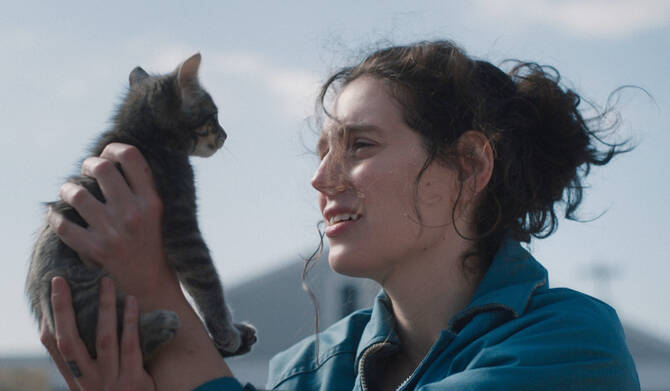
The film captures the messy, beautiful ways people care for one another. Supporting performances — particularly by “Mickey 17” actor Naomi Ackie who plays the best friend Lydia — and encounters with strangers and a kitten, reinforce the story’s celebration of solidarity and community.
“Sorry, Baby” reminds us that human resilience is rarely entirely solitary; it is nurtured through acts of care, intimacy and tenderness.
A pivotal scene between Agnes and her friend’s newborn inspires the film’s title. A single, reassuring line gently speaks a pure and simple truth: “I know you’re scared … but you’re OK.”
It is a reminder that in the end, no matter how dark life gets, it goes on, and so does the human capacity to love.
A decade of Kaph: Building an archive for the Arab world’s visual culture
Independent publishing house Kaph Books will open a Saudi branch soon
Updated 51 sec ago
Jasmine Bager
RIYADH: Kaph Books marks its tenth anniversary this month. Over the past decade, the independent publishing house has become a central force in how visual culture from the Arab world is documented, circulated and preserved.
Kaph was founded in Beirut by Nour Salamé to address a clear lack of high-quality art publishing produced locally, authored from within the region, and distributed internationally. It remains the only independent art publisher from the Arab world with sustained international distribution. Its catalogue now includes more than 100 publications spanning visual art, architecture and children’s books, produced in collaboration with major institutions across the region and circulated worldwide.
Kaph's booth at Misk's Art Book Fair. (Supplied)
“‘Kaph’ is a word that is taken from the alphabet of many different languages,” Salamé tells Arab News. “(In Arabic) it means the palm of the hand. For us, arts and culture are a way of connecting everyone together. Our mission is to document and archive our art history and (express) our view of what is happening, rather than letting other narratives be imposed on us.”
Kaph’s independence shapes its editorial decisions and long-term partnerships, allowing it to maintain a consistent vision while working closely with artists, writers and institutions.
Before founding Kaph, Salamé worked in business and consulting in Paris before returning to her native Lebanon.
Her first experience producing a book came through a collaboration with her mother on an interior design publication. While brief, the collaboration proved formative. Salamé later conducted extensive research with an art historian on Lebanese art and, as a result, self-published a book that sold out, marking her deeper entry into publishing as a means of engaging with the art world.
Kaph earned recognition quickly. Its third publication was nominated for the Paris Photo–Aperture Photobook Award.
“This was when we figured that, with innovative design and using Arabic, even back in 2017, we could really stand out,” Salamé says.
Kaph soon began participating in major international book fairs, positioning its titles alongside leading global publishers. Institutional collaborations expanded in parallel, beginning with Louvre Abu Dhabi, for which Kaph produced five publications around the museum’s opening, and has since produced four more and counting.
The company has also worked with Sharjah Art Foundation, Barjeel Art Foundation, Art Jameel, Doha Film Institute, and multiple national pavilions at the Venice Biennale — including those of Saudi Arabia, the UAE, Lebanon and Morocco.
Kaph’s growth unfolded against a backdrop of upheaval in Lebanon. The 2019 uprising, the COVID-19 pandemic and the 2020 Beirut port explosion severely disrupted cultural life. Salamé recalls a moment that appears emblematic of the publishing house’s resilience.
“Our offices were completely destroyed during the (Beirut) blast,” she says. “But not one single book fell from the shelves.”
As global exhibitions resumed, Kaph’s institutional work accelerated. It has expanded into architecture publications and continues to develop children’s books, including titles focused on museum education and visual literacy. Each expansion, Salamé notes, remains tied to the same core purpose.
“If you are an artist, or the Ministry of Culture, and you’re staging an exhibition, you do want something to remain,” Salamé says. “You want people to see your work, even if they’re not (able to attend the exhibition). This is what books are for.”
International distribution, she adds, ensures that exhibitions and cultural moments can be accessed long after they have ended. Language and design are integral to that mission. Many Kaph titles are bilingual or multilingual.
“Each book is uniquely crafted,” Salamé says. “It’s very important that the books are of high quality so that they can compete in the international market.”
Saudi Arabia has become a central focus of Kaph’s institutional collaborations in recent years. The publisher works closely with the Ministry of Culture — including the Visual Arts Commission, the Architecture and Design Commission, and the Diriyah Biennale Foundation — and has produced publications for the Saudi Pavilion at the Venice Biennale and major exhibitions such as the Islamic Arts Biennale. It also collaborates regularly with Misk Art Institute on exhibition catalogues and book projects.
And Kaph will soon open in JAX District, deepening its presence in the Kingdom and reinforcing its commitment to producing quality art books from within the cultural contexts they document.
“We do this because we have a mission: to create high quality books to promote and archive art practices from the region,” Salamé concludes.