

Pakistan joins Arab, Islamic states in rejecting Israel’s recognition of Somaliland

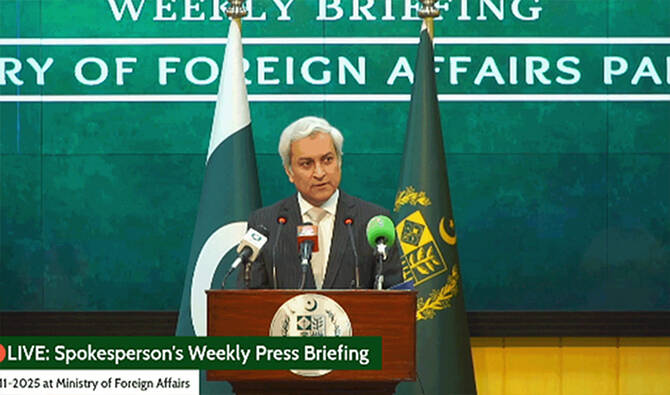
A screengrab taken from the weekly press briefing showing spokesperson of Pakistan's Ministry of Foreign Affairs,Tahir Andrabi, in Islamabad, Pakistan, on November 7, 2025. (@ForeignOfficePk/X)
Short Url
Updated 28 December 2025
Follow

Pakistan joins Arab, Islamic states in rejecting Israel’s recognition of Somaliland

  • Pakistan foreign office reaffirms support for Somalia’s sovereignty, calling Israel’s move illegal and destabilizing for the region
  • Islamabad rejects forced displacement of Palestinians amid reports of Israeli outreach to East African states over Gaza

ISLAMABAD: Pakistan on Saturday joined a group of other Islamic and Arab nations on Saturday to condemn Israel’s decision to recognize Somaliland, a breakaway African region, calling it a violation of international law and reaffirming its support for the sovereignty and territorial integrity of Somalia, the foreign office said.

Israel this week announced it had recognized Somaliland — a self-declared region that broke away from Somalia in 1991 but has not previously been recognized by any United Nations member state — triggering condemnation from Somalia and criticism from regional bodies.

“Pakistan strongly condemns any attempts to undermine the sovereignty, unity, and territorial integrity of Somalia, and rejects, in this regard, the announcement made by Israel recognizing the independence of the so-called

Somaliland region of the Federal Republic of Somalia,” Pakistan’s foreign office said in a statement on Saturday.

“Such illegal and provocative actions constitute a flagrant violation of international law and not only threaten the peace and stability of the brotherly country of Somalia, but also that of the entire region,” it continued. “The international community must step in to reject any such actions, and prevent and deter Israel from undermining the ongoing efforts for peace and stability in the broader region.”

The statement also linked the issue to the wider Middle East conflict, with Pakistan reiterating its opposition to any attempts at the forced displacement of Palestinians.

The foreign office’s reference to the issue came in the context of international media reports earlier this year in March, saying Israel and the United States had reached out to East African states, including Somaliland, to take in Palestinians from Gaza.

“Pakistan reiterates its unequivocal rejection of any steps aimed at the forced displacement of Palestinians from their land under any circumstances,” the statement said, reaffirming support for the Palestinian people’s right to self-determination and for an independent Palestinian state based on pre-1967 borders, with East Jerusalem as its capital.

Somalia’s government has said Israel’s recognition of Somaliland violates its sovereignty, while the African Union has opposed unilateral recognition of breakaway regions on the continent.

Israeli Prime Minister Benjamin Netanyahu said on Friday his country had recognized Somaliland “in the spirit of the Abraham Accords,” referring to US-brokered deals that helped establish ties between Israel and Arab states.

Separately, in a joint statement issued on Saturday, the ministers of Arab and Islamic nations condemned Israel’s decision, announced on December 26, warning that the move carries “serious repercussions for peace and security in the Horn of Africa and the Red Sea region” and undermines international peace and security, the Jordan News Agency reported. 

The joint statement was issued by the foreign ministers of Egypt, Algeria, Comoros, Djibouti, The Gambia, Iran, Iraq, Kuwait, Libya, Maldives, Nigeria, Oman, Pakistan, Palestine, Qatar, Somalia, Sudan, Türkiye and Yemen, as well as the OIC.

The joint statement described the recognition as an unprecedented and flagrant violation of international law and the charter of the United Nations, which uphold the principles of state sovereignty, unity and territorial integrity, JNA added.

It warned that recognizing the independence of parts of states sets a dangerous precedent and poses a direct threat to international peace and security.

The statement also reiterated categorical opposition to any attempt to link the move with plans to displace the Palestinian people outside their land, stressing that such proposals are rejected “in form and substance.”


Pakistan highlights Gwadar transshipment role as shipping routes face disruption over regional tensions

Updated 05 March 2026
Follow

Pakistan highlights Gwadar transshipment role as shipping routes face disruption over regional tensions

  • Pakistani ports possess “untapped potential” to attract global shipping lines for transshipment operations, says minister
  • Pakistan eyes leveraging Gwadar as regional transshipment hub as Iran’s closure of Strait of Hormuz disrupts global maritime trade

KARACHI: Pakistan’s Maritime Affairs Minister Junaid Anwar Chaudhry on Thursday highlighted the importance of the port city of Gwadar’s transshipment role as major shipping routes, including the Strait of Hormuz, face disruption due to Iran’s ongoing conflict with the US and Israel in the Gulf. 

The meeting takes place as Iran has effectively closed the Strait of Hormuz, a strategic waterway that lies between it and Oman. It is one of the world’s most critical oil transit routes, with roughly 20 percent of global oil supplies passing through it. Iran has vowed it will attack any ship that enters the strait, causing energy prices to rise sharply on Monday amid disruptions to tanker traffic in the waterway.

Gwadar is a deep-sea port in Pakistan’s southwestern Balochistan province that lies close to the Strait of Hormuz. Pakistani officials have in the past highlighted Gwadar’s geostrategic position as the shortest trade route to the Gulf and Central Asia, stressing that it has the potential to become a regional transshipment hub.

Chaudhry chaired a high-level meeting of government officials to assess emerging logistical challenges facing Pakistan’s trade, particularly in the energy sector, amid tensions in the Gulf. 

“Special focus was placed on fully leveraging the potential of Gwadar Port as a regional transshipment hub and positioning it as an alternative of regional instability,” Pakistan’s maritime affairs ministry said in a statement. 

The minister said Pakistani ports possessed “significant untapped potential” to attract international shipping lines for transshipment operations, noting that it could also ensure long-term sustainability and growth of the country’s maritime sector.

Participants of the meeting discussed measures to strengthen Pakistan’s position as a viable alternative transit and transshipment destination, as key waterways are affected by the disruption. 

The committee also reviewed proposals to amend relevant rules and regulations to facilitate international transshipment operations through on-dock and off-dock terminals.

The chairmen of the Port Qasim Authority, Karachi Port Trust and Gwadar Port Authority attended the meeting, briefing committee members on the current operational readiness of their ports. They spoke about the available capacity for container transshipment, bulk cargo handling and refueling services at Pakistani ports. 

The port in Gwadar is a central part of the China-Pakistan Economic Corridor (CPEC), under which Beijing has funneled tens of billions of dollars into massive transport, energy and infrastructure projects in Pakistan.

Pakistan has long eyed the deep-sea port as a key asset that can help boost its trade with Central Asian states, the Gulf region and ensure the country earns valuable foreign exchange.