

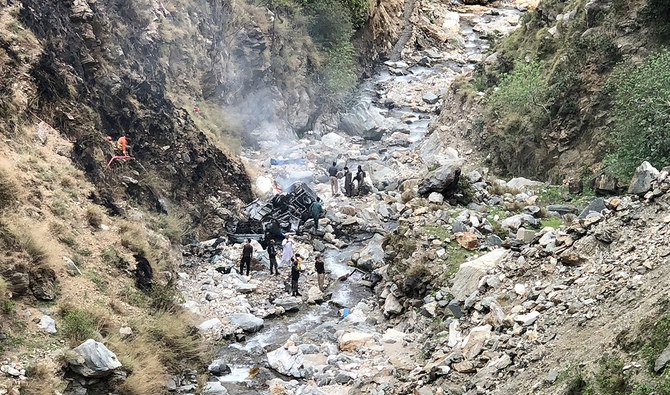

ISLAMABAD: Pakistani interior minister Mohsin Naqvi on Saturday ordered enhanced and ‘foolproof’ security for Chinese workers in Pakistan, following a suicide bombing in the country’s northwest last month in which five Chinese nationals were killed.
Last Tuesday’s incident was the third major attack in little over a week on China’s interests in the South Asian nation, where Beijing has invested more than $65 billion in energy, infrastructure and other projects as part of its wider Belt and Road initiative.
In late 2022, the two allied countries started a joint investigation into an attack that year on China’s nationals and its interests, which have seen a rise in recent months.
There was no immediate claim of responsibility for the latest attack, in which a suicide bomber rammed a vehicle into a convoy of Chinese engineers working on a hydropower project at Dasu in Pakistan’s northwest, killing six people, including five Chinese nationals and their Pakistani driver.
On Saturday, Naqvi presided over a meeting to review security measures for foreigners, a day after Prime Minister Shehbaz Sharif presided a high-level security meeting and ordered the interior ministry to coordinate with provinces to eliminate militant violence and ensure the safety of Chinese nationals deployed at various project sites in the country.
“In the meeting, the security measures of foreigners, especially Chinese citizens, were reviewed in detail,” the interior ministry said in a statement, quoting Naqvi as calling for the implementation of standard operating procedures for the safety of foreign workers.
“The enemy does not want the development and prosperity of Pakistan,” Naqvi said. “Pakistan will never allow the nefarious purposes of evil elements to succeed.”
On Friday PM Sharif said he would personally review the security of Chinese nationals in his monthly meetings and instructed the ministry to develop a comprehensive plan for the regular audit of security procedures for foreign workers.
Last Tuesday’s bombing followed a March 20 attack on a strategic port used by China in the southwestern province of Balochistan, where Beijing has poured billions of dollars into infrastructure projects, and a March 25 assault on a naval air base, also in the southwest. Both attacks were claimed by the Baloch Liberation Army (BLA), the most prominent of several separatist groups in Balochistan.
Dasu, the site of a major dam, has been attacked in the past, with a bus blast in 2021 killing 13 people, nine Chinese among them, although no group claimed responsibility, just like last Tuesday’s attack which remains unclaimed.
Pakistan is home to twin insurgencies, one mounted by religiously motivated militants and the other by ethnic separatists who seek secession, blaming the government’s inequitable division of natural resources in southwestern Balochistan province. The government denies this.
Chinese interests are under attack primarily by ethnic militants seeking to push Beijing out of mineral-rich Balochistan, but that area is far from the site of last Tuesday’s bombing.
Pakistan has set up a dedicated force of police and military to ensure security for Chinese activities, officials say.


